🚪 学习前导 · 先看这里再开始
🎯 学完你能干什么
- 能定义 力(force)—— 推 / 拉 / 扭,单位牛顿(newton, N)
- 能区分 contact 接触力(摩擦/弹力/正压力)vs non-contact 非接触力(重力/磁力/电力)
- 能区分 质量(mass, kg) 和 重量(weight, N)—— W = m × g
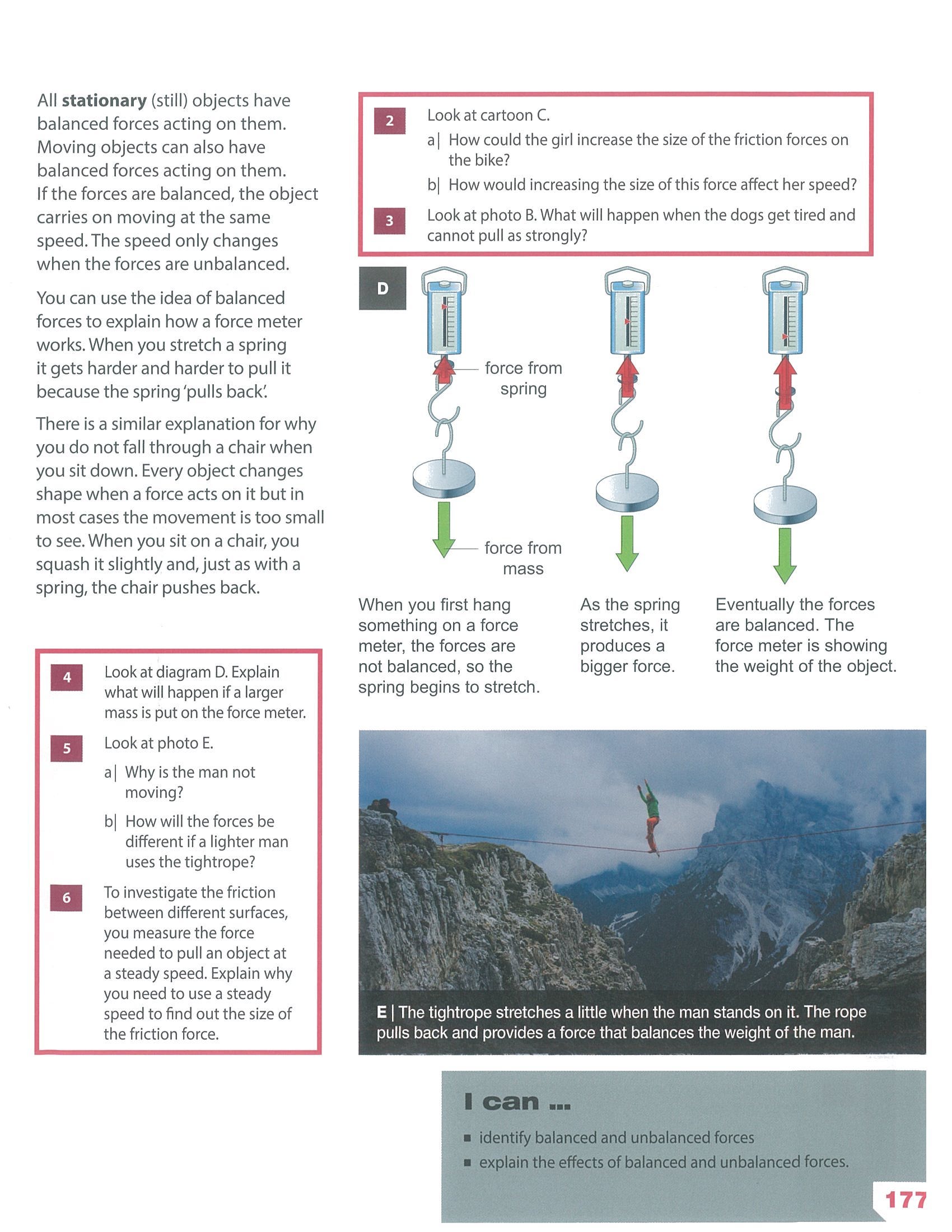
- 能解释 胡克定律 Hooke's law + 弹性极限 elastic limit
- 能用 力计 force meter / newton meter 测力
- 能解释 friction 摩擦力的成因 + 利弊
- 能用公式 P = F / A 计算压强,单位 pascal (Pa)
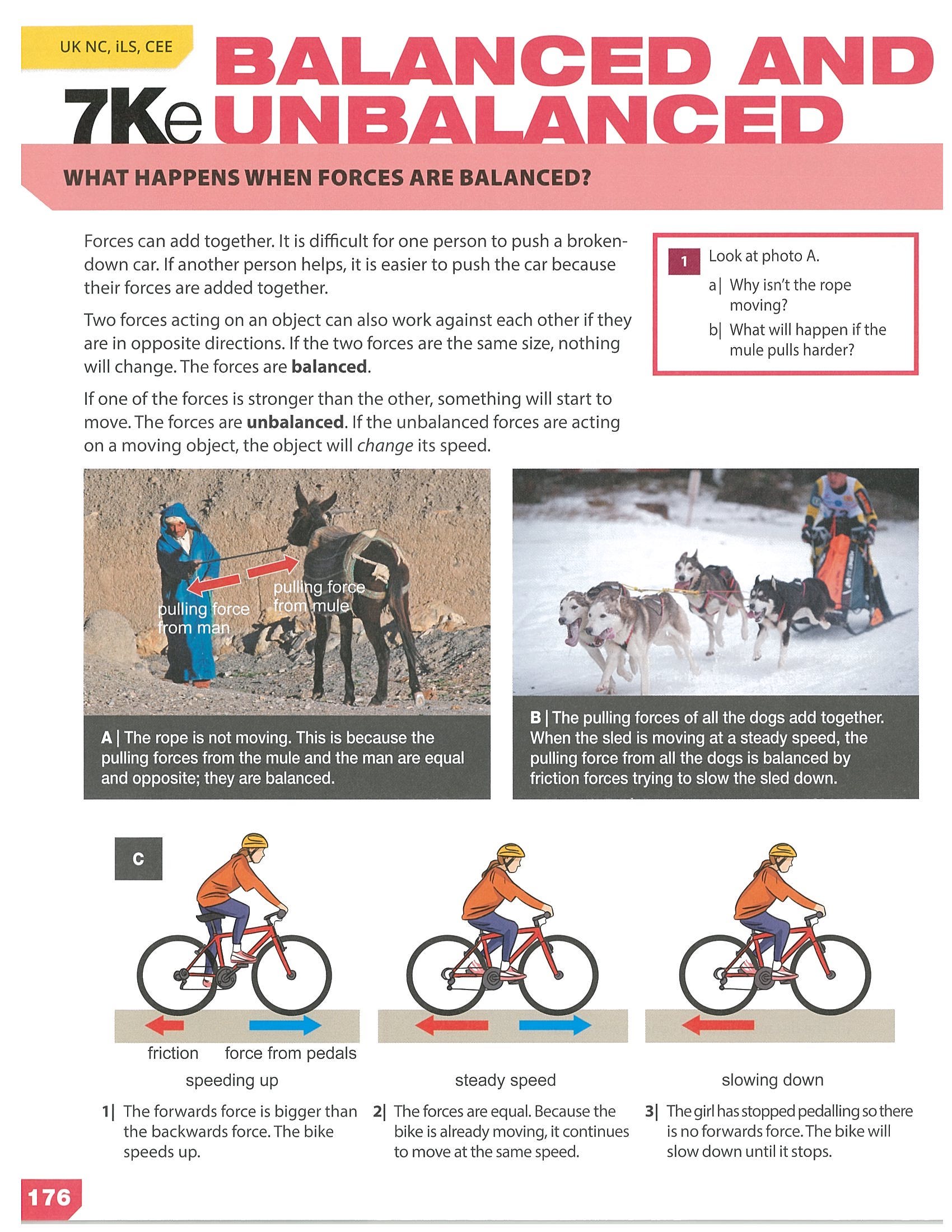
- 能区分 balanced 平衡力 和 unbalanced 不平衡力对运动的影响
🛣️ 推荐学习路径
- 通读教材 16 页(不查词,速读 30 分钟)
- 跟读本视图:左边看教材图,右边看笔记(约 2.5 小时)
- 做 Workbook 7K 全部题目(约 1.5 小时)
- 专项训练:拼写卡 + 力图标注 + 答题规范(30 分钟)
- 挑战分级练习 L1→L2→L3(约 1 小时)
- 查漏错题本 + 自检清单(考前 30 分钟)
⚠️ 老师常考
- 必考 区分 mass (kg) vs weight (N):weight = mass × g
- 必考 contact vs non-contact forces 分类
- 必考 用箭头图表示力(方向 + 大小成比例)
- 必考 压强公式 P = F / A,单位 Pa
- 高频 balanced vs unbalanced forces 对运动状态的影响
- 高频 胡克定律:F = k × e(弹力与延长量成正比)
- 高频 摩擦力的利弊(必要 vs 浪费能量)
- 高频 同样力作用在不同面积 → 不同压强(如刀刃 vs 刀背)
- 拓展 STEM:结构设计 / 桥梁工程师 / 安全标准
🧭 前置回顾(来自 7G / 7I)
- kinetic energy 动能(7I)—— 物体受不平衡力 → 加速度 → 动能增加
- gravitational potential 重力势能(7I)—— 把物体举起做的功 = mgh
- elastic potential 弹性势能(7I)—— 7Kb 弹簧拉伸时储存的能量
- energy transfer(7I)—— 力做功 = 能量转移
- particles 粒子(7G)—— 摩擦本质是粒子层面的相互作用
📖 教材跟读 · 左图右注
📄 教材 p.165–167
📝 学习内容
核心理解:力 + 重量 vs 质量
1. 什么是力 Force
力 = 推(push)/ 拉(pull)/ 扭(twist)——任何能改变物体的运动状态或形状的作用。
📌 单位:牛顿 newton (N)。
- 1 N ≈ 一个苹果的重量
- 地球上 1 kg 物体的重量 ≈ 10 N(更精确 9.8 N)
2. 力是有方向的(向量)
表示力时必须画箭头:
- 箭头方向表示力的方向
- 箭头长度表示力的大小(成比例)
- 箭头起点是力的作用点
3. 力的两大分类(必考!)
(A) Contact forces 接触力
需要两个物体接触才有:
- Friction 摩擦力——表面相对滑动时
- Normal force 正压力 / 支撑力——桌子托住书
- Tension 张力——绳子拉物体
- Air resistance / drag 空气阻力——物体在空气/水中运动
- Applied force 推力 / 拉力——手推车
- Spring force 弹力——弹簧拉伸或压缩时
(B) Non-contact forces 非接触力
不需要接触也能作用("超距作用"):
- Gravity 重力——地球拉所有有质量的物体
- Magnetic 磁力——磁铁吸铁 / 推同极
- Electrostatic 静电——摩擦过的气球吸纸片
4. Mass 质量 vs Weight 重量(必懂!)
| Mass 质量 | Weight 重量 | |
|---|---|---|
| 是什么 | 物质的多少(含多少原子) | 地球对物体的重力大小 |
| 单位 | 千克 kg | 牛顿 N |
| 测量工具 | 天平 balance | 力计 spring balance / scales |
| 随地点变? | 不变(地球 / 月球 / 太空都一样) | 会变(月球上是地球的 1/6) |
| 是不是力? | 不是 | 是(是一种力) |
5. Weight 公式(必背)
Weight (N) = mass (kg) × g
其中 g 是重力加速度(gravitational field strength)
地球:g ≈ 10 N/kg(精确值 9.8)
月球:g ≈ 1.6 N/kg
木星:g ≈ 25 N/kg
例:
- 50 kg 的人在地球:W = 50 × 10 = 500 N
- 同一个人在月球:W = 50 × 1.6 = 80 N(轻了 6 倍)
- 同一个人的mass 还是 50 kg(不变!)
宇航员在太空"漂浮",是 weight 变成 0 了吗?还是 mass 变 0?
💡 既不是 weight = 0,也不是 mass = 0。
• mass 不变——宇航员还是同样的物质量
• weight 接近 0(不是 0)——空间站离地球 400km,重力还有 90% 的强度
• 看起来"漂浮"是因为整个空间站自由下落——和宇航员一起下落 → 相对感觉无重力
这叫 "微重力 microgravity",不是没重力。
• mass 不变——宇航员还是同样的物质量
• weight 接近 0(不是 0)——空间站离地球 400km,重力还有 90% 的强度
• 看起来"漂浮"是因为整个空间站自由下落——和宇航员一起下落 → 相对感觉无重力
这叫 "微重力 microgravity",不是没重力。
6. 不同力的例子(生活)
| 情景 | 有哪些力 |
|---|---|
| 书静止在桌上 | 重力(向下)+ 正压力(向上,桌子托)—— 平衡 |
| 骑自行车 | 推力(前)+ 摩擦力(后)+ 空气阻力(后)+ 重力(下)+ 地面正压力(上) |
| 磁铁吸冰箱 | 磁力(吸住)+ 重力(向下)+ 摩擦力(阻止滑落) |
| 气球升空 | 浮力(上)+ 重力(下) |
⚠️ 高频题:单位换算 kg ↔ N(乘 10);mass vs weight 区分;contact / non-contact 分类;力的箭头图。
✅ 学完小检查(3 题)
1. 我能区分 mass (kg) 和 weight (N),并用 W=m×g 计算
2. 我能把常见力归类(contact / non-contact)并举例
3. 我能解释"宇航员漂浮"现象(不是 mass=0 也不是 weight=0)
💡 句子级中英对照。
📄 教材 p.165 · 7Ka Forces
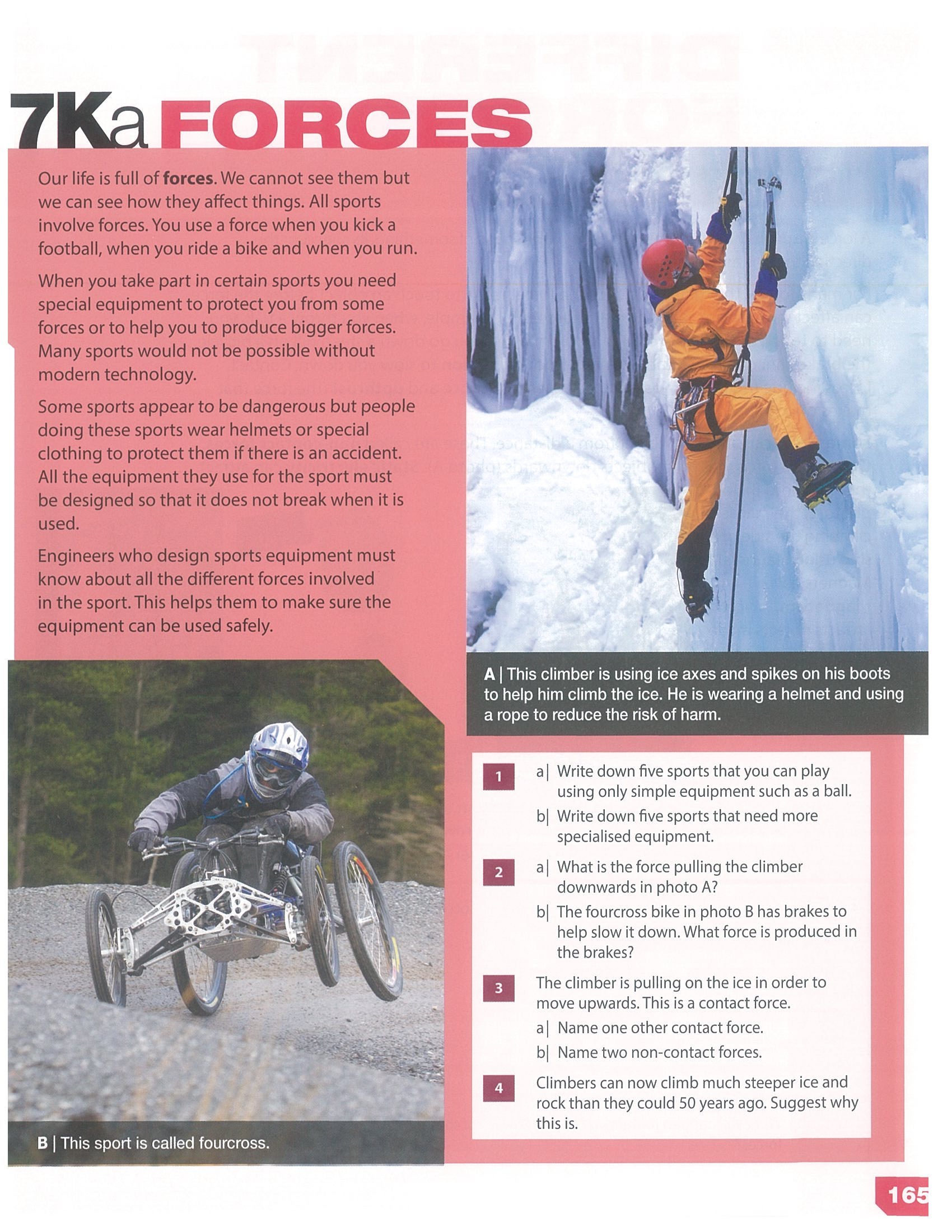
Our life is full of forces.
我们的生活充满了力。
We cannot see them but we can see how they affect things.
我们看不见力,但能看到力如何影响物体。
All sports involve forces.
所有运动都涉及力。
You use a force when you kick a football, when you ride a bike and when you run.
当你踢足球、骑自行车和跑步时,你都在使用力。
When you take part in certain sports you need special equipment to protect you from some forces or to help you to produce bigger forces.
当你参加某些运动时,你需要特殊装备来保护你免受某些力的伤害,或帮助你产生更大的力。
Many sports would not be possible without modern technology.
没有现代技术,许多运动都不可能进行。
Some sports appear to be dangerous but people doing these sports wear helmets or special clothing to protect them if there is an accident.
有些运动看起来很危险,但参与这些运动的人会戴头盔或穿特殊服装,以便在发生事故时保护自己。
All the equipment they use for the sport must be designed so that it does not break when it is used.
他们在运动中使用的所有装备都必须被设计成使用时不会断裂。
Engineers who design sports equipment must know about all the different forces involved in the sport.
设计运动装备的工程师必须了解这项运动中涉及的各种不同力。
This helps them to make sure the equipment can be used safely.
这有助于他们确保装备可以安全使用。
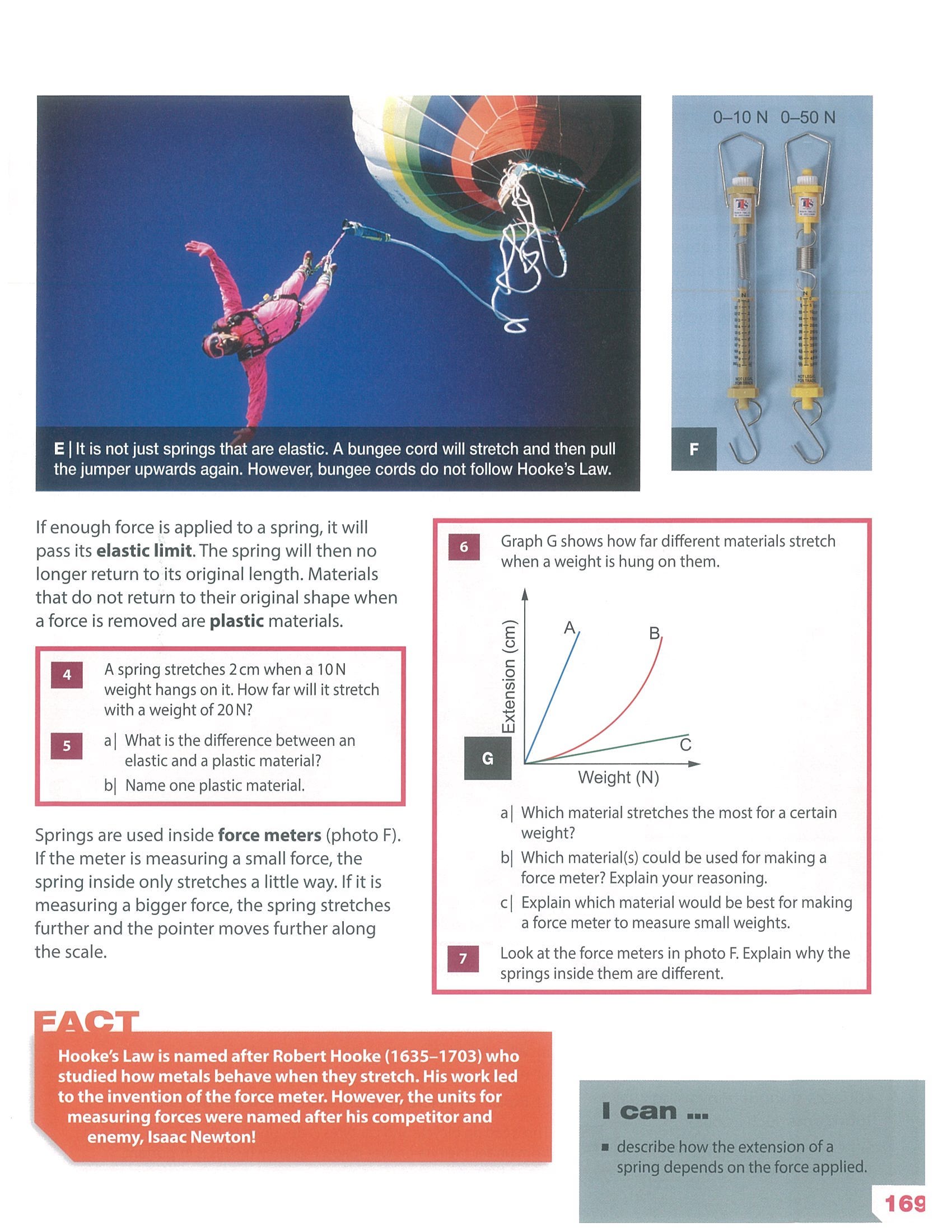
This climber is using ice axes and spikes on his boots to help him climb the ice.
这名攀冰者正在使用冰镐和靴子上的尖钉来帮助自己攀爬冰面。
He is wearing a helmet and using a rope to reduce the risk of harm.
他戴着头盔并使用绳索,以降低受伤风险。
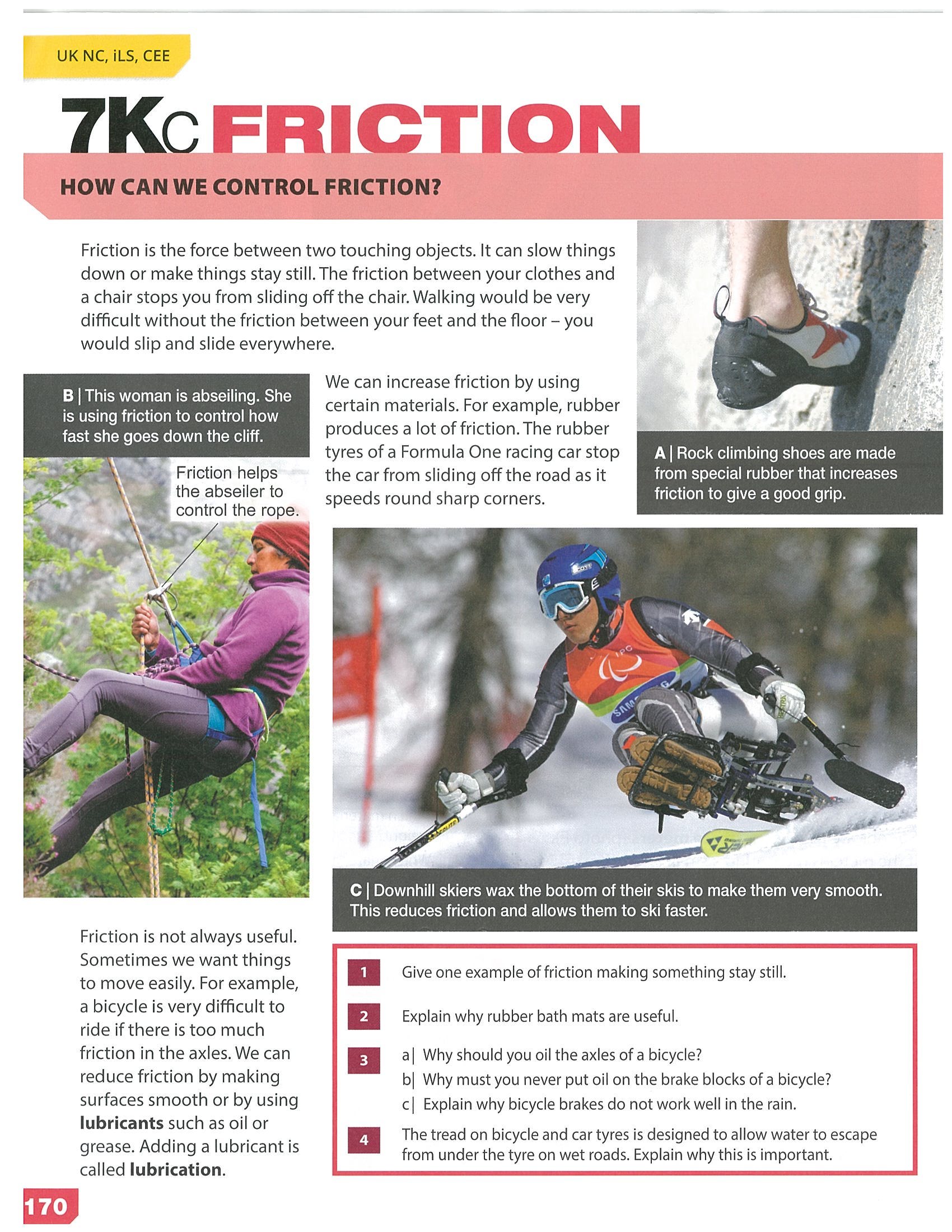
This sport is called fourcross.
这项运动叫作四人竞速越野自行车。
Write down five sports that you can play using only simple equipment such as a ball.
写出五种只需要球等简单装备就能进行的运动。
Write down five sports that need more specialised equipment.
写出五种需要更专业装备的运动。
What is the force pulling the climber downwards in photo A?
照片 A 中把攀冰者向下拉的力是什么?
The fourcross bike in photo B has brakes to help slow it down.
照片 B 中的四人竞速越野自行车有刹车来帮助它减速。
What force is produced in the brakes?
刹车中产生了什么力?
The climber is pulling on the ice in order to move upwards.
攀冰者拉住冰面以便向上移动。
This is a contact force.
这是一个接触力。
Name one other contact force.
说出另一种接触力。
Name two non-contact forces.
说出两种非接触力。
Climbers can now climb much steeper ice and rock than they could 50 years ago.
现在攀登者能够攀爬比 50 年前陡得多的冰面和岩壁。
Suggest why this is.
推测为什么会这样。
📄 教材 p.166 · 7Ka Different Forces
A force is a push or a pull.
力是一种推或拉。
Forces can change the shape of something, its speed, or the direction that it is moving in.
力可以改变某物的形状、速度或运动方向。
For many forces, the thing providing the force needs to touch an object before the force can affect it.
对许多力来说,提供力的物体需要接触另一个物体,才能对它产生影响。
These are called contact forces.
这些力叫作接触力。
For example, when you throw a ball, you need to touch the ball to exert a force on it.
例如,当你扔球时,你需要接触球才能对它施加力。
When you go down a steep hill on a bicycle, the brakes need to touch the wheel to produce friction to slow you down.
当你骑自行车下陡坡时,刹车需要接触车轮,产生摩擦力来让你减速。
Contact forces include friction, air resistance, water resistance and upthrust.
接触力包括摩擦力、空气阻力、水阻力和浮力。
Upthrust is the force that makes things float.
浮力是使物体漂浮的力。
Some forces can affect an object from a distance.
有些力可以在远处影响物体。
These are called non-contact forces.
这些力叫作非接触力。
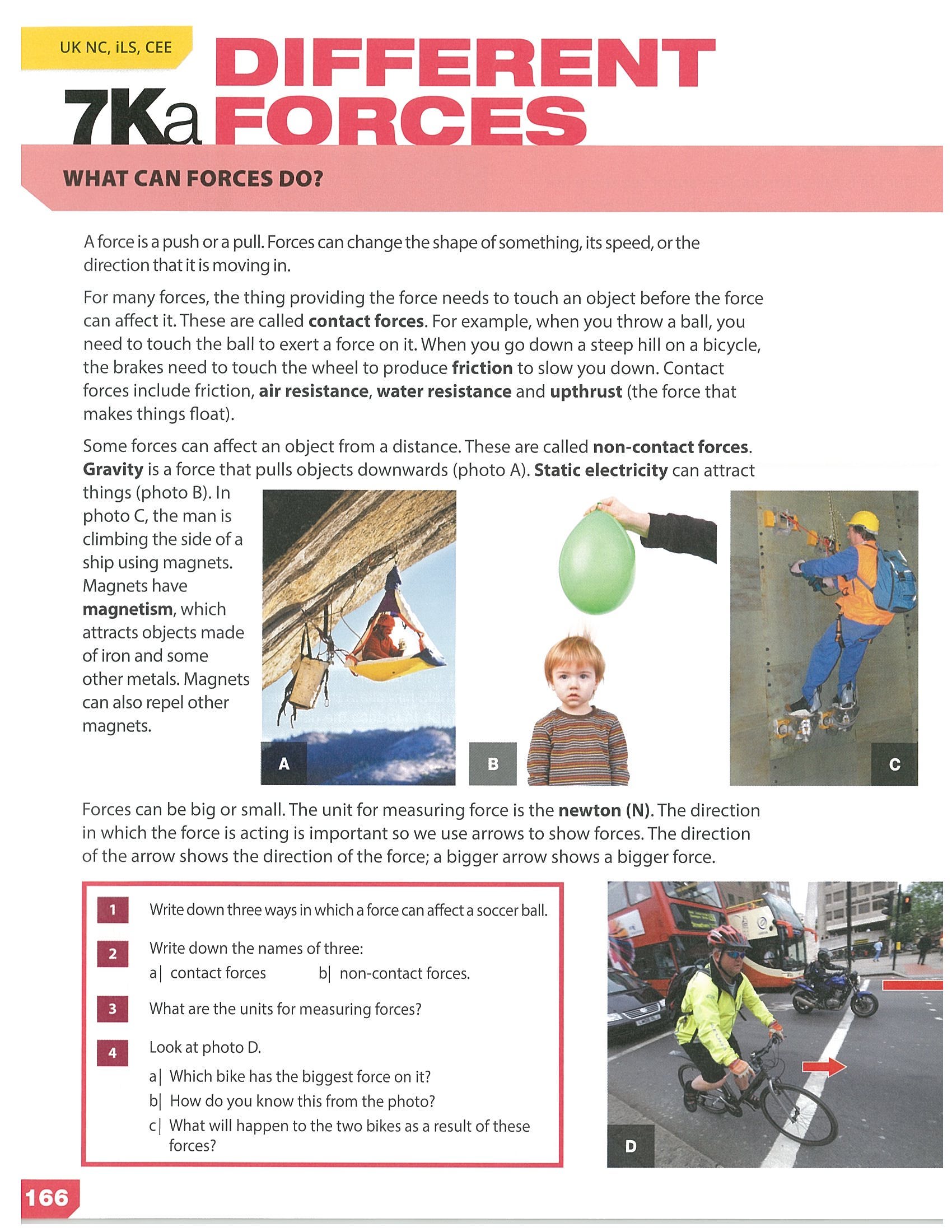
Gravity is a force that pulls objects downwards.
重力是一种把物体向下拉的力。
Static electricity can attract things.
静电可以吸引物体。
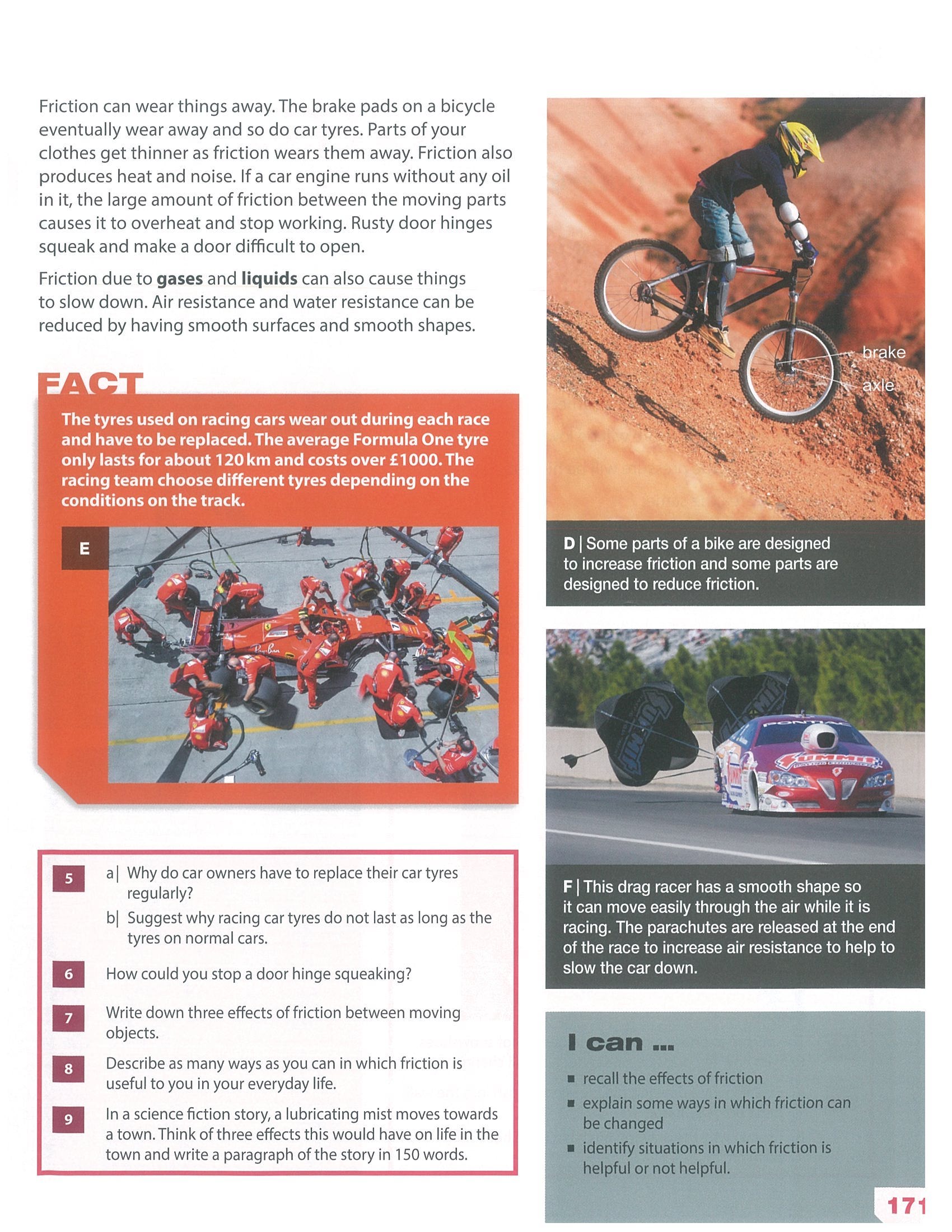
In photo C, the man is climbing the side of a ship using magnets.
在照片 C 中,这名男子正在使用磁铁攀爬船侧。
Magnets have magnetism, which attracts objects made of iron and some other metals.
磁铁具有磁性,会吸引由铁和某些其他金属制成的物体。
Magnets can also repel other magnets.
磁铁也可以排斥其他磁铁。
Forces can be big or small.
力可以大也可以小。
The unit for measuring force is the newton (N).
测量力的单位是牛顿(N)。
The direction in which the force is acting is important so we use arrows to show forces.
力作用的方向很重要,所以我们用箭头表示力。
The direction of the arrow shows the direction of the force.
箭头方向表示力的方向。
A bigger arrow shows a bigger force.
更大的箭头表示更大的力。
Write down three ways in which a force can affect a soccer ball.
写出力可以影响足球的三种方式。
Write down the names of three contact forces.
写出三种接触力的名称。
Write down the names of three non-contact forces.
写出三种非接触力的名称。
What are the units for measuring forces?
测量力的单位是什么?
Look at photo D.
看照片 D。
Which bike has the biggest force on it?
哪辆自行车受到的力最大?
How do you know this from the photo?
你如何从照片中知道这一点?
What will happen to the two bikes as a result of these forces?
由于这些力,两辆自行车会发生什么?
📄 教材 p.167 · Weight and Mass
Sometimes there are a lot of forces acting on something.
有时,一个物体会受到许多力的作用。
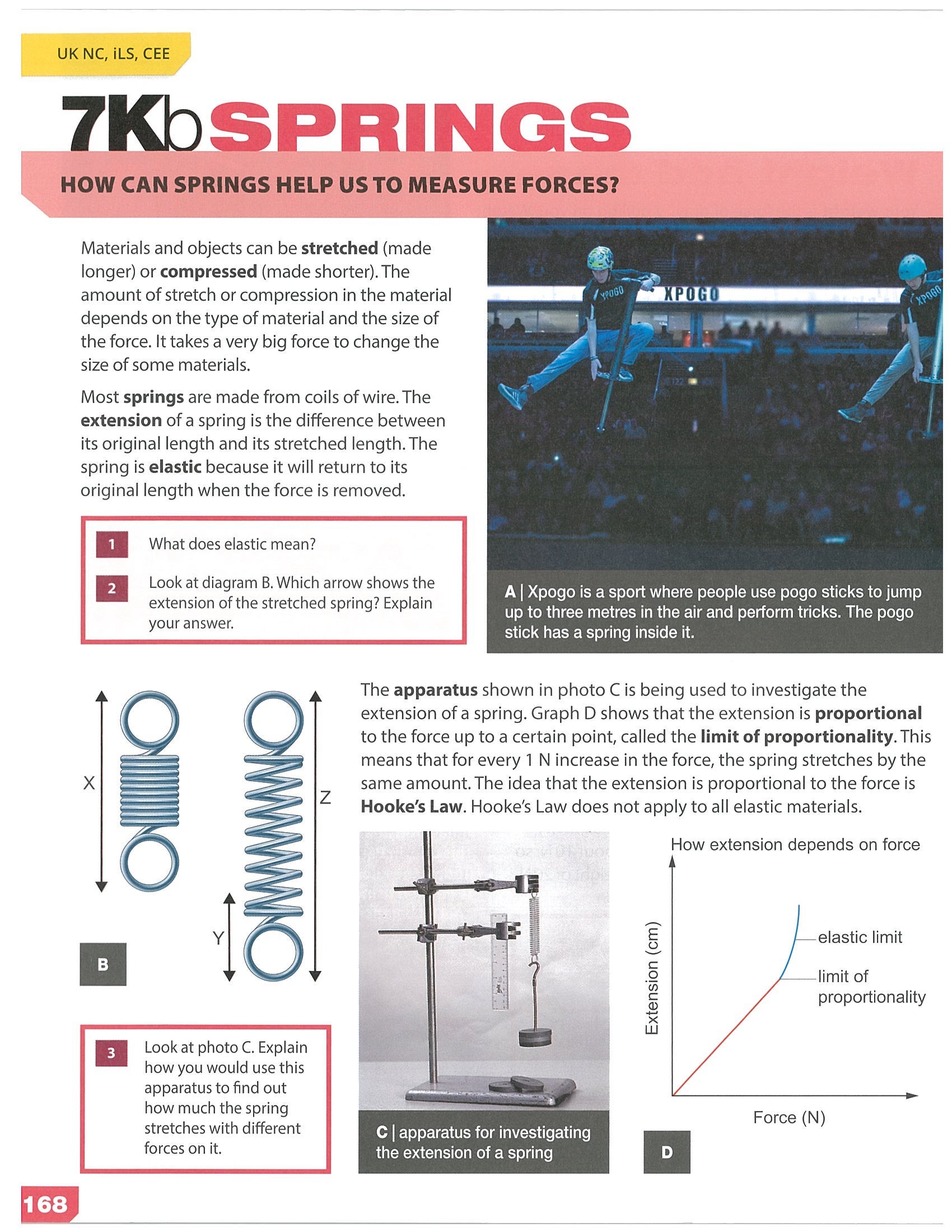
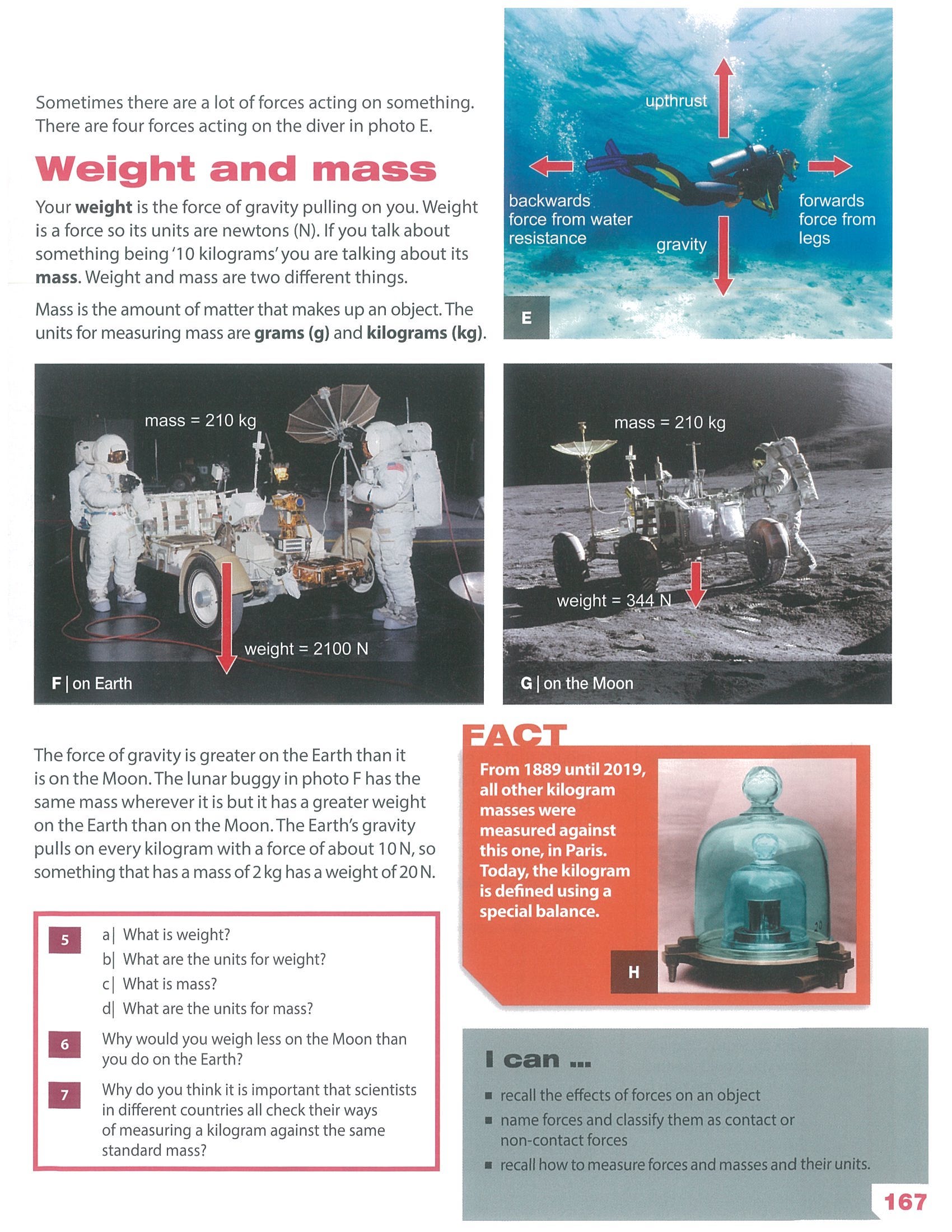
There are four forces acting on the diver in photo E.
照片 E 中的跳水者受到四个力的作用。
Upthrust.
浮力。
Backwards resistance force from water.
来自水的向后阻力。
Forwards force from legs.
来自腿部的向前力。
Force from gravity.
来自重力的力。
Weight and Mass
重量和质量
Your weight is the force of gravity pulling on you.
你的重量是重力拉你的力。
Weight is a force so its units are newtons (N).
重量是一种力,所以它的单位是牛顿(N)。
If you talk about something being "10 kilograms" you are talking about its mass.
如果你说某个东西是“10 千克”,你说的是它的质量。
Weight and mass are two different things.
重量和质量是两个不同的东西。
Mass is the amount of matter that makes up an object.
质量是构成一个物体的物质量。
The units for measuring mass are grams (g) and kilograms (kg).
测量质量的单位是克(g)和千克(kg)。
The force of gravity is greater on the Earth than it is on the Moon.
地球上的重力比月球上的重力更大。
The lunar buggy in photo F has the same mass wherever it is but it has a greater weight on the Earth than on the Moon.
照片 F 中的月球车无论在哪里质量都相同,但它在地球上的重量比在月球上更大。
The Earth's gravity pulls on every kilogram with a force of about 10 N.
地球重力对每千克物体施加约 10 N 的力。
Something that has a mass of 2 kg has a weight of 20 N.
质量为 2 kg 的物体重量为 20 N。
On Earth: mass = 210 kg, weight = 2100 N.
在地球上:质量 = 210 kg,重量 = 2100 N。
On the Moon: mass = 210 kg, weight = 344 N.
在月球上:质量 = 210 kg,重量 = 344 N。
FACT
FACT 框
From 1889 until 2019, all other kilogram masses were measured against this one, in Paris.
从 1889 年到 2019 年,所有其他千克质量都以巴黎的这个标准千克为参照进行测量。
Today, the kilogram is defined using a special balance.
今天,千克使用一种特殊天平来定义。
What is weight?
什么是重量?
What are the units for weight?
重量的单位是什么?
What is mass?
什么是质量?
What are the units for mass?
质量的单位是什么?
Why would you weigh less on the Moon than you do on the Earth?
为什么你在月球上的重量会比在地球上小?
Why do you think it is important that scientists in different countries all check their ways of measuring a kilogram against the same standard mass?
你认为为什么不同国家的科学家都要用同一个标准质量来检查他们测量千克的方法?
I can…
我能……
I can recall the effects of forces on an object.
我能记住力对物体的影响。
I can name forces and classify them as contact or non-contact forces.
我能说出力的名称,并把它们分类为接触力或非接触力。
I can recall how to measure forces and masses and their units.
我能记住如何测量力和质量,以及它们的单位。
💡 7Ka 力的种类与基础概念 · 含音标 / 词性 / 词源 / 教材原句 / 现代延伸 / 易错。
💪 力的基础词
force
/fɔːrs/
n./v.
力;推/拉/扭
词源拉丁 fortis(强壮的)→ 古法语 force = "力量、强度"
教材"Our life is full of forces."(我们的生活充满了力)
延伸① air force 空军 ② force someone to do 强迫某人做 ③ by force 强行地
同根forceful adj. 强有力的 同义strength, power
push
/pʊʃ/
v./n.
推
词源古法语 poulser = "推、撞"
教材"A force can be a push, a pull or a twist."(力可以是推、拉或扭)
延伸① push the door 推门 ② push notification 推送通知 ③ push hard 用力推
pull
/pʊl/
v./n.
拉
词源古英语 pullian = "拔、扯"
教材"You pull the rope when you do rock climbing."(攀岩时你拉绳子)
延伸① pull request 拉取请求(GitHub) ② pull a muscle 拉伤肌肉
push vs pull:英文门上常写 PUSH(推)/ PULL(拉)—— 看错就推不开门。
🌍 接触力 vs 非接触力
friction
/ˈfrɪkʃn/
n.
摩擦力
词源拉丁 fricare = "摩擦、揉搓" → frictionem
教材"Friction is a contact force that opposes motion."(摩擦力是阻碍运动的接触力)
延伸① reduce friction 减少摩擦 ② friction between two people 两人之间的不和
同根frictional adj. 摩擦的
gravity
/ˈɡrævəti/
n.
重力、引力
词源拉丁 gravis(重的)→ gravitas(重量、严肃)
教材"Gravity is a non-contact force that pulls objects down."(重力是把物体向下拉的非接触力)
延伸① centre of gravity 重心 ② zero gravity 失重 ③ gravity of the situation 局势严重性
同根grave adj. 严重的 / gravitational adj. 重力的
magnetic
/mæɡˈnetɪk/
adj.
磁的、有磁性的
词源希腊 Magnesia(古希腊地名,产磁石)→ magnetes lithos(磁石)
教材"Magnetic force is a non-contact force between magnets."(磁力是磁体之间的非接触力)
延伸① magnetic field 磁场 ② magnet n. 磁铁 ③ magnetic personality 有魅力的人
contact
/ˈkɒntækt/
n./v.
接触;联系
词源拉丁 com-(一起)+ tangere(触碰)= "互相触碰"
教材"Contact forces only act when two objects touch."(接触力只在两物体相碰时起作用)
延伸① contact lens 隐形眼镜 ② contact me 联系我 ③ eye contact 眼神接触
contact vs non-contact:考试常考!摩擦/弹力/正压力 = contact;重力/磁力/电力 = non-contact(不用碰也能产生)。