🚪 学习前导 · 先看这里再开始
🎯 学完你能干什么
- 能用焦耳 joule (J) 和千焦 (kJ) 描述能量大小
- 能根据年龄 / 性别 / 活动量估算每日能量需求
- 能区分 8+ 种 能量储存形式(energy stores)——动能、势能、热、化学、弹性、电、光、声、核
- 能用箭头图描述能量在不同 store 之间的转移(transfer)
- 能说出 conservation of energy 能量守恒定律——能量不会凭空产生或消失,只会转移或转换
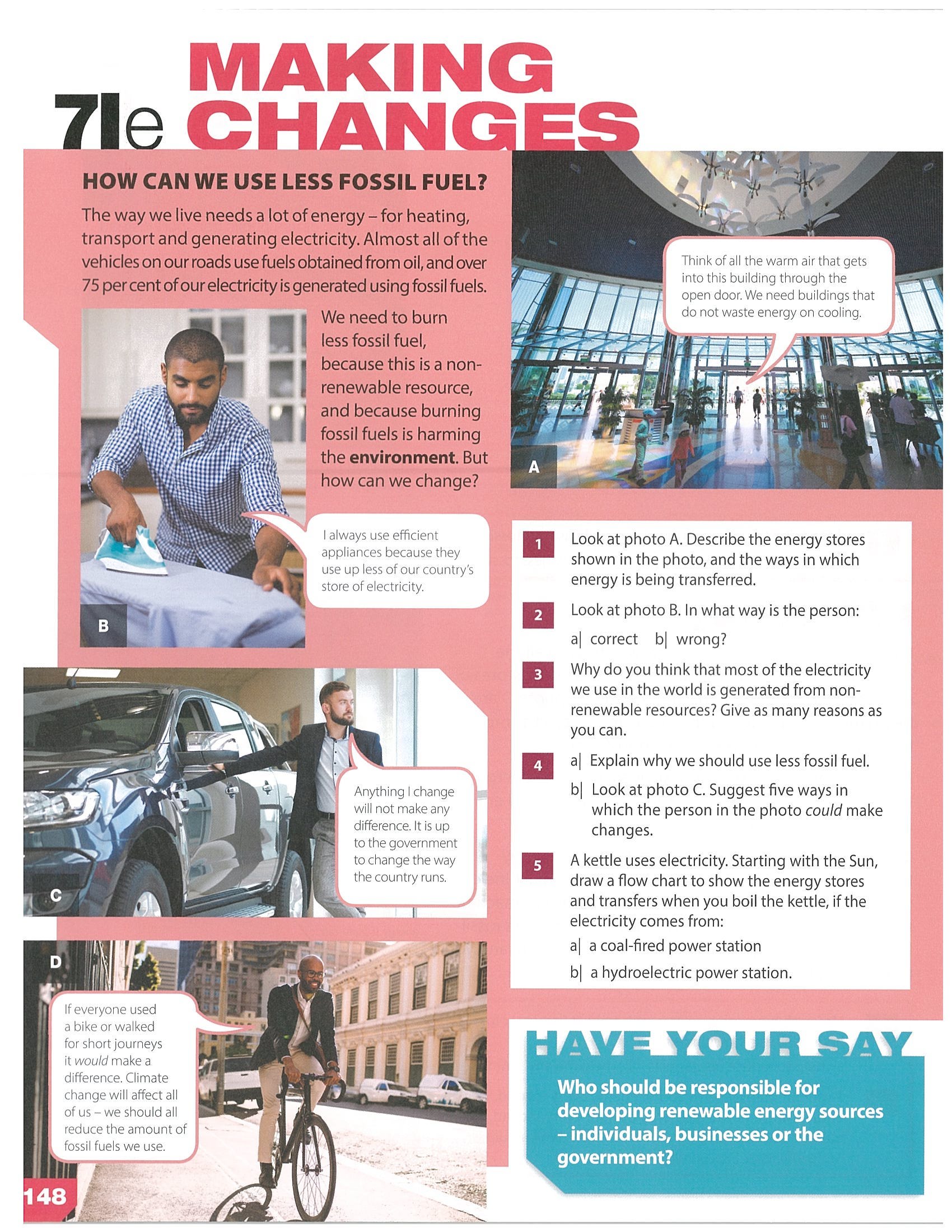
- 能区分化石燃料 vs 可再生能源,并列出优缺点
- 能计算能量转换的 efficiency 效率(有用输出 / 总输入 × 100%)
- 能讨论"使用更少能源"对环境的影响
🛣️ 推荐学习路径
- 通读教材 16 页(不查词,速读 30 分钟)
- 跟读本视图:左边看教材图,右边看笔记(约 2.5 小时)
- 做 Workbook 7I 全部题目(约 1.5 小时)
- 专项训练:拼写卡 + 能量流动图标注 + 答题规范(30 分钟)
- 挑战分级练习 L1→L2→L3(约 1 小时)
- 查漏错题本 + 自检清单(考前 30 分钟)
⚠️ 老师常考
- 必考 能量单位 J / kJ + 食物能量计算
- 必考 8 种 energy store 的英文名 + 例子
- 必考 用箭头图描述 energy transfer(从 store A → store B)
- 必考 conservation of energy(能量守恒:能量不灭,只转换)
- 高频 化石燃料的形成 + 类型(煤 / 油 / 天然气)+ 缺点(不可再生 / 污染)
- 高频 可再生能源对比(太阳 / 风 / 水 / 生物质 / 地热)
- 高频 efficiency 效率 = 有用能量 / 总输入 × 100%
- 高频 fair test 公平实验(控制变量,data ratios 比例对比)
- 拓展 STEM:transport careers + nuclear fusion in the Sun
🧭 前置回顾(来自 7B / 7C / 7G)
- scientific method 科学方法(7B)—— 7Ia 涉及 fair comparisons 和 working scientifically
- respiration 呼吸作用(7C)—— 食物 + 氧 → 能量(化学能 → 热/动能)
- kinetic theory 粒子动能(7G)—— 温度高 = 粒子动能大
- chemical reactions 化学反应(7H)—— 燃烧、呼吸都是化学能 → 其他能量形式的反应
- combustion 燃烧(7F/7H)—— 化石燃料的能量来源
📖 教材跟读 · 左图右注
📄 教材 p.133–137
📝 学习内容
核心理解:能量 + 食物 + 科学比较
1. 能量是一个可测量的量
能量(Energy)让事情发生——加热、移动、发光、声音、思考都需要能量。
- 单位:joule(焦耳,J)—— 国际标准
- 大单位:kilojoule(千焦,kJ)= 1000 J
- 更大:megajoule(兆焦,MJ)= 1 000 000 J
📌 食物能量常用 kJ 标——读懂食物包装上的"per 100g"或"per serving"。
2. 食物 = 化学能源
身体的能量来自食物。不同食物含的能量不一样:
| 食物类型 | 每 100g 能量 | 对比 |
|---|---|---|
| 水 / 蔬菜 | 0–100 kJ | 极低 |
| 水果(苹果) | 200 kJ | 低 |
| 面包 / 米饭 | 1000 kJ | 中 |
| 肉类 | 800–1500 kJ | 中高 |
| 奶酪 / 巧克力 | 2000+ kJ | 高 |
| 油 / 黄油 | 3000+ kJ | 最高 |
3. 每日能量需求(必懂)
不同人每日能量需求不同——取决于:
- Age 年龄:成长期儿童 / 青少年需求高;老年人较低
- Sex 性别:男性平均高于女性
- Body size 体型:体重大需求多
- Activity 活动量:运动员/重体力工作者 > 久坐办公族
- Climate 气候:冷地区需求略高(保暖耗能)
📌 参考:成年男性 ~10 500 kJ/day;成年女性 ~8 400 kJ/day;运动员可达 15 000 kJ/day。
4. 能量平衡(必考!)
能量摄入 > 消耗 → 体重增加(多余能量储存为脂肪)
能量摄入 = 消耗 → 体重稳定
能量摄入 < 消耗 → 体重下降(消耗储存的脂肪)
5. Fair Comparisons 公平比较
比较不同的事物时必须用同样的"参考标准"——这就是 fair comparison。
例:
- "巧克力 vs 苹果哪个能量高?"——要按每 100g比,不是按"一块"比
- "小明 vs 小红谁吃得多?"——要按每天总和比,不是按单餐
6. Ratios 比例(必懂)
用比例而不是绝对值来对比,更公平。
例:
- 狗 vs 人吃的食物——人吃得多但人也重得多。比较"每 kg 体重的能量摄入"才公平
- 体重 70 kg 的成人每天 ~10 500 kJ → 150 kJ/kg/天
- 体重 10 kg 的小狗每天 ~4 000 kJ → 400 kJ/kg/天 → 小狗按体重比例需求更多
为什么小动物按体重比例需要更多能量?
💡 小动物表面积/体积比大 → 散热快 → 需要持续产热保持体温 → 需要更多能量。这就是为什么蜂鸟每天吃自己体重的食物量。
7. WS Working Scientifically 科学探究
做"哪个食物能量更多"的实验时:
- 用燃烧食物加热水的方法测能量(calorimetry 量热法)
- 必须控制变量:相同水量、相同初始温度、相同燃烧距离
- 重复测多次取平均值,提高可靠性 reliability
✅ 学完小检查(3 题)
1. 我能说出能量的单位(J / kJ / MJ)和换算
2. 我能列出影响每日能量需求的 4 个因素
3. 我能用比例(per kg / per 100g)做公平比较
💡 句子级中英对照。
📄 教材 p.133 · 7Ia Energy and Changes
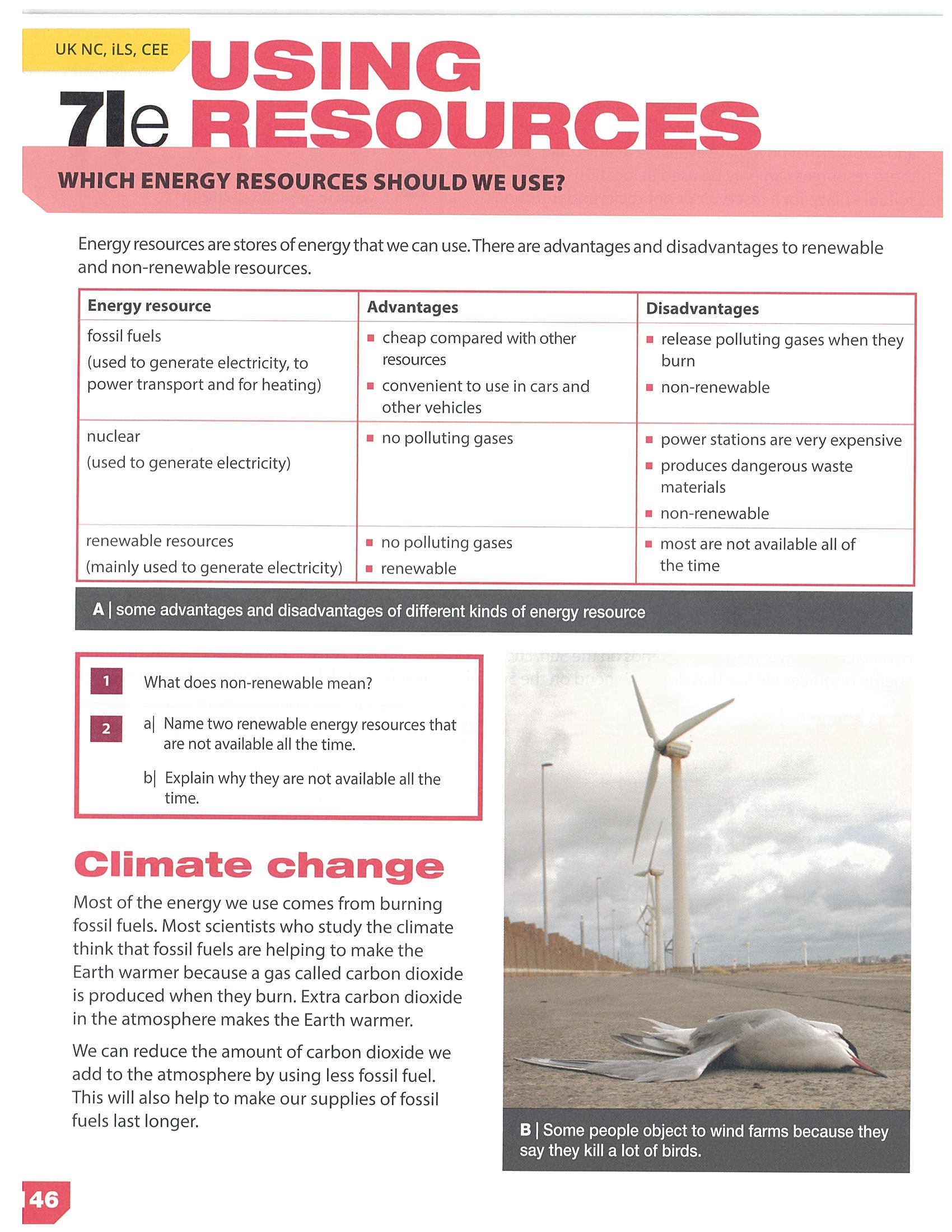
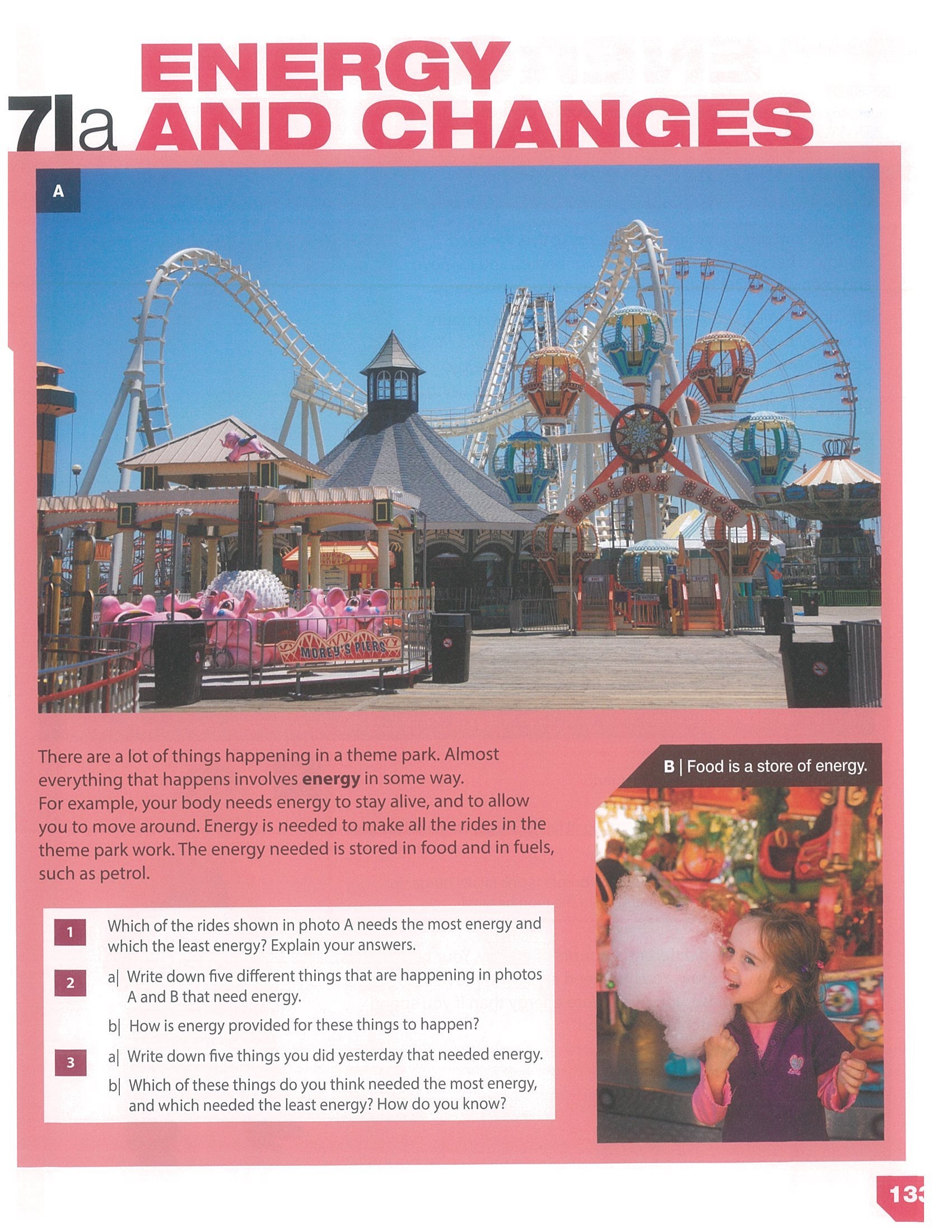
There are a lot of things happening in a theme park.
主题公园里有很多事情正在发生。
Almost everything that happens involves energy in some way.
几乎所有发生的事情都以某种方式涉及能量。
For example, your body needs energy to stay alive, and to allow you to move around.
例如,你的身体需要能量来维持生命,也需要能量让你四处活动。
Energy is needed to make all the rides in the theme park work.
主题公园里所有游乐设施运行都需要能量。
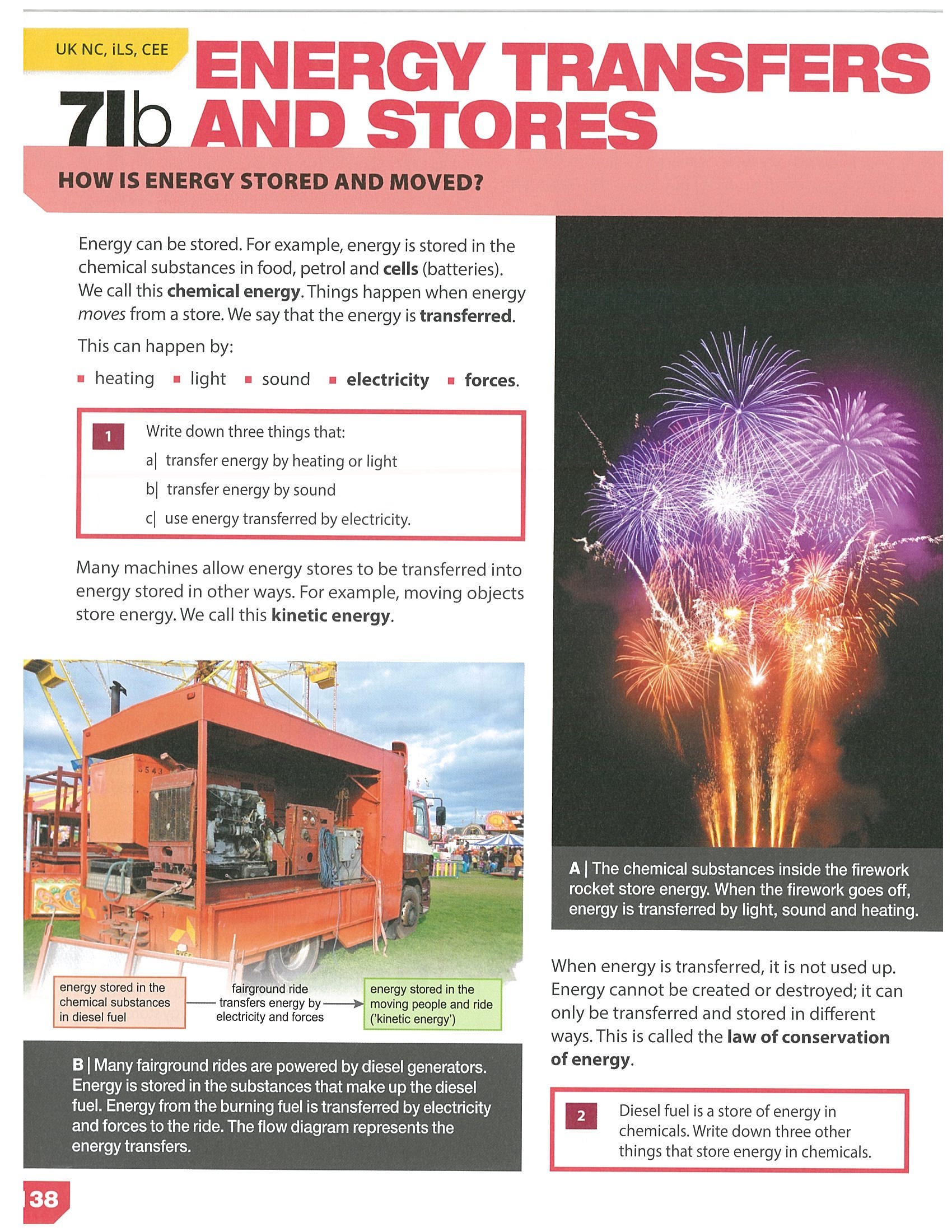
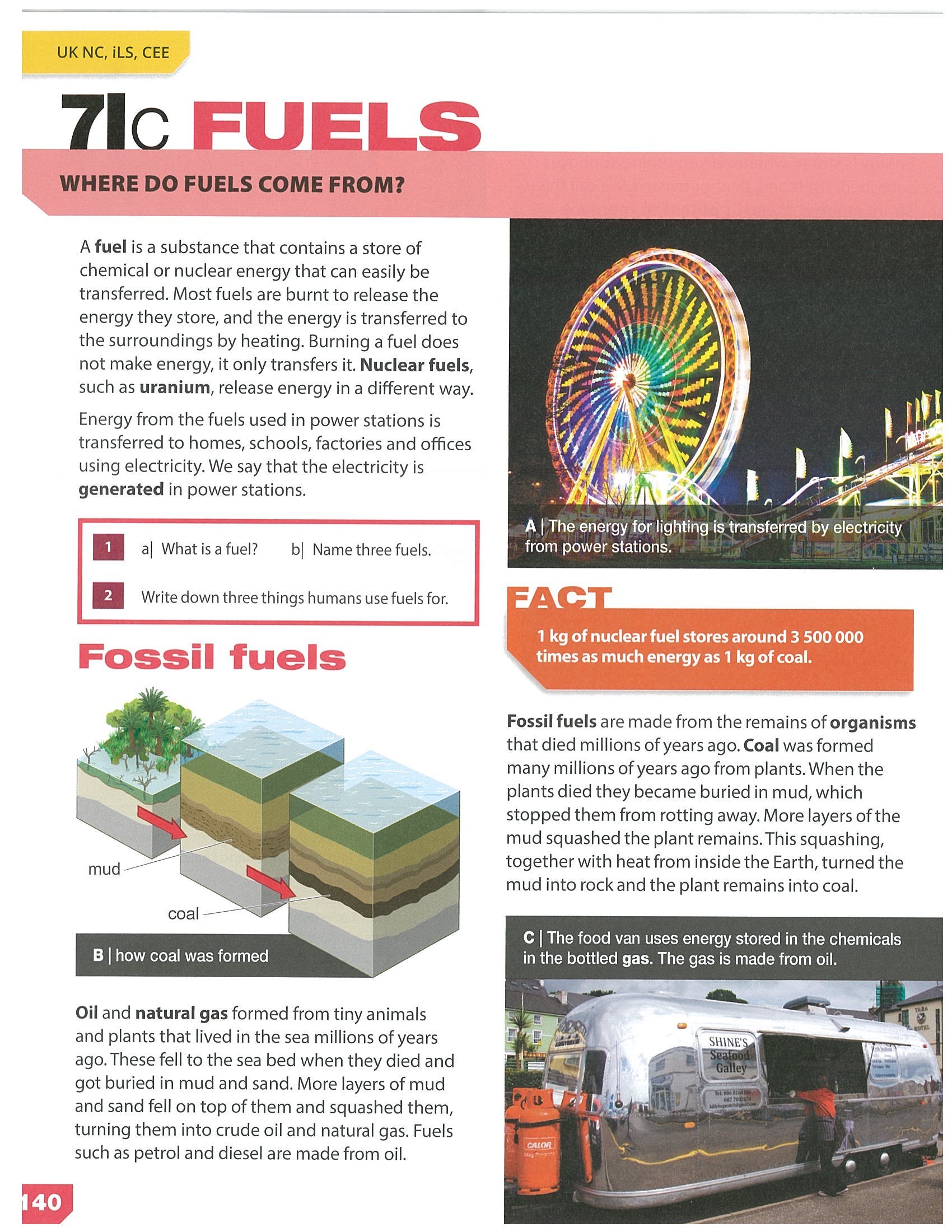
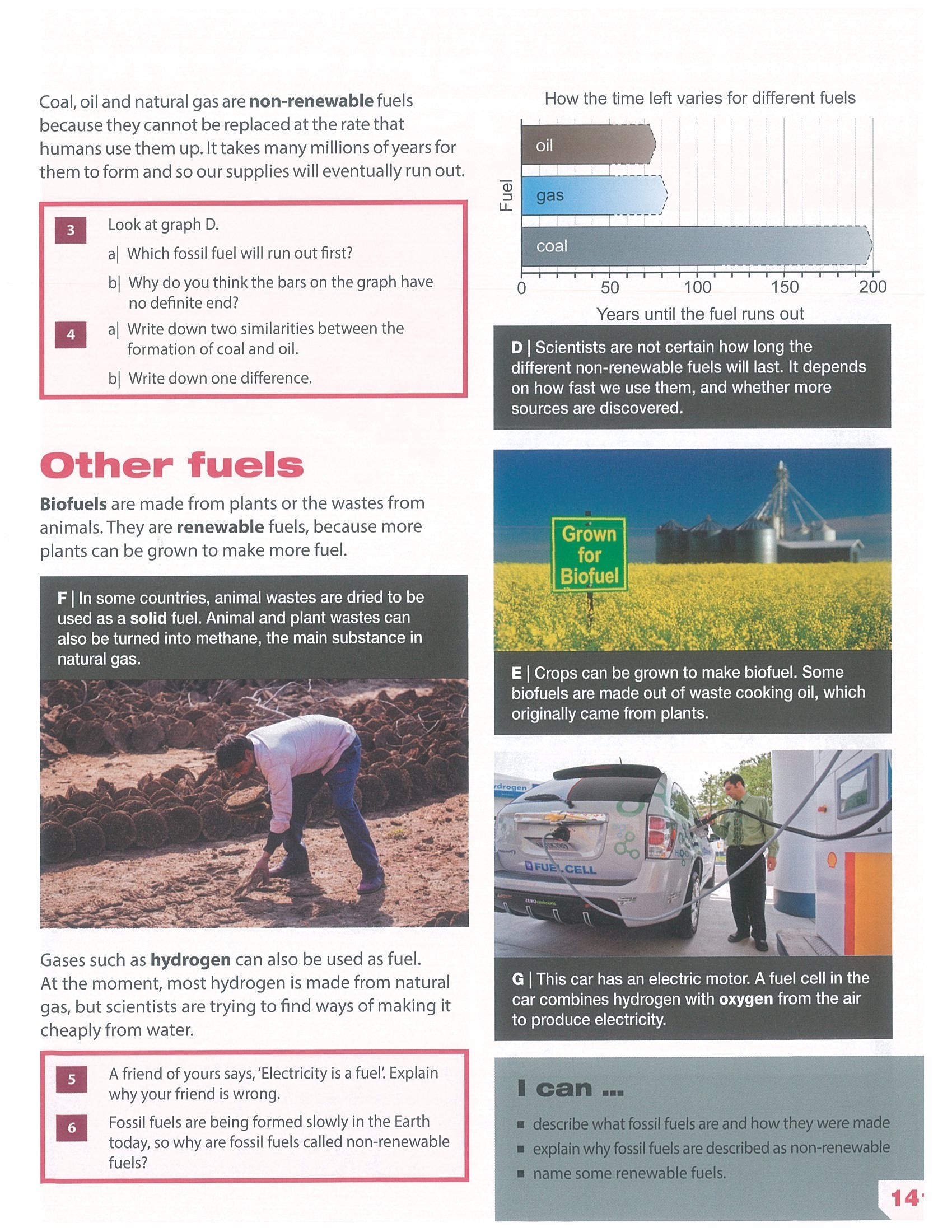
The energy needed is stored in food and in fuels, such as petrol.
所需的能量储存在食物和燃料中,例如汽油。
Food is a store of energy.
食物是能量的储存。
Which of the rides shown in photo A needs the most energy and which the least energy?
照片 A 中哪些游乐设施需要最多能量,哪些需要最少能量?
Explain your answers.
解释你的答案。
Write down five different things that are happening in photos A and B that need energy.
写出照片 A 和 B 中正在发生的、需要能量的五件不同事情。
How is energy provided for these things to happen?
这些事情发生所需的能量是如何提供的?
Write down five things you did yesterday that needed energy.
写出你昨天做过的五件需要能量的事情。
Which of these things do you think needed the most energy, and which needed the least energy?
你认为这些事情中哪一件需要最多能量,哪一件需要最少能量?
How do you know?
你怎么知道?
📄 教材 p.134 · 7Ia Energy from Food
Humans and other animals need energy to live.
人类和其他动物需要能量才能生存。
We need energy to help us to grow and repair our bodies, and to move and keep warm.
我们需要能量来帮助身体生长和修复,也需要能量来运动和保暖。
Our bodies use food as a source of energy.
我们的身体把食物作为能量来源。
The unit for measuring energy is the joule (J).
测量能量的单位是焦耳(J)。
The amount of energy needed to lift an apple from the floor onto a table is about 1 J.
把一个苹果从地板举到桌子上所需的能量大约是 1 J。
Most foods contain a lot more energy than this, so we usually measure the energy in foods using kilojoules (kJ).
大多数食物含有的能量远多于这个数值,所以我们通常用千焦(kJ)来测量食物中的能量。
1 kJ = 1000 J.
1 kJ = 1000 J。
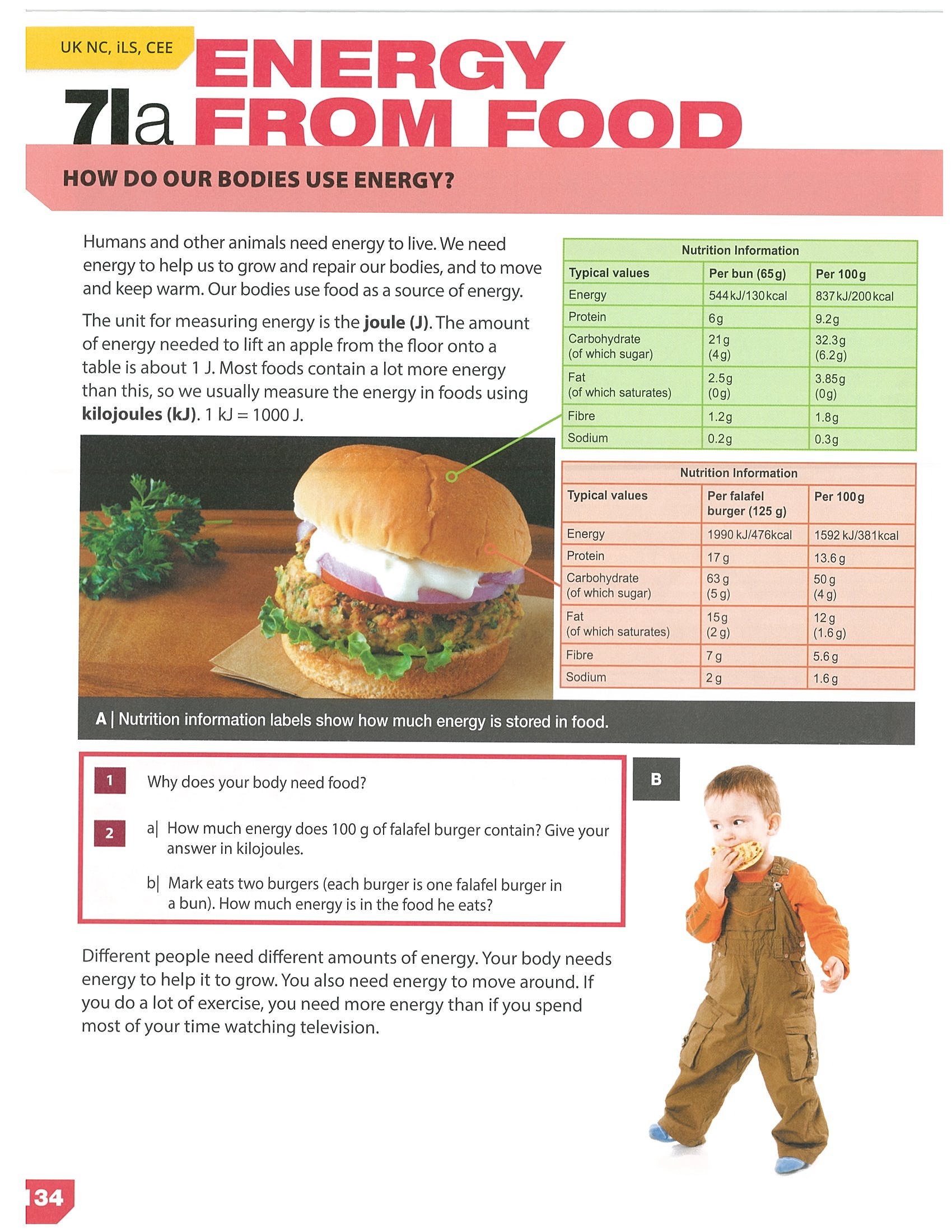
Nutrition information labels show how much energy is stored in food.
营养信息标签显示食物中储存了多少能量。
Nutrition Information
营养信息
Per bun, 65 g: energy 544 kJ or 130 kcal.
每个面包,65 g:能量 544 kJ 或 130 kcal。
Per 100 g of bun: energy 837 kJ or 200 kcal.
每 100 g 面包:能量 837 kJ 或 200 kcal。
Per falafel burger, 125 g: energy 1990 kJ or 476 kcal.
每个炸鹰嘴豆饼汉堡,125 g:能量 1990 kJ 或 476 kcal。
Per 100 g of falafel burger: energy 1592 kJ or 381 kcal.
每 100 g 炸鹰嘴豆饼汉堡:能量 1592 kJ 或 381 kcal。
Why does your body need food?
你的身体为什么需要食物?
How much energy does 100 g of falafel burger contain?
100 g 炸鹰嘴豆饼汉堡含有多少能量?
Give your answer in kilojoules.
用千焦给出你的答案。
Mark eats two burgers, and each burger is one falafel burger in a bun.
Mark 吃了两个汉堡,每个汉堡由一个炸鹰嘴豆饼和一个面包组成。
How much energy is in the food he eats?
他吃下的食物中含有多少能量?
Different people need different amounts of energy.
不同的人需要不同数量的能量。
Your body needs energy to help it to grow.
你的身体需要能量来帮助它生长。
You also need energy to move around.
你也需要能量来四处活动。
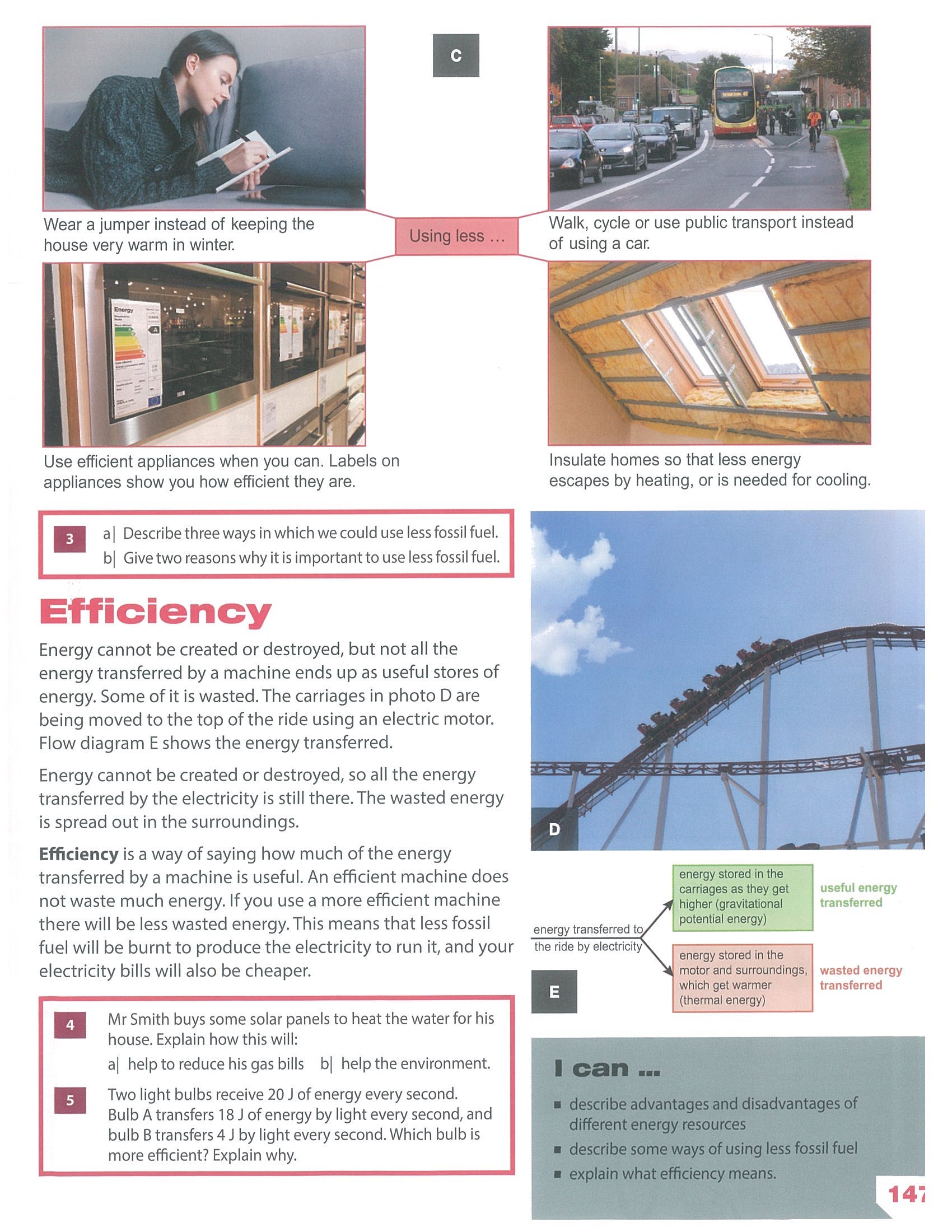
If you do a lot of exercise, you need more energy than if you spend most of your time watching television.
如果你做很多运动,你需要的能量就会比大部分时间看电视时更多。
📄 教材 p.135 · Different Daily Energy Needs
A good diet should provide only the amount of energy that a person's body needs.
良好的饮食应该只提供一个人身体所需要的能量。
If the diet contains more energy than the person needs, the body will store the energy in fat and the person will gain weight.
如果饮食中含有的能量超过这个人的需要,身体会把能量储存在脂肪中,这个人就会增重。
If the diet does not contain enough energy the person will lose weight and become thinner.
如果饮食中能量不足,这个人就会体重下降并变瘦。
A good balanced diet also provides all the nutrients that the body needs for health, and includes a mixture of different foods.
良好的均衡饮食还会提供身体健康所需的所有营养物质,并包含多种不同食物。
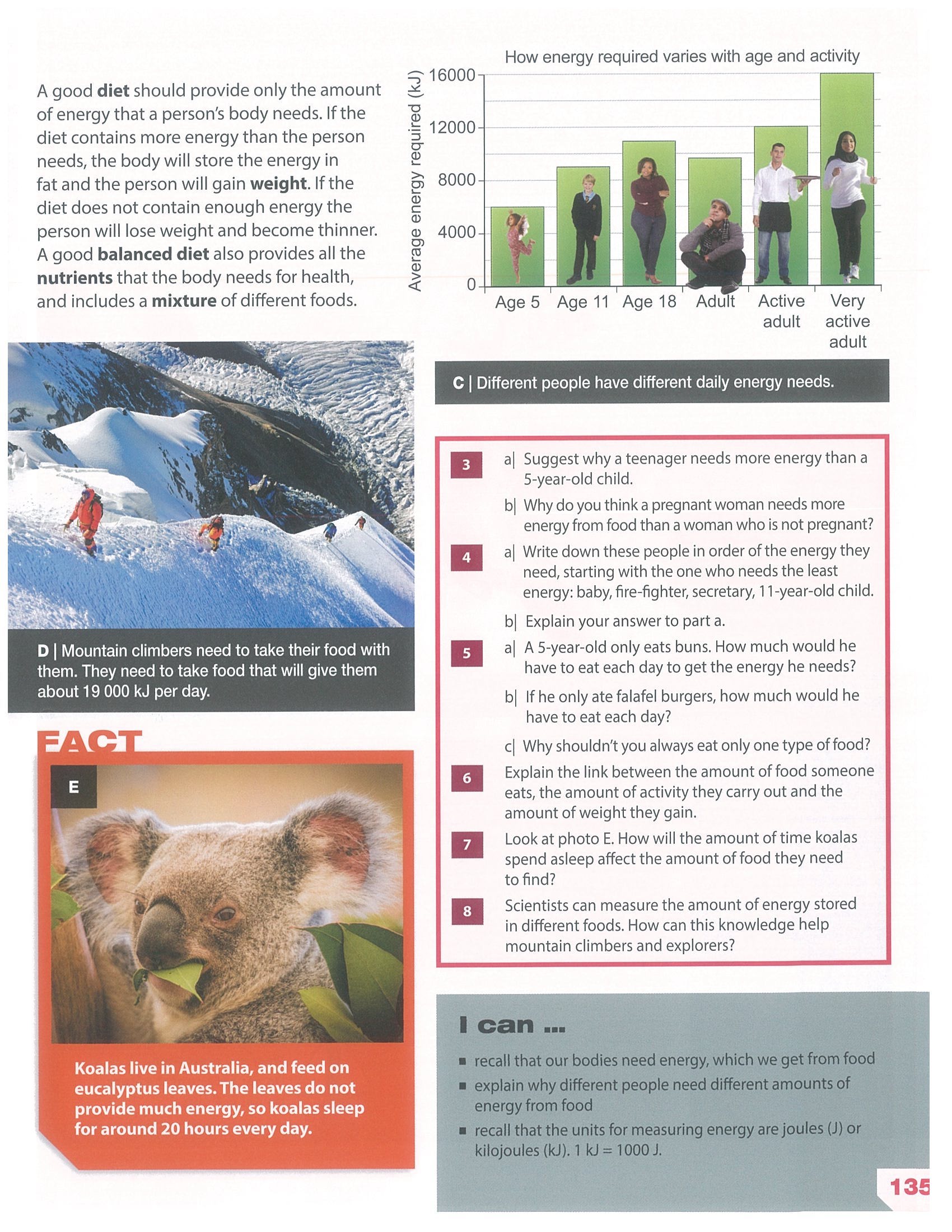
Different people have different daily energy needs.
不同的人有不同的每日能量需求。
Suggest why a teenager needs more energy than a 5-year-old child.
推测为什么青少年比 5 岁儿童需要更多能量。
Why do you think a pregnant woman needs more energy from food than a woman who is not pregnant?
你认为为什么孕妇比没有怀孕的女性需要从食物中获得更多能量?
Write down these people in order of the energy they need, starting with the one who needs the least energy: baby, fire-fighter, secretary, 11-year-old child.
按能量需求从少到多排列这些人:婴儿、消防员、秘书、11 岁儿童。
Explain your answer.
解释你的答案。
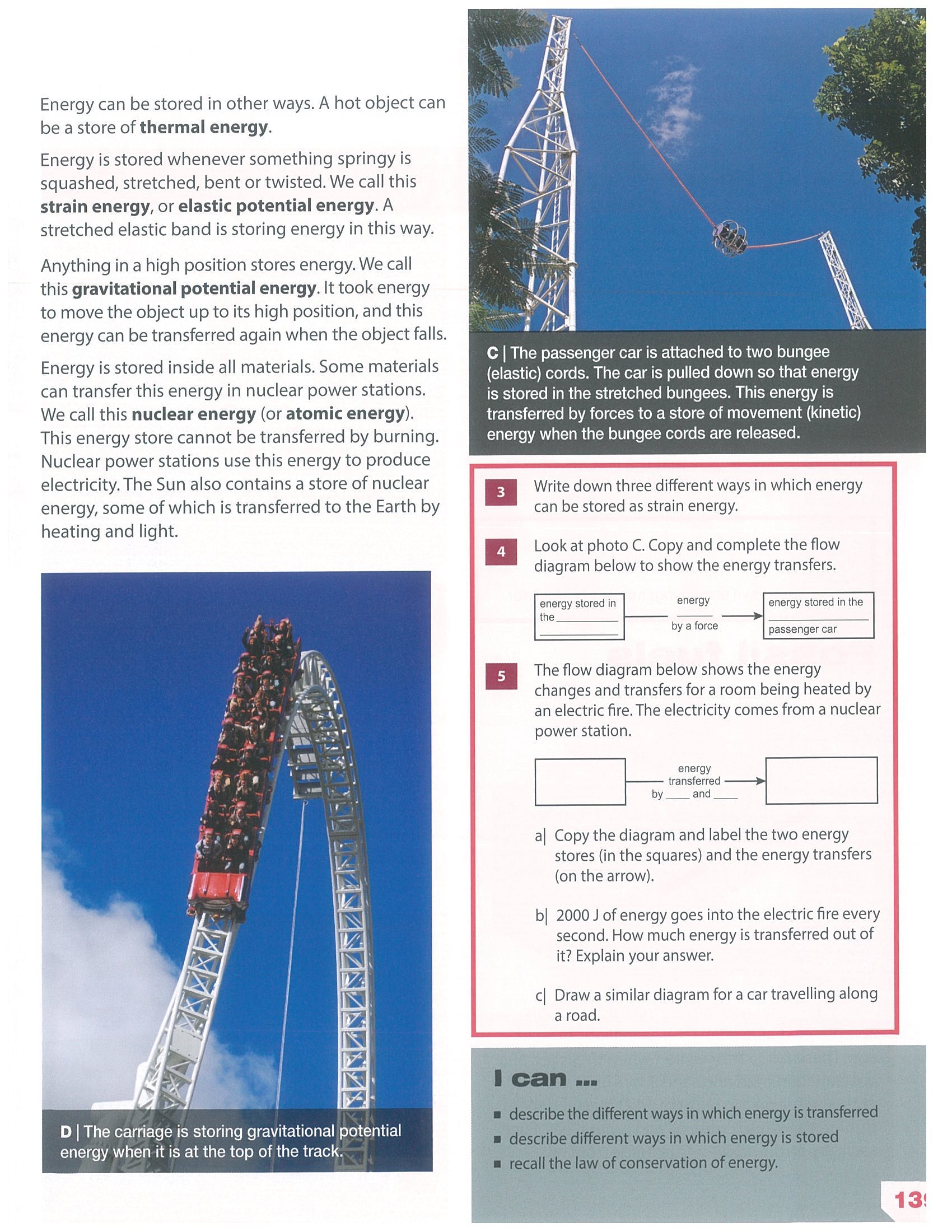
Mountain climbers need to take their food with them.
登山者需要随身携带食物。
They need to take food that will give them about 19 000 kJ per day.
他们需要携带每天能提供大约 19 000 kJ 能量的食物。
A 5-year-old only eats buns.
一个 5 岁儿童只吃面包。
How much would he have to eat each day to get the energy he needs?
他每天需要吃多少,才能获得所需能量?
If he only ate falafel burgers, how much would he have to eat each day?
如果他只吃炸鹰嘴豆饼汉堡,他每天需要吃多少?
Why shouldn't you always eat only one type of food?
为什么你不应该总是只吃一种食物?
Explain the link between the amount of food someone eats, the amount of activity they carry out and the amount of weight they gain.
解释一个人吃的食物量、活动量和体重增加量之间的联系。
Look at photo E.
看照片 E。
How will the amount of time koalas spend asleep affect the amount of food they need to find?
考拉睡觉的时间长短会如何影响它们需要寻找的食物量?
Scientists can measure the amount of energy stored in different foods.
科学家可以测量不同食物中储存的能量。
How can this knowledge help mountain climbers and explorers?
这些知识如何帮助登山者和探险者?
FACT
FACT 框
Koalas live in Australia, and feed on eucalyptus leaves.
考拉生活在澳大利亚,以桉树叶为食。
The leaves do not provide much energy, so koalas sleep for around 20 hours every day.
这些叶子不能提供太多能量,所以考拉每天大约睡 20 小时。
I can…
我能……
I can recall that our bodies need energy, which we get from food.
我能记住我们的身体需要能量,而这些能量来自食物。
I can explain why different people need different amounts of energy from food.
我能解释为什么不同的人需要从食物中获得不同数量的能量。
I can recall that the units for measuring energy are joules (J) or kilojoules (kJ).
我能记住测量能量的单位是焦耳(J)或千焦(kJ)。
1 kJ = 1000 J.
1 kJ = 1000 J。
📄 教材 p.136 · 7Ia Fair Comparisons and Ratios
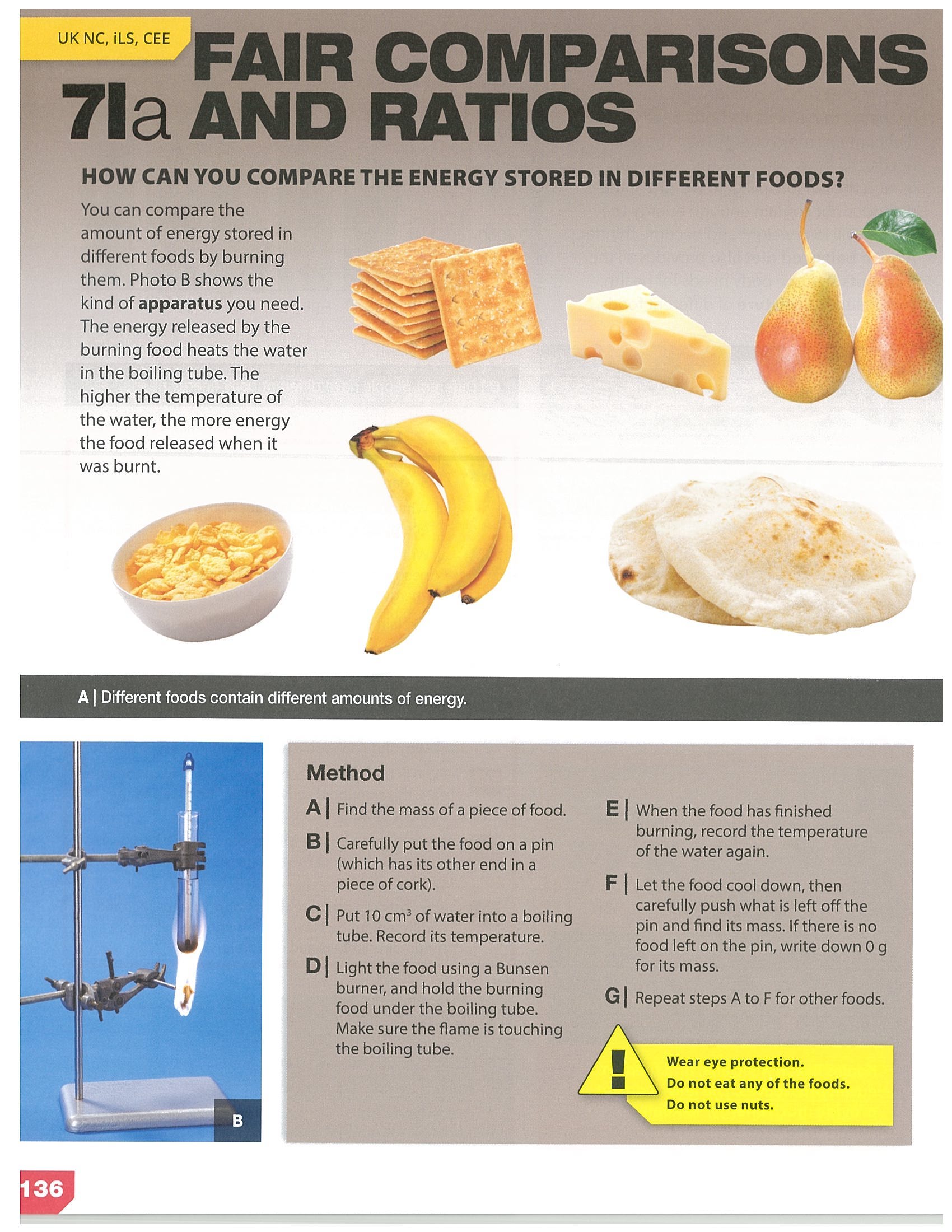
You can compare the amount of energy stored in different foods by burning them.
你可以通过燃烧不同食物来比较它们储存的能量。
Photo B shows the kind of apparatus you need.
照片 B 展示了你需要的装置。
The energy released by the burning food heats the water in the boiling tube.
燃烧食物释放的能量会加热沸腾管中的水。
The higher the temperature of the water, the more energy the food released when it was burnt.
水的温度升得越高,说明食物燃烧时释放的能量越多。
Different foods contain different amounts of energy.
不同食物含有不同数量的能量。
Method
方法
Find the mass of a piece of food.
测量一块食物的质量。
Carefully put the food on a pin, which has its other end in a piece of cork.
小心地把食物放在一根针上,针的另一端插在软木塞中。
Put 10 cm3 of water into a boiling tube.
向沸腾管中加入 10 cm3 的水。
Record its temperature.
记录水的温度。
Light the food using a Bunsen burner, and hold the burning food under the boiling tube.
用本生灯点燃食物,并把正在燃烧的食物放在沸腾管下方。
Make sure the flame is touching the boiling tube.
确保火焰接触到沸腾管。
When the food has finished burning, record the temperature of the water again.
当食物燃烧完后,再次记录水的温度。
Let the food cool down, then carefully push what is left off the pin and find its mass.
让食物冷却,然后小心地把针上剩下的东西推下来,并测量它的质量。
If there is no food left on the pin, write down 0 g for its mass.
如果针上没有剩余食物,就把它的质量记录为 0 g。
Repeat the steps for other foods.
对其他食物重复这些步骤。
Safety
安全
Wear eye protection.
佩戴护目镜。
Do not eat any of the foods.
不要吃任何实验用食物。
Do not use nuts.
不要使用坚果。
📄 教材 p.137 · Working Scientifically: Comparing Results
Working Scientifically
像科学家一样工作
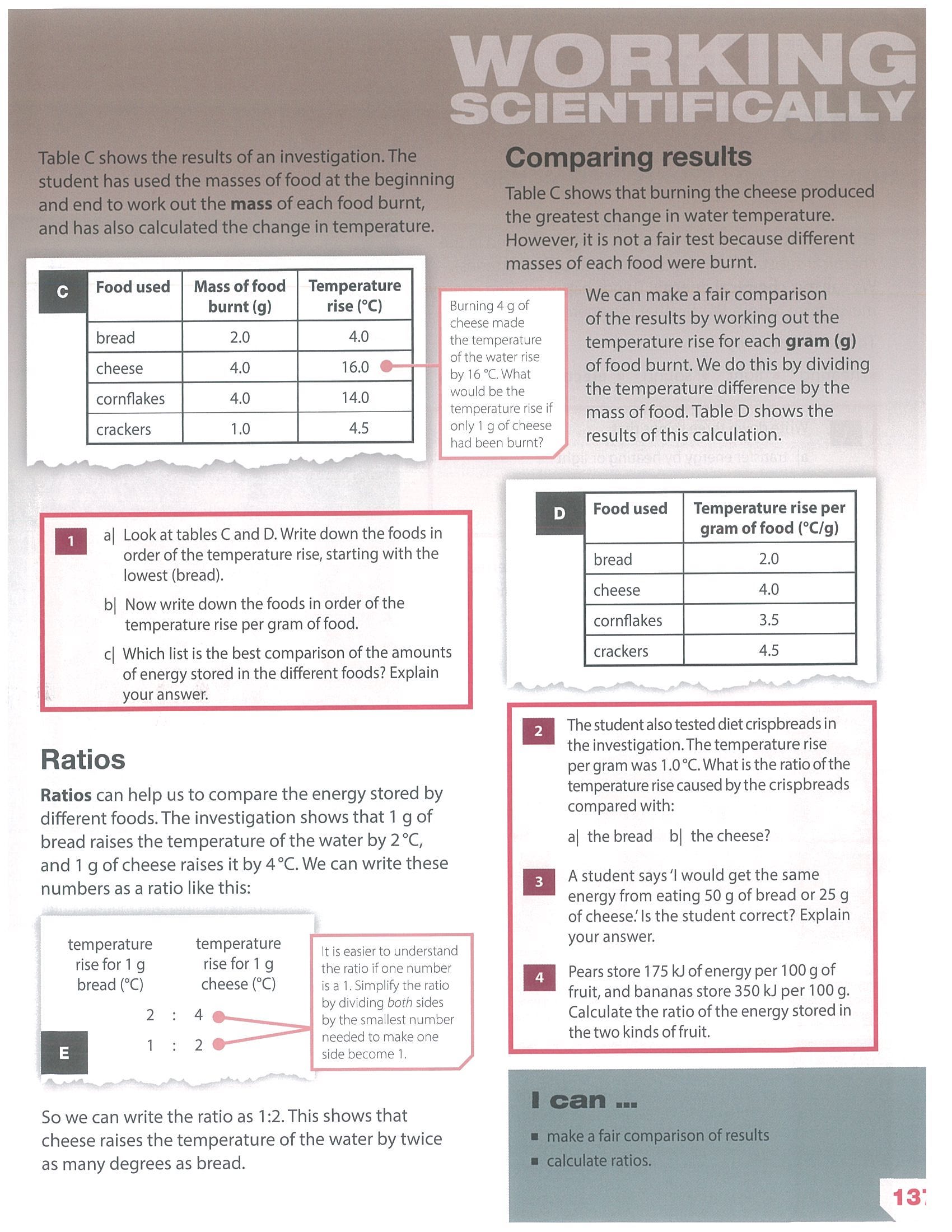
Table C shows the results of an investigation.
表 C 显示了一次调查的结果。
The student has used the masses of food at the beginning and end to work out the mass of each food burnt, and has also calculated the change in temperature.
学生使用食物开始和结束时的质量来计算每种食物燃烧掉的质量,并且还计算了温度变化。
However, it is not a fair test because different masses of each food were burnt.
然而,这不是一次公平测试,因为每种食物燃烧的质量不同。
Comparing Results
比较结果
Table C shows that burning the cheese produced the greatest change in water temperature.
表 C 显示,燃烧奶酪使水温变化最大。
We can make a fair comparison of the results by working out the temperature rise for each gram of food burnt.
我们可以通过计算每燃烧 1 g 食物造成的温度升高,来公平地比较结果。
We do this by dividing the temperature difference by the mass of food.
我们通过用温度差除以食物质量来做到这一点。
Table D shows the results of this calculation.
表 D 显示了这个计算的结果。
Tables C-D
表 C-D
Bread: mass of food burnt 2.0 g; temperature rise 4.0°C; temperature rise per gram 2.0°C/g.
面包:燃烧食物质量 2.0 g;温度升高 4.0°C;每克温度升高 2.0°C/g。
Cheese: mass of food burnt 4.0 g; temperature rise 16.0°C; temperature rise per gram 4.0°C/g.
奶酪:燃烧食物质量 4.0 g;温度升高 16.0°C;每克温度升高 4.0°C/g。
Cornflakes: mass of food burnt 4.0 g; temperature rise 14.0°C; temperature rise per gram 3.5°C/g.
玉米片:燃烧食物质量 4.0 g;温度升高 14.0°C;每克温度升高 3.5°C/g。
Crackers: mass of food burnt 1.0 g; temperature rise 4.5°C; temperature rise per gram 4.5°C/g.
饼干:燃烧食物质量 1.0 g;温度升高 4.5°C;每克温度升高 4.5°C/g。
Burning 4 g of cheese made the temperature of the water rise by 16°C.
燃烧 4 g 奶酪使水温升高了 16°C。
What would be the temperature rise if only 1 g of cheese had been burnt?
如果只燃烧 1 g 奶酪,温度会升高多少?
Look at tables C and D.
看表 C 和表 D。
Write down the foods in order of the temperature rise, starting with the lowest, bread.
按温度升高从低到高写出食物顺序,从最低的面包开始。
Now write down the foods in order of the temperature rise per gram of food.
现在按每克食物造成的温度升高来写出食物顺序。
Which list is the best comparison of the amounts of energy stored in the different foods?
哪一个列表最适合比较不同食物中储存的能量?
Explain your answer.
解释你的答案。
Ratios
比值
Ratios can help us to compare the energy stored by different foods.
比值可以帮助我们比较不同食物储存的能量。
The investigation shows that 1 g of bread raises the temperature of the water by 2°C, and 1 g of cheese raises it by 4°C.
这个调查显示,1 g 面包使水温升高 2°C,而 1 g 奶酪使水温升高 4°C。
We can write these numbers as a ratio like this: 2:4.
我们可以把这些数字写成这样的比值:2:4。
It is easier to understand the ratio if one number is a 1.
如果其中一个数字是 1,比值会更容易理解。
Simplify the ratio by dividing both sides by the smallest number needed to make one side become 1.
通过把两边都除以能让一边变成 1 的最小数字来化简比值。
So we can write the ratio as 1:2.
因此,我们可以把这个比值写成 1:2。
This shows that cheese raises the temperature of the water by twice as many degrees as bread.
这说明奶酪使水温升高的度数是面包的两倍。
The student also tested diet crispbreads in the investigation.
这个学生在调查中还测试了低热量薄脆饼。
The temperature rise per gram was 1.0°C.
每克造成的温度升高为 1.0°C。
What is the ratio of the temperature rise caused by the crispbreads compared with the bread?
薄脆饼与面包造成的温度升高之比是多少?
What is the ratio of the temperature rise caused by the crispbreads compared with the cheese?
薄脆饼与奶酪造成的温度升高之比是多少?
A student says, "I would get the same energy from eating 50 g of bread or 25 g of cheese."
一个学生说:“我吃 50 g 面包或 25 g 奶酪会获得相同能量。”
Is the student correct?
这个学生说得对吗?
Explain your answer.
解释你的答案。
Pears store 175 kJ of energy per 100 g of fruit, and bananas store 350 kJ per 100 g.
梨每 100 g 储存 175 kJ 能量,香蕉每 100 g 储存 350 kJ 能量。
Calculate the ratio of the energy stored in the two kinds of fruit.
计算这两种水果储存能量的比值。
I can…
我能……
I can make a fair comparison of results.
我能对结果进行公平比较。
I can calculate ratios.
我能计算比值。
💡 7Ia 能量形式核心词。点单词右侧 🔊 听读音。词源 + 教材原句 + 易错点。
⚡ 能量与单位
energy
/ˈenərdʒi/
n.
能量(不可数)
词源希腊 en-(内)+ ergon(工作)= "en-ergeia 内在的活动力"。亚里士多德造的词。
教材"Almost everything that happens involves energy in some way."(几乎所有发生的事都涉及能量)
延伸① solar energy 太阳能 ② energy drink 能量饮料 ③ full of energy 精力充沛
不可数!不能说 "two energies"。要说 "two forms of energy"。
joule
/dʒuːl/
n.
焦耳(能量单位,符号 J)
词源人名!来自英国物理学家 James Prescott Joule(1818–1889,研究热与能量的关系)。
教材"Energy is measured in joules (J)."(能量以焦耳为单位)
换算1 kJ = 1000 J;1 MJ = 1 000 000 J。食物包装上常用 kJ。
不读 "jole"!发音 /dʒuːl/ 像 "jool"。符号 J 大写(人名缩写规则)。
🔥 能量的 8 种形式
kinetic
/kɪˈnetɪk/
adj.
动能的、运动的
词源希腊 kinētikos = "运动相关的"(同源词 cinema 电影 = 活动影像)
教材"kinetic energy — energy of a moving object"(动能 = 运动物体的能量)
记忆看到 kinetic 想"运动"。cinema(电影) 也是 kine- 词根。
kinetic vs potential:动能是"已经在动",势能是"潜在的、储存的"。考试常考混!
potential
/pəˈtenʃl/
adj./n.
势能的;潜力
词源拉丁 potentia = "能力、潜能"(同源 power, possible)
教材"gravitational potential energy — energy stored due to height"(重力势能 = 因高度储存的能量)
延伸① elastic potential energy 弹性势能 ② He has great potential. 他很有潜力
"储存"是关键:球放在桌上 = 重力势能(还没掉下来);球下落途中 = 动能。
thermal
/ˈθɜːrml/
adj.
热的、热能的
词源希腊 thermē = "热"(同源 thermometer 温度计,thermos 保温瓶)
教材"thermal energy — energy due to temperature"(热能 = 因温度产生的能量)
延伸thermal underwear 保暖内衣,thermal imaging 热成像
thermal ≠ heat:thermal 是形容词,heat 是名词/动词。学校英语里 thermal energy 更专业。
chemical
/ˈkemɪkl/
adj.
化学的
词源阿拉伯 al-kīmiyāʾ → 拉丁 alchemia(炼金术)→ chemistry
教材"chemical energy stored in food, fuels and batteries"(食物、燃料、电池里储存化学能)
三大化学能来源① 食物(人体)② 燃料(汽车、发电)③ 电池
light
/laɪt/
n./adj.
光;轻的
词源古英语 lēoht(光)
教材"Plants use light energy from the Sun for photosynthesis."(植物用太阳光能进行光合作用)
注意:light 是 transfer pathway(传递路径),不是 store(储存)。但日常说"light energy"也接受。
sound
/saʊnd/
n.
声音
词源拉丁 sonus = 声音(同源 sonic, resonate)
教材"sound energy travels as vibrations"(声能以振动方式传播)
sound 也是 transfer pathway。声音是物质振动传递能量,本身不能"储存"。