🚪 学习前导 · 先看这里再开始
🎯 学完你能干什么
- 能区分 element 元素、compound 化合物、mixture 混合物三个概念
- 能说出 atom 原子、molecule 分子的差别
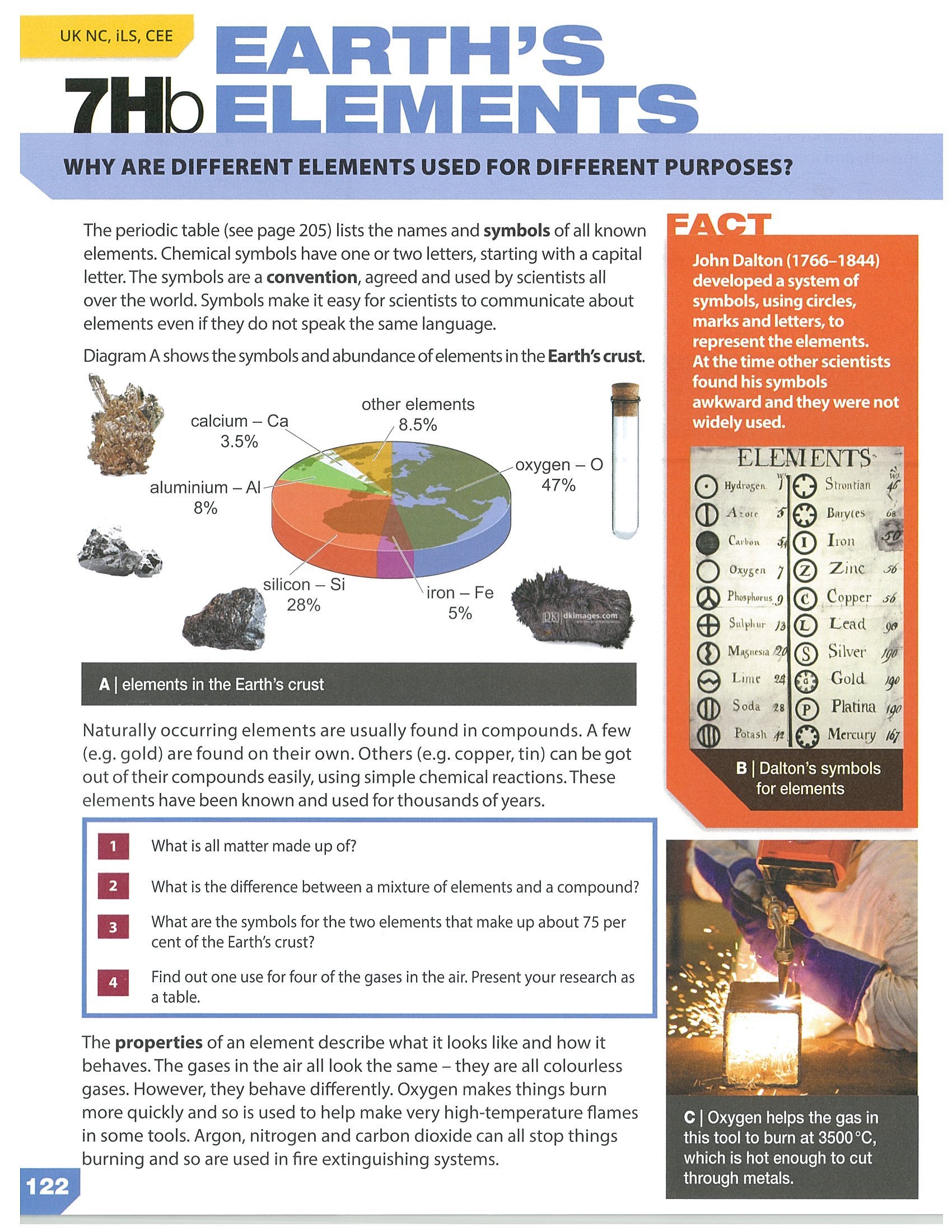
- 能列出空气的主要成分(N₂ 78% / O₂ 21% / Ar / CO₂)
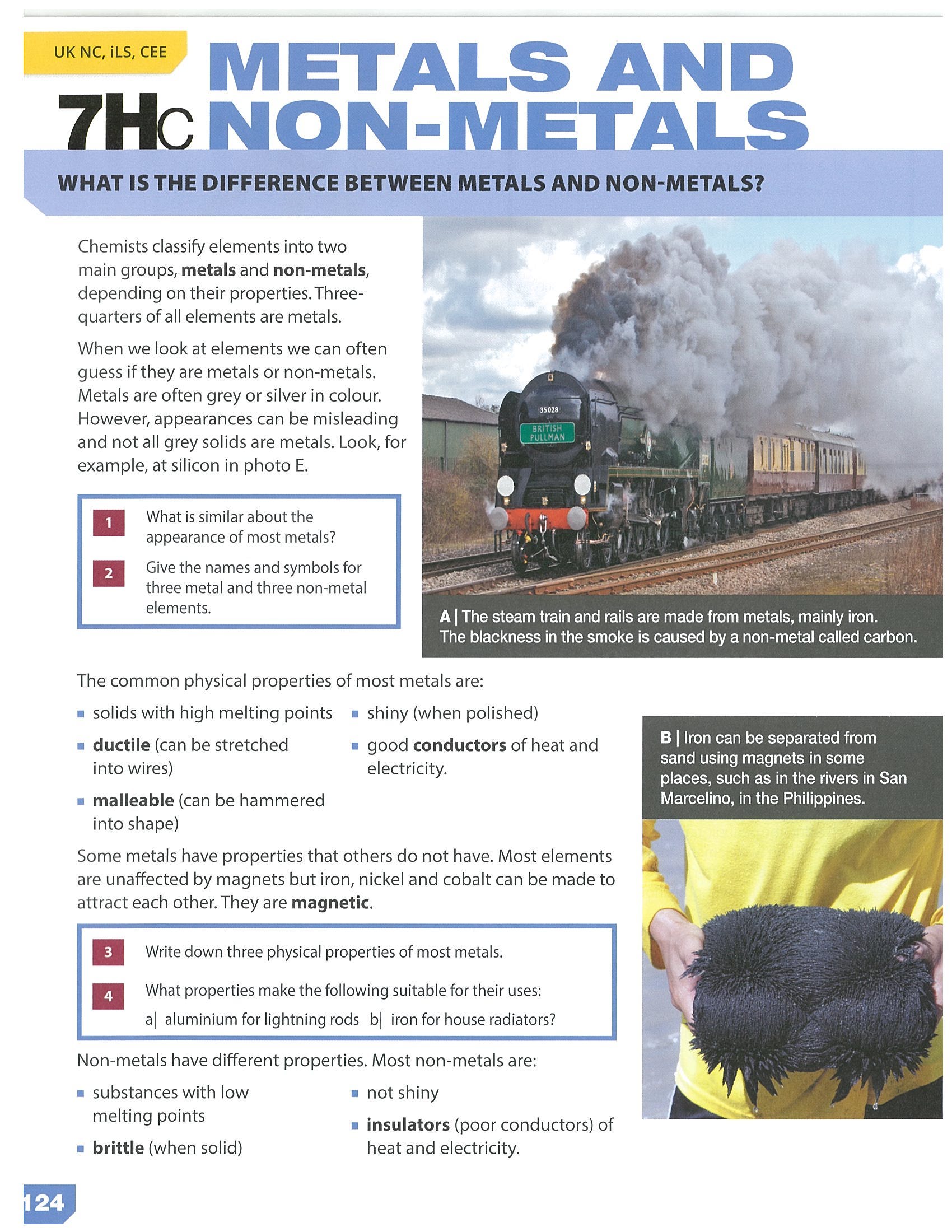
- 能比较 metal 金属 与 non-metal 非金属的属性
- 能解释 ore 矿石怎么提炼出金属(mining + extraction)
- 能写出常见的化合物名字规则(金属在前 / 非金属带 -ide / 含氧带 -ate)
- 能区分 physical change 物理变化 和 chemical reaction 化学反应
- 能用词方程式 word equation描述化学反应
🛣️ 推荐学习路径
- 通读教材 16 页(不查词,速读 30 分钟)
- 跟读本视图:左边看教材图,右边看笔记(约 2.5 小时)
- 做 Workbook 7H 全部题目(约 1.5 小时)
- 专项训练:拼写卡 + 元素符号标注 + 答题规范(30 分钟)
- 挑战分级练习 L1→L2→L3(约 1 小时)
- 查漏错题本 + 自检清单(考前 30 分钟)
⚠️ 老师常考
- 必考 区分 element / compound / mixture 的定义和例子
- 必考 区分 atom vs molecule
- 必考 空气成分 + 比例(N₂ 78% / O₂ 21%)
- 必考 金属 vs 非金属的属性对比(导电 / 延展 / 光泽 / 熔点)
- 高频 常见元素符号(H / O / C / N / Fe / Cu / Au 等)
- 高频 化合物命名规则(NaCl=sodium chloride,CuO=copper oxide)
- 高频 化学反应识别:颜色变 / 气体出 / 温度变 / 沉淀生成
- 高频 写词方程式(reactants → products)
- 拓展 STEM:mining for profit + resource scarcity
🧭 前置回顾(来自 7E / 7F / 7G)
- particle 粒子(7G)—— 7H 把粒子细分成 atom(原子)和 molecule(分子)
- mixture / pure substance(7E)—— 7H 区分 element / compound / mixture 三层
- neutralisation(7F)—— 7H 化学反应里中和是一种
- word equation(7F)—— 7H 化学反应里继续使用
- states of matter(7G)—— 7H 反应里产物可以是气体/液体/固体
📖 教材跟读 · 左图右注
📄 教材 p.117–120
📝 学习内容
核心理解:物质世界 + 空气成分
1. 物质从哪里来 — 三大来源
- 从地下挖——矿物、金属矿石、化石燃料
- 从海洋取——盐、镁、淡水(淡化)
- 从空气提——氮气、氧气、二氧化碳
📌 几乎所有人造产品的原料都来自这三处之一——这就是 resources(资源)。
2. 资源是 finite(有限的)
地下的矿越挖越少 → 总有一天会用完。这就是为什么要:
- recycle 回收——金属、玻璃、塑料反复利用
- reduce 减少——少用一次性物品
- find substitutes——用更丰富的材料替代稀缺材料
3. Sorting Resource Data(WS 工作技能)
科学家用表格 + 图表整理资源数据来发现规律:
- Bar chart 柱状图——比较不同资源的数量
- Pie chart 饼图——展示比例(比如空气成分)
- Line graph 折线图——展示随时间变化
📌 选哪种图取决于数据类型——分类型用柱状/饼图,连续变化用折线。
4. Air 空气成分(必背!)
| 气体 | 比例 | 用途/特点 |
|---|---|---|
| Nitrogen 氮气 N₂ | 78% | 占大头;化学性质不活泼 |
| Oxygen 氧气 O₂ | 21% | 生物呼吸 + 燃烧需要 |
| Argon 氩气 Ar | 约 1% | 惰性气体(用于灯泡、激光) |
| Carbon dioxide CO₂ | 0.04% | 植物光合作用需要 |
| 水蒸气、其他 | 少量 | 湿度来源 |
📌 记 78 / 21 / 1——氮 78%,氧 21%,其他加起来约 1%。
5. 空气是 mixture 混合物,不是化合物
- 各气体之间没有发生化学反应——还是各自的分子
- 可以用物理方法分开(如 fractional distillation 分级蒸馏)
- 跟compound 化合物不同——后者元素已结合成新物质(如 H₂O)
为什么空气是 mixture 而不是 compound?
💡 关键点 1:各气体之间没有化学反应——氮气还是 N₂,氧气还是 O₂,没有结合成新物质。
关键点 2:比例可以变(不同地点不同时间空气成分略有不同)——化合物的元素比例是固定的。
关键点 3:可以物理方法分离(液化后分馏)——化合物只能化学方法分解。
关键点 2:比例可以变(不同地点不同时间空气成分略有不同)——化合物的元素比例是固定的。
关键点 3:可以物理方法分离(液化后分馏)——化合物只能化学方法分解。
6. Investigating Air 探究空气(WS)
常见实验:
- 测氧气比例——用蜡烛或铁屑消耗氧气,看水位上升多少(应该 ≈ 1/5)
- 测二氧化碳——用石灰水(limewater),遇 CO₂ 变浑浊
- 测水蒸气——用无水硫酸铜(白色 → 蓝色)或钴蓝色试纸(蓝色 → 粉色)
⚠️ 高频题:给一组资源数据/空气成分饼图让你解读 + 解释关系 + 推测变化。常考"为什么氮气比例最高但不参与呼吸"。
✅ 学完小检查(3 题)
1. 我能说出空气 4 种主要成分及比例(N₂ 78% / O₂ 21% / Ar ~1% / CO₂ 0.04%)
2. 我能解释为什么空气是 mixture 而不是 compound
3. 我能选合适的图表(柱状/饼/折线)展示不同数据
💡 句子级中英对照。
📄 教材 p.117 · 7Ha Our Material World
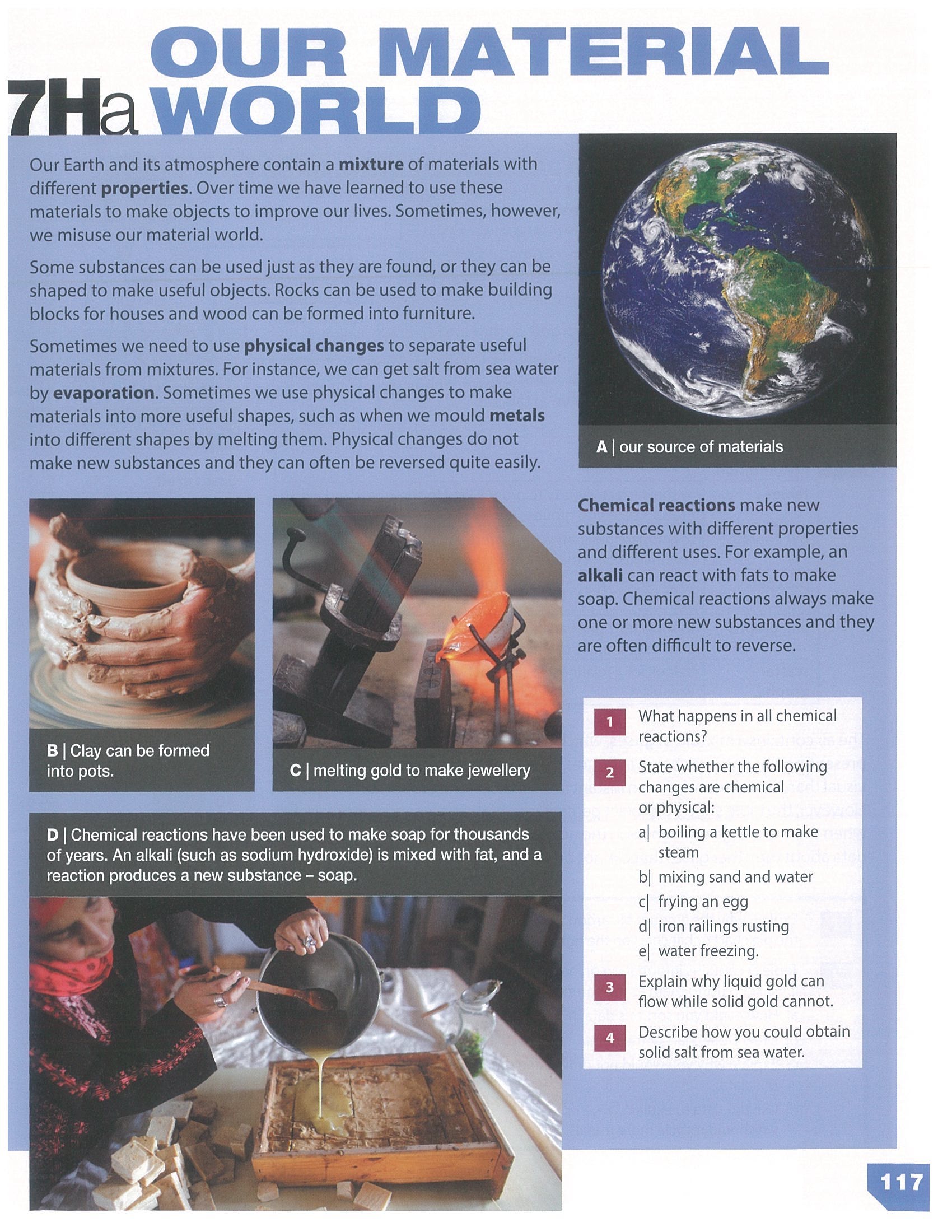
Our Earth and its atmosphere contain a mixture of materials with different properties.
我们的地球和大气含有由不同性质的材料组成的混合物。
Over time we have learned to use these materials to make objects to improve our lives.
随着时间推移,我们学会了使用这些材料制造物品来改善生活。
Sometimes, however, we misuse our material world.
但是,有时我们也会错误地使用我们的材料世界。
Some substances can be used just as they are found, or they can be shaped to make useful objects.
有些物质可以直接按它们被发现时的样子使用,也可以被塑造成有用的物品。
Rocks can be used to make building blocks for houses and wood can be formed into furniture.
岩石可以用来制造房屋的建筑块,木材可以被制成家具。
Sometimes we need to use physical changes to separate useful materials from mixtures.
有时我们需要利用物理变化,从混合物中分离出有用材料。
For instance, we can get salt from sea water by evaporation.
例如,我们可以通过蒸发从海水中获得盐。
Sometimes we use physical changes to make materials into more useful shapes, such as when we mould metals into different shapes by melting them.
有时我们利用物理变化把材料变成更有用的形状,例如通过熔化金属,把金属塑造成不同形状。
Physical changes do not make new substances and they can often be reversed quite easily.
物理变化不会产生新物质,而且通常很容易被逆转。
Our source of materials.
我们的材料来源。
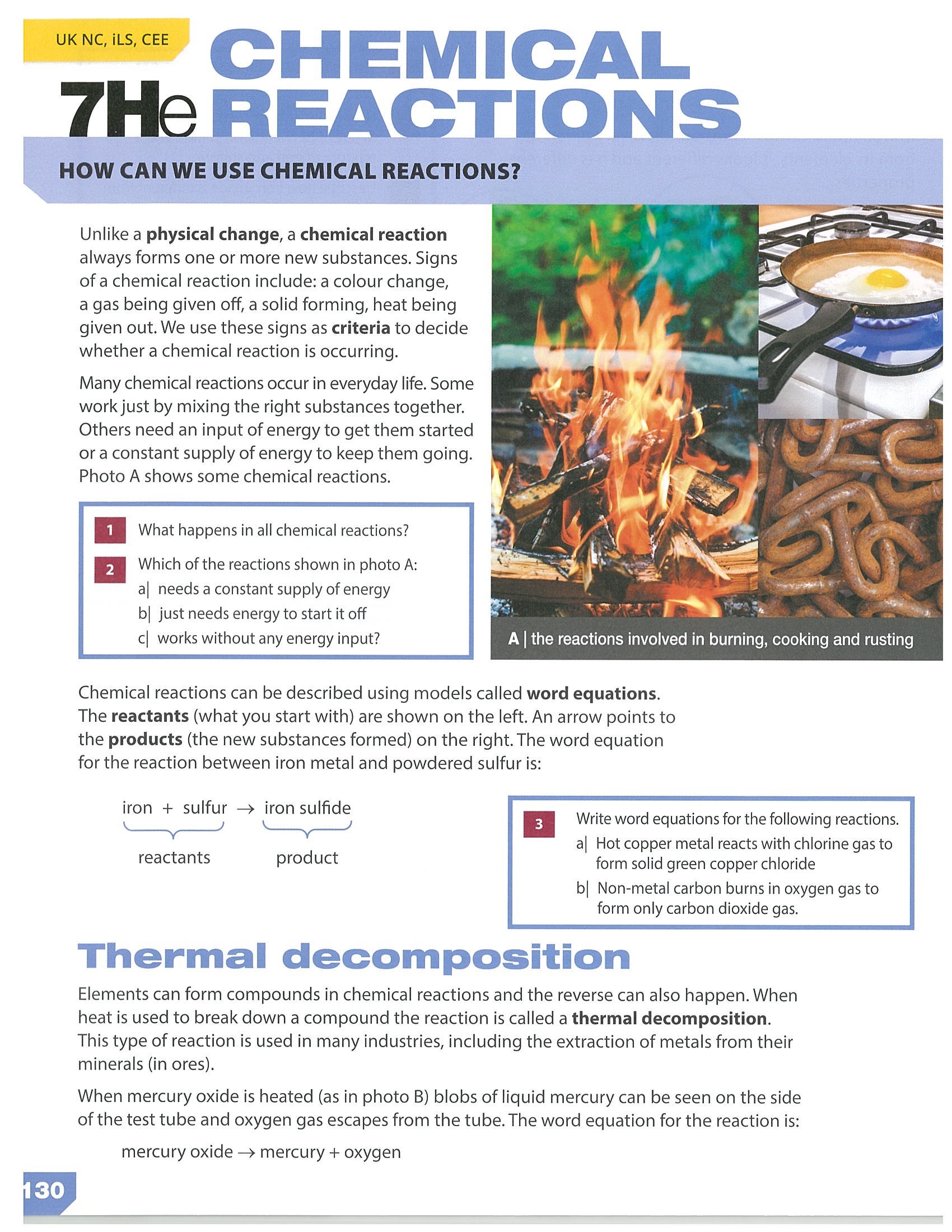
Chemical reactions make new substances with different properties and different uses.
化学反应会产生具有不同性质和不同用途的新物质。
For example, an alkali can react with fats to make soap.
例如,碱性溶液可以和脂肪反应生成肥皂。
Chemical reactions always make one or more new substances and they are often difficult to reverse.
化学反应总会产生一种或多种新物质,而且通常很难逆转。
Clay can be formed into pots.
黏土可以被制成罐子。
Melting gold to make jewellery.
熔化黄金来制作首饰。
Chemical reactions have been used to make soap for thousands of years.
人类已经使用化学反应制造肥皂几千年了。
An alkali, such as sodium hydroxide, is mixed with fat, and a reaction produces a new substance, soap.
一种碱性物质,例如氢氧化钠,与脂肪混合,反应会产生一种新物质,也就是肥皂。
What happens in all chemical reactions?
所有化学反应中都会发生什么?
State whether the following changes are chemical or physical.
判断下面这些变化是化学变化还是物理变化。
Boiling a kettle to make steam.
烧开水壶产生蒸汽。
Mixing sand and water.
混合沙子和水。
Frying an egg.
煎鸡蛋。
Iron railings rusting.
铁栏杆生锈。
Water freezing.
水结冰。
Explain why liquid gold can flow while solid gold cannot.
解释为什么液态金可以流动,而固态金不能流动。
Describe how you could obtain solid salt from sea water.
描述你如何从海水中获得固体盐。
📄 教材 p.118 · 7Ha Sorting Resource Data
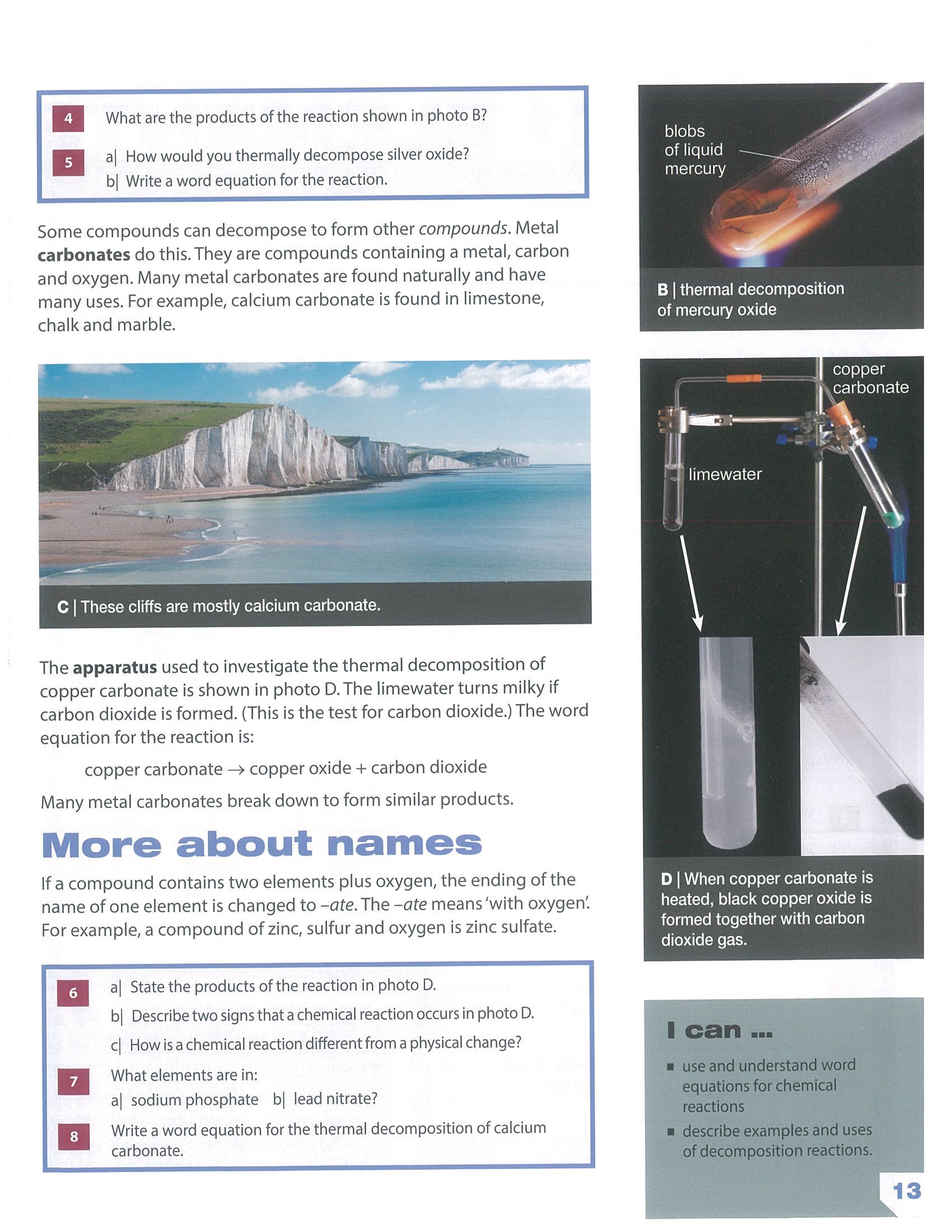
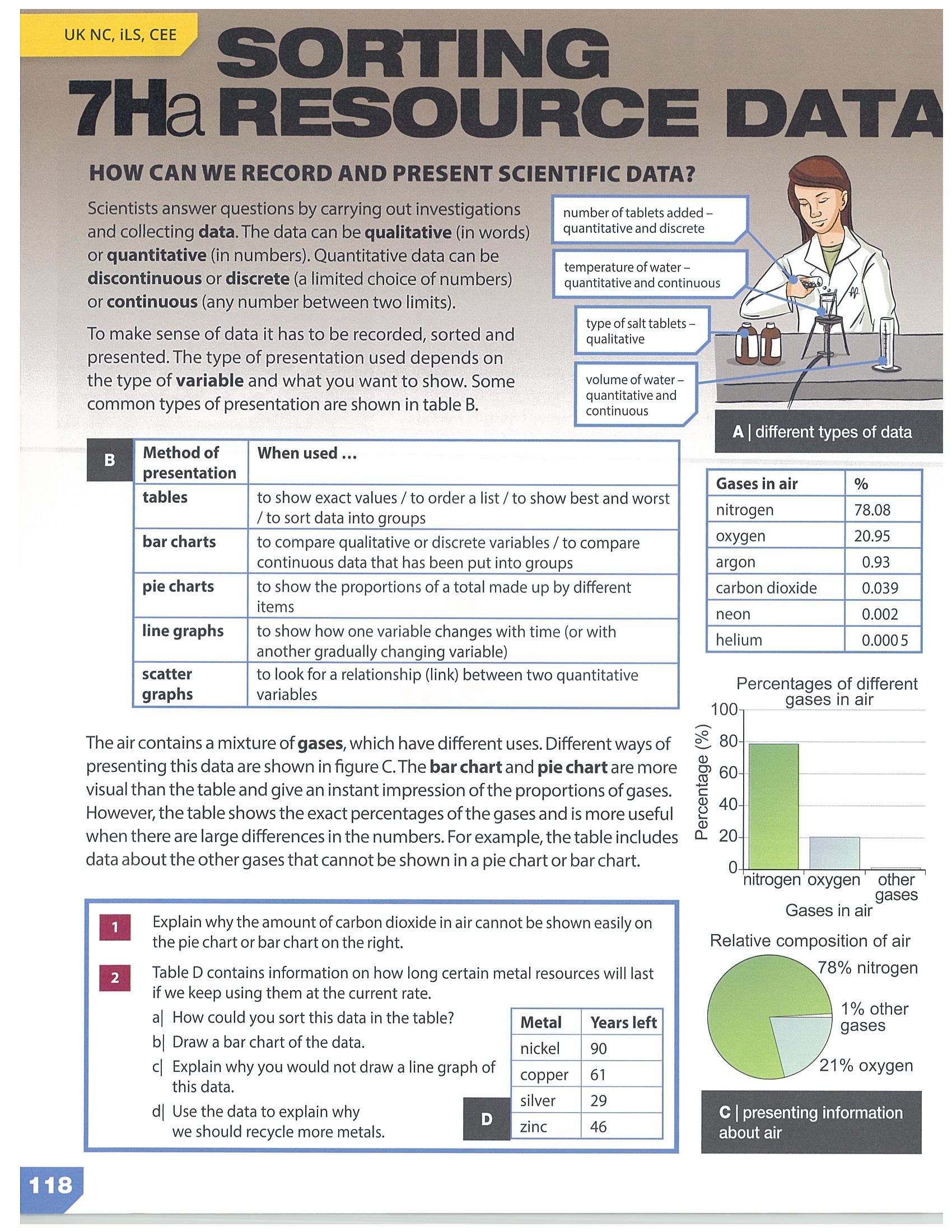
Scientists answer questions by carrying out investigations and collecting data.
科学家通过进行调查和收集数据来回答问题。
The data can be qualitative, in words, or quantitative, in numbers.
数据可以是定性的,也就是用文字表示;也可以是定量的,也就是用数字表示。
Quantitative data can be discontinuous or discrete, a limited choice of numbers, or continuous, any number between two limits.
定量数据可以是不连续或离散的,也就是只能从有限的数字中选择;也可以是连续的,也就是两个限制值之间的任意数字。
To make sense of data it has to be recorded, sorted and presented.
为了理解数据,必须记录、整理并呈现数据。
The type of presentation used depends on the type of variable and what you want to show.
使用哪种呈现方式取决于变量的类型,以及你想展示什么。
Some common types of presentation are shown in table B.
表 B 展示了一些常见的数据呈现方式。
Number of tablets added: quantitative and discrete.
加入药片的数量:定量且离散。
Temperature of water: quantitative and continuous.
水的温度:定量且连续。
Type of salt tablets: qualitative.
盐片的类型:定性。
Volume of water: quantitative and continuous.
水的体积:定量且连续。
Table B
表 B
Tables are used to show exact values, to order a list, to show best and worst, or to sort data into groups.
表格用于显示精确数值、给列表排序、显示最好和最差,或把数据分组。
Bar charts are used to compare qualitative or discrete variables, or to compare continuous data that has been put into groups.
条形图用于比较定性变量或离散变量,也可以比较已经分组的连续数据。
Pie charts are used to show the proportions of a total made up by different items.
饼图用于显示不同项目在整体中所占的比例。
Line graphs are used to show how one variable changes with time, or with another gradually changing variable.
折线图用于显示一个变量如何随时间变化,或如何随另一个逐渐变化的变量变化。
Scatter graphs are used to look for a relationship, or link, between two quantitative variables.
散点图用于寻找两个定量变量之间的关系或联系。
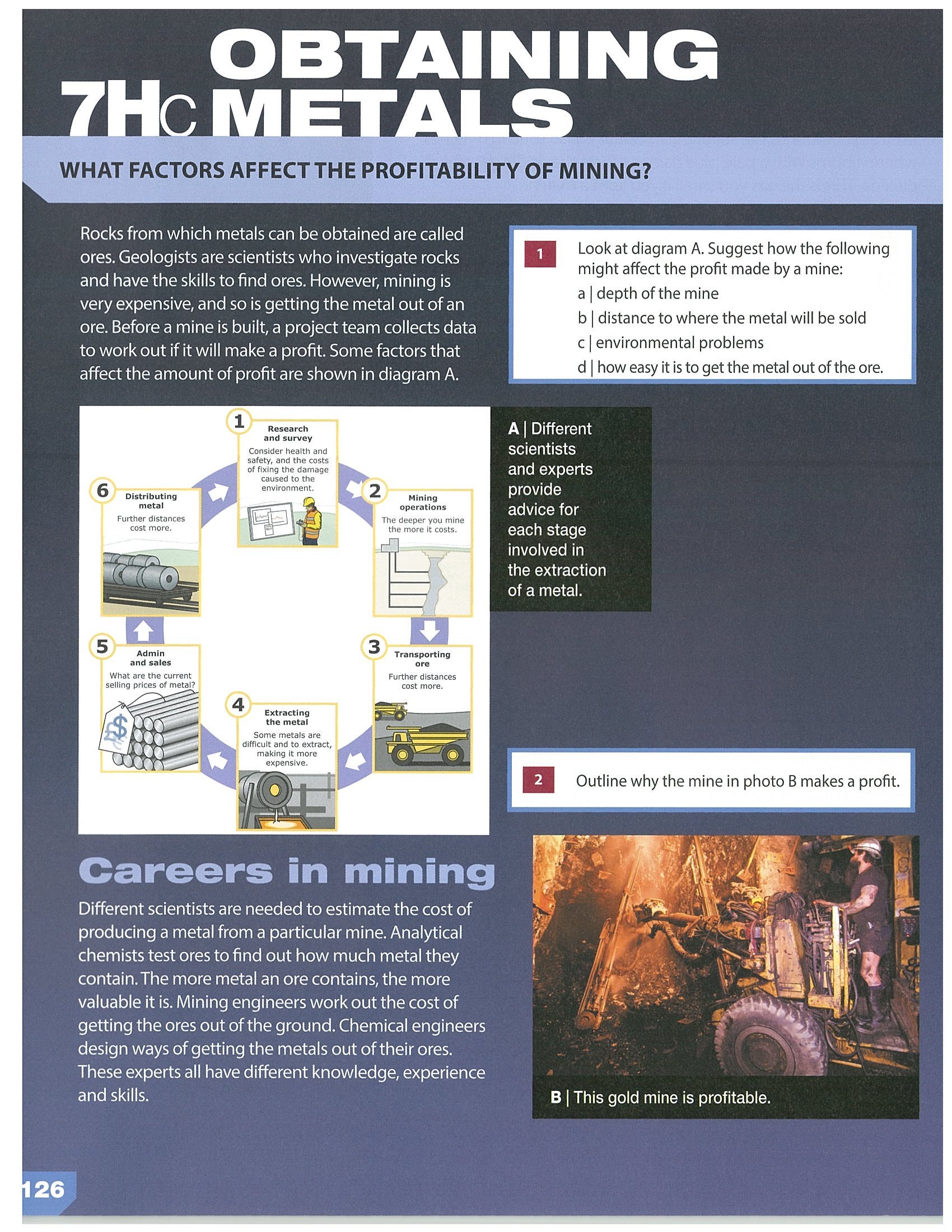
The air contains a mixture of gases, which have different uses.
空气含有多种气体的混合物,这些气体有不同用途。
Different ways of presenting this data are shown in figure C.
图 C 展示了呈现这些数据的不同方式。
The bar chart and pie chart are more visual than the table and give an instant impression of the proportions of gases.
条形图和饼图比表格更直观,可以让人立刻了解各种气体的比例。
However, the table shows the exact percentages of the gases and is more useful when there are large differences in the numbers.
不过,表格显示了各气体的准确百分比,当数字差异很大时更有用。
For example, the table includes data about the other gases that cannot be shown in a pie chart or bar chart.
例如,表格包含了其他气体的数据,而这些数据无法很好地显示在饼图或条形图中。
Explain why the amount of carbon dioxide in air cannot be shown easily on the pie chart or bar chart on the right.
解释为什么空气中二氧化碳的含量不容易显示在右边的饼图或条形图上。
Table D contains information on how long certain metal resources will last if we keep using them at the current rate.
表 D 包含一些金属资源在当前使用速度下还能维持多久的信息。
How could you sort this data in the table?
你可以怎样整理表格中的这些数据?
Draw a bar chart of the data.
根据这些数据画一个条形图。
Explain why you would not draw a line graph of this data.
解释为什么你不会用折线图来表示这些数据。
Use the data to explain why we should recycle more metals.
利用这些数据解释为什么我们应该回收更多金属。
Presenting information about air.
呈现关于空气的信息。
📄 教材 p.119 · Working Scientifically: Investigating Air
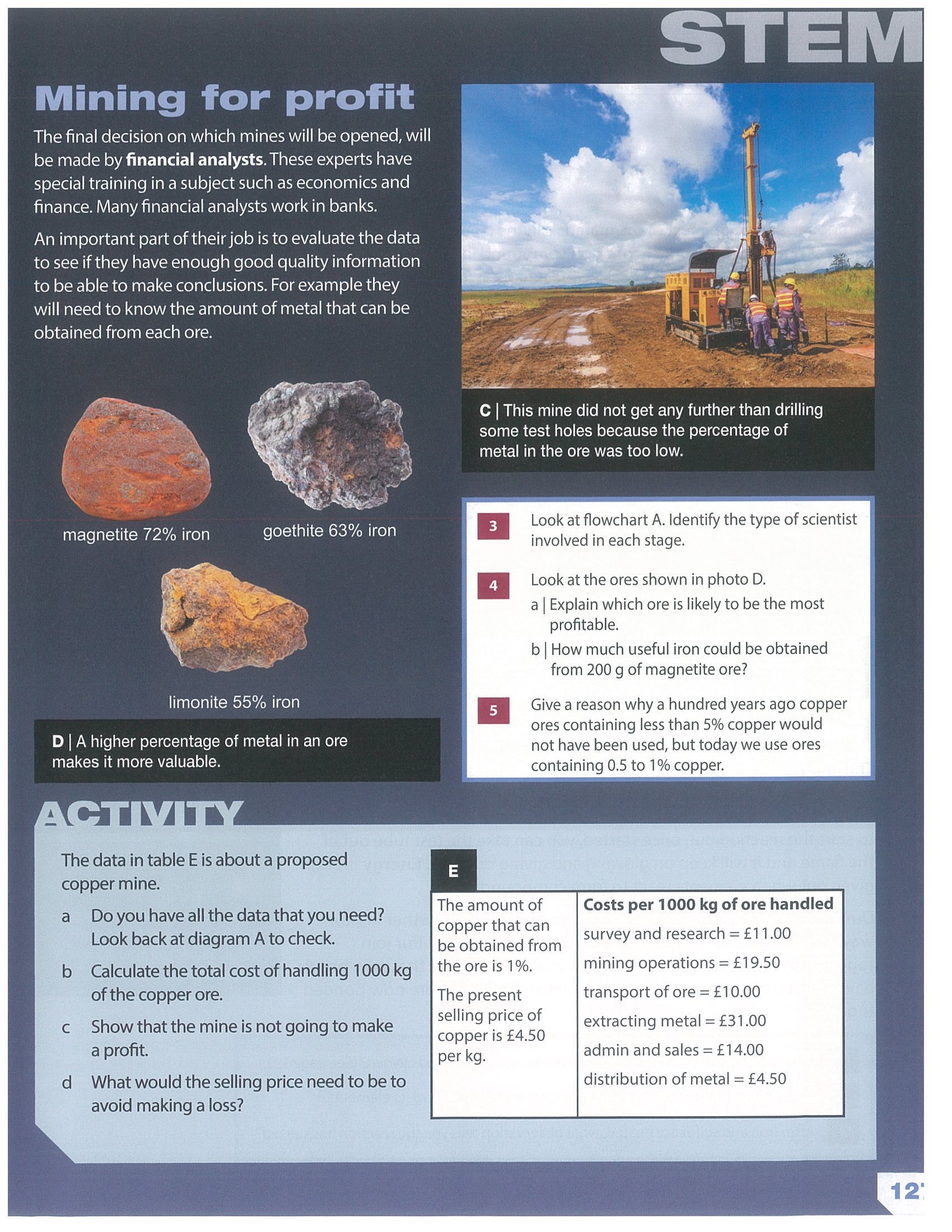
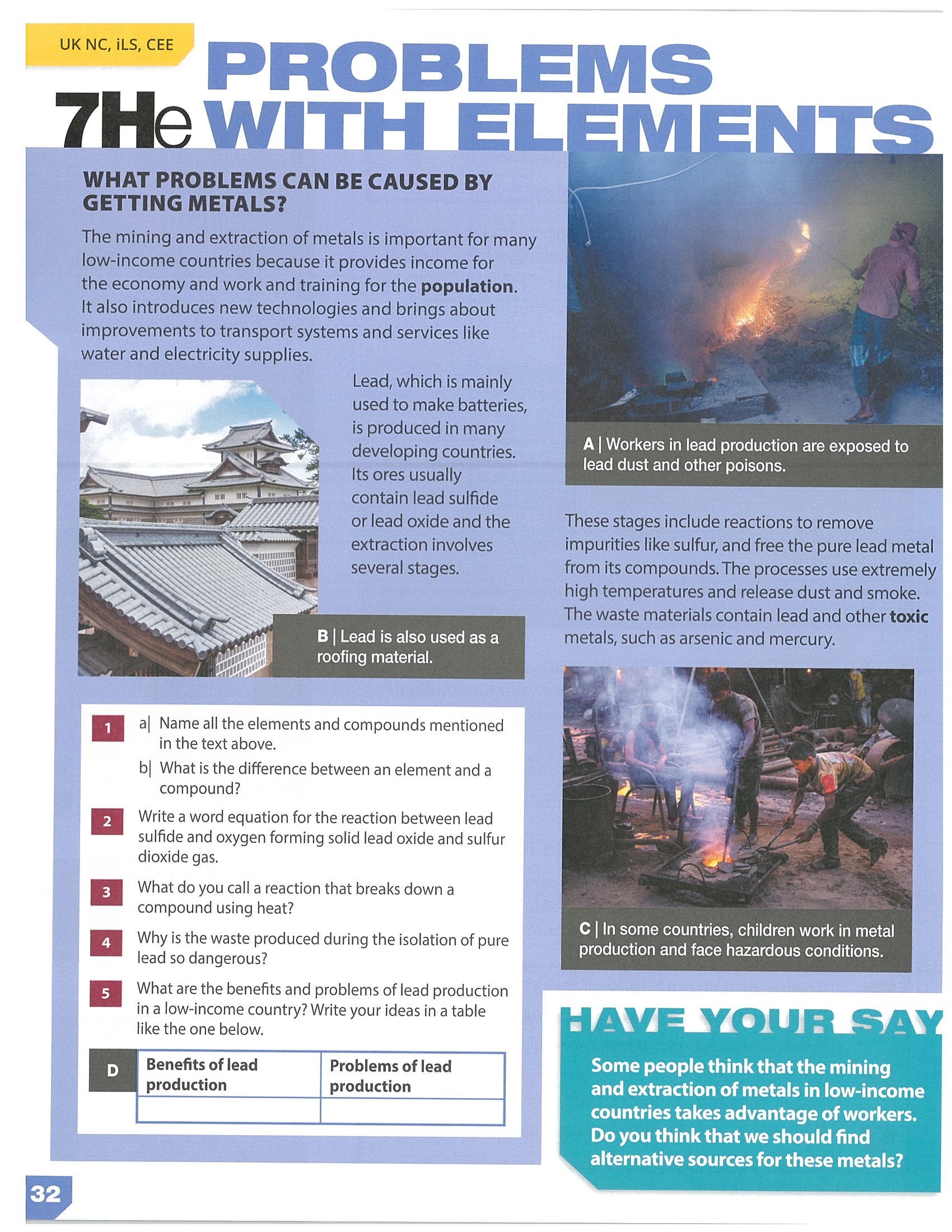
Candles use the oxygen in air when they burn and will go out when the oxygen is used up.
蜡烛燃烧时会使用空气中的氧气,当氧气用完时蜡烛会熄灭。
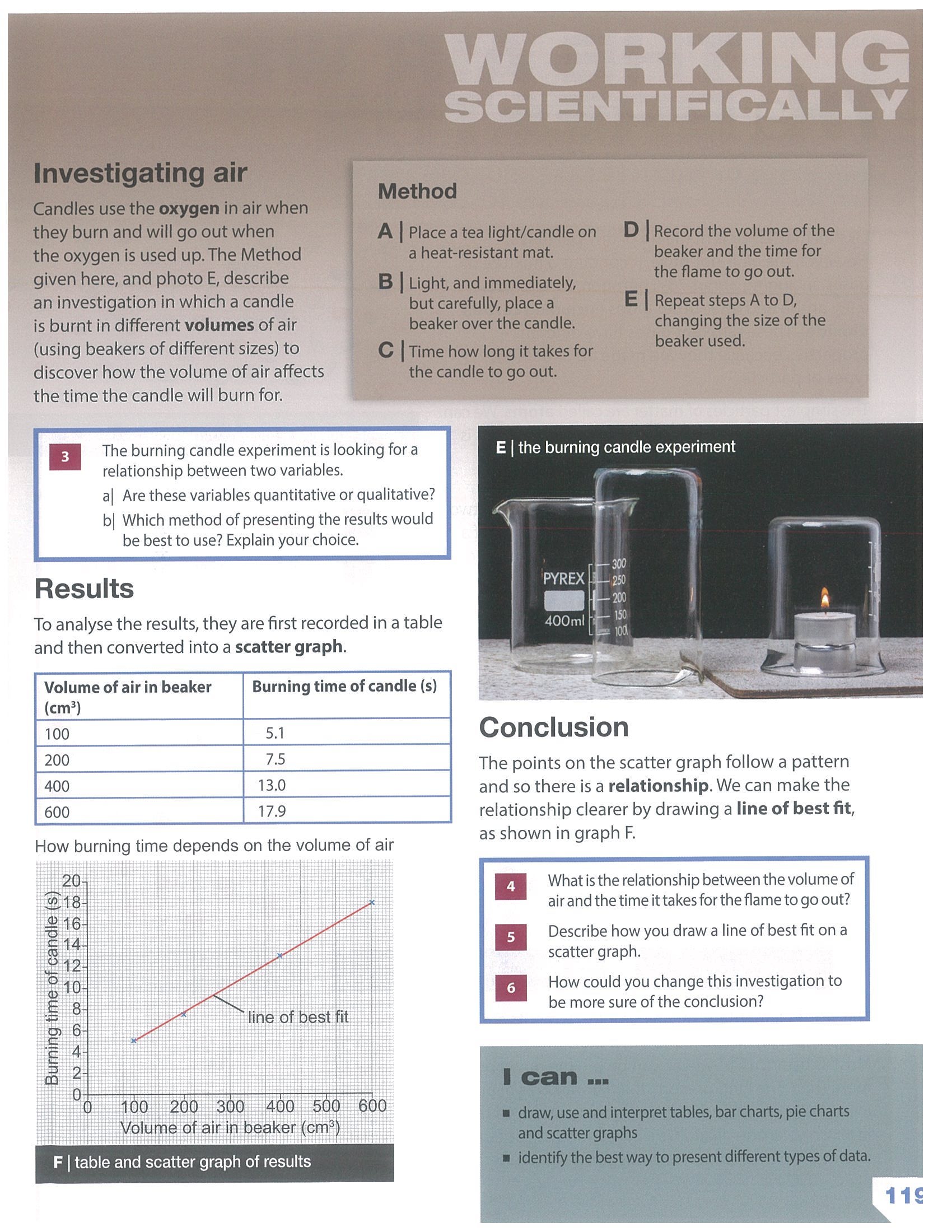
The method given here, and photo E, describe an investigation in which a candle is burnt in different volumes of air.
这里给出的方法和照片 E 描述了一个调查:让蜡烛在不同体积的空气中燃烧。
Beakers of different sizes are used to discover how the volume of air affects the time the candle will burn for.
使用不同大小的烧杯,是为了发现空气体积如何影响蜡烛燃烧的时间。
Method
方法
Place a tea light or candle on a heat-resistant mat.
把茶蜡或蜡烛放在耐热垫上。
Light it, and immediately, but carefully, place a beaker over the candle.
点燃它,然后立刻但小心地把一个烧杯罩在蜡烛上。
Time how long it takes for the candle to go out.
测量蜡烛熄灭需要多长时间。
Record the volume of the beaker and the time for the flame to go out.
记录烧杯的体积和火焰熄灭所需的时间。
Repeat the steps, changing the size of the beaker used.
改变所用烧杯的大小,重复这些步骤。
The burning candle experiment.
燃烧蜡烛实验。
The burning candle experiment is looking for a relationship between two variables.
燃烧蜡烛实验是在寻找两个变量之间的关系。
Are these variables quantitative or qualitative?
这些变量是定量的还是定性的?
Which method of presenting the results would be best to use?
用哪种方式呈现实验结果最好?
Explain your choice.
解释你的选择。
Results
结果
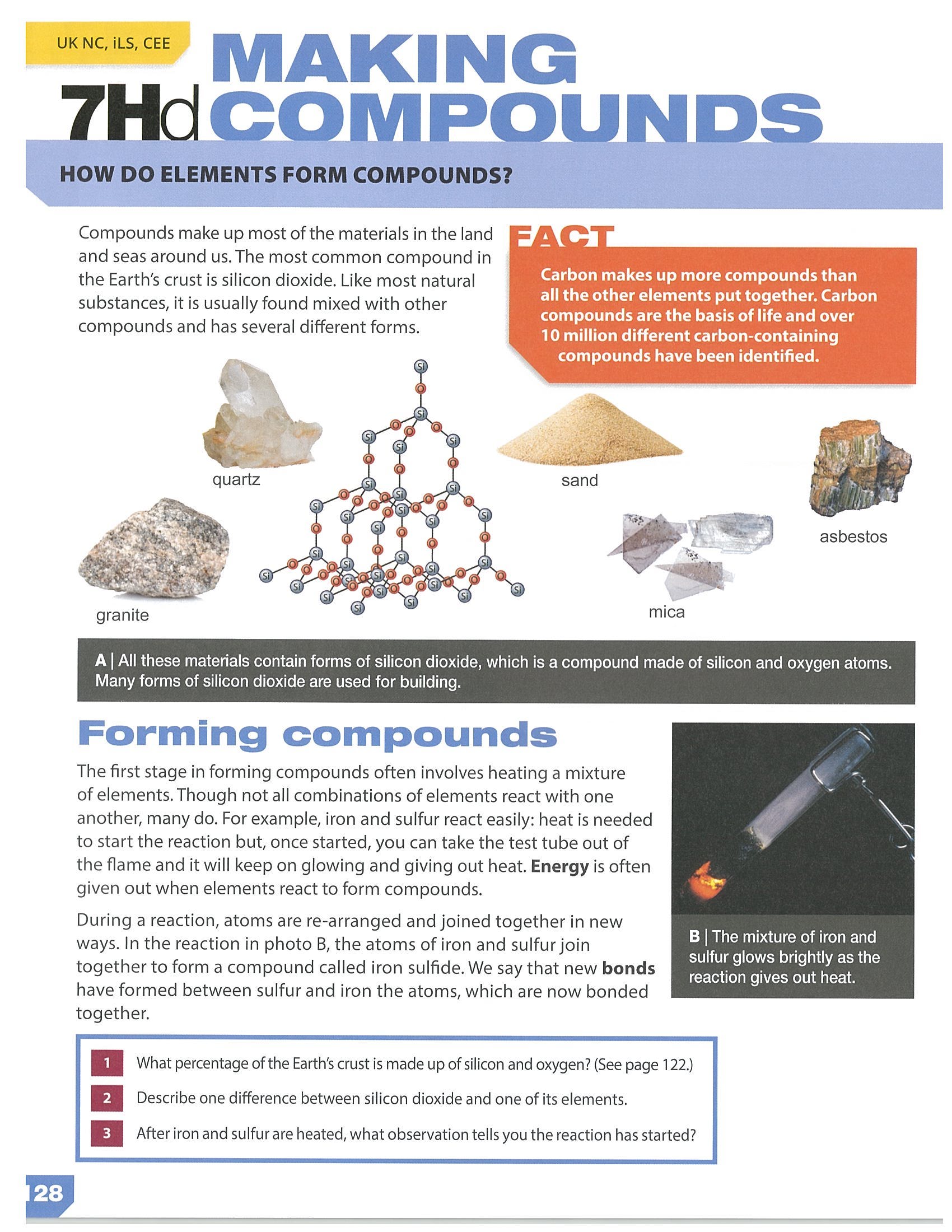
To analyse the results, they are first recorded in a table and then converted into a scatter graph.
为了分析结果,先把结果记录在表格中,然后转换成散点图。
Volume of air in beaker: 100 cm3. Burning time of candle: 5.1 s.
烧杯中空气体积:100 cm3。蜡烛燃烧时间:5.1 秒。
Volume of air in beaker: 200 cm3. Burning time of candle: 7.5 s.
烧杯中空气体积:200 cm3。蜡烛燃烧时间:7.5 秒。
Volume of air in beaker: 400 cm3. Burning time of candle: 13.0 s.
烧杯中空气体积:400 cm3。蜡烛燃烧时间:13.0 秒。
Volume of air in beaker: 600 cm3. Burning time of candle: 17.9 s.
烧杯中空气体积:600 cm3。蜡烛燃烧时间:17.9 秒。
Conclusion
结论
The points on the scatter graph follow a pattern and so there is a relationship.
散点图上的点呈现出一种规律,因此存在关系。
We can make the relationship clearer by drawing a line of best fit, as shown in graph F.
我们可以画一条最佳拟合线,让这种关系更清楚,如图 F 所示。
What is the relationship between the volume of air and the time it takes for the flame to go out?
空气体积和火焰熄灭所需时间之间有什么关系?
Describe how you draw a line of best fit on a scatter graph.
描述如何在散点图上画一条最佳拟合线。
How could you change this investigation to be more sure of the conclusion?
你可以怎样改变这个调查,使结论更可靠?
I can…
我能……
I can draw, use and interpret tables, bar charts, pie charts and scatter graphs.
我能绘制、使用并解释表格、条形图、饼图和散点图。
I can identify the best way to present different types of data.
我能识别呈现不同类型数据的最佳方式。
📄 教材 p.120 · 7Ha The Air We Breathe
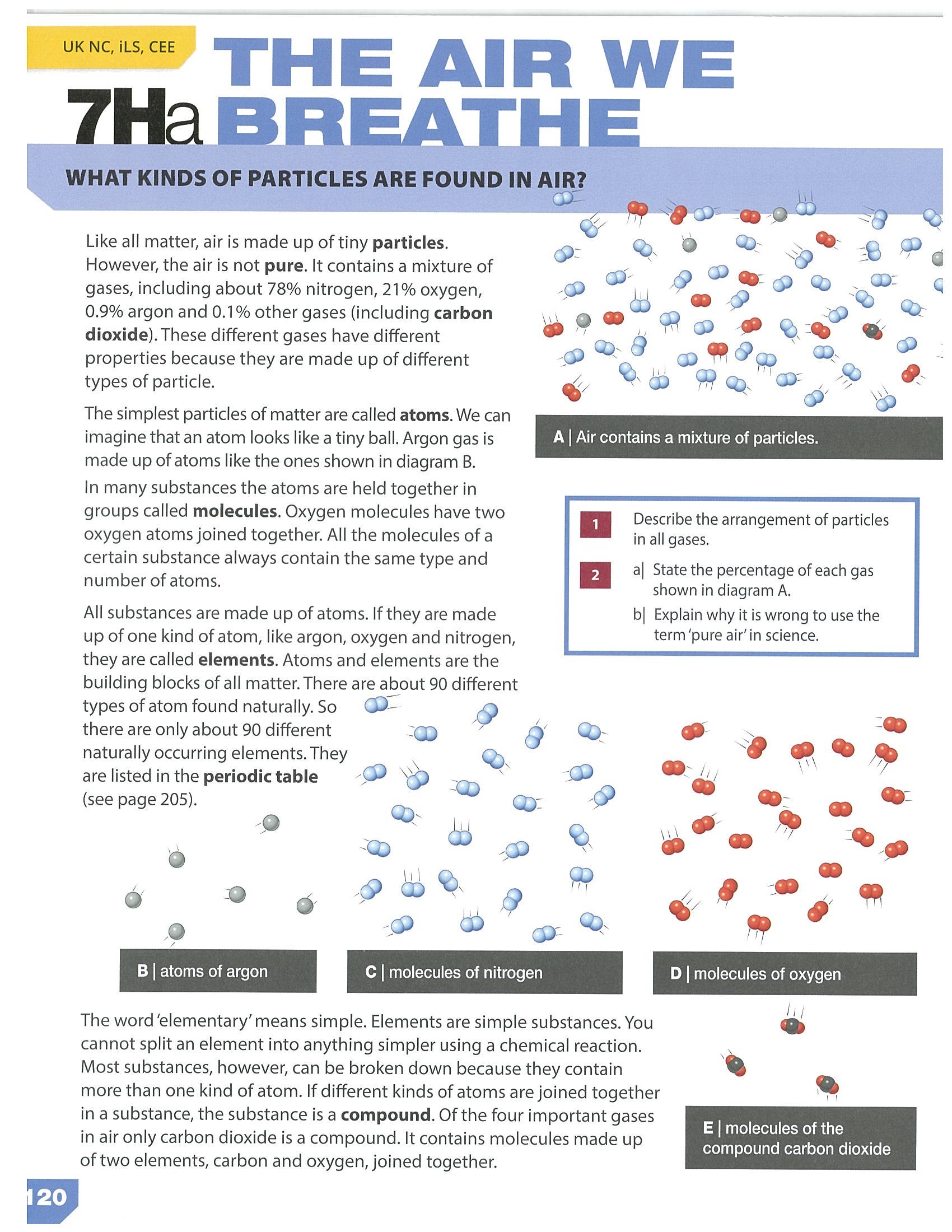
Like all matter, air is made up of tiny particles.
像所有物质一样,空气由微小粒子组成。
However, the air is not pure.
然而,空气并不是纯净物。
It contains a mixture of gases, including about 78% nitrogen, 21% oxygen, 0.9% argon and 0.1% other gases, including carbon dioxide.
它含有多种气体的混合物,包括约 78% 的氮气、21% 的氧气、0.9% 的氩气和 0.1% 的其他气体,其中包括二氧化碳。
These different gases have different properties because they are made up of different types of particle.
这些不同气体具有不同性质,因为它们由不同类型的粒子组成。
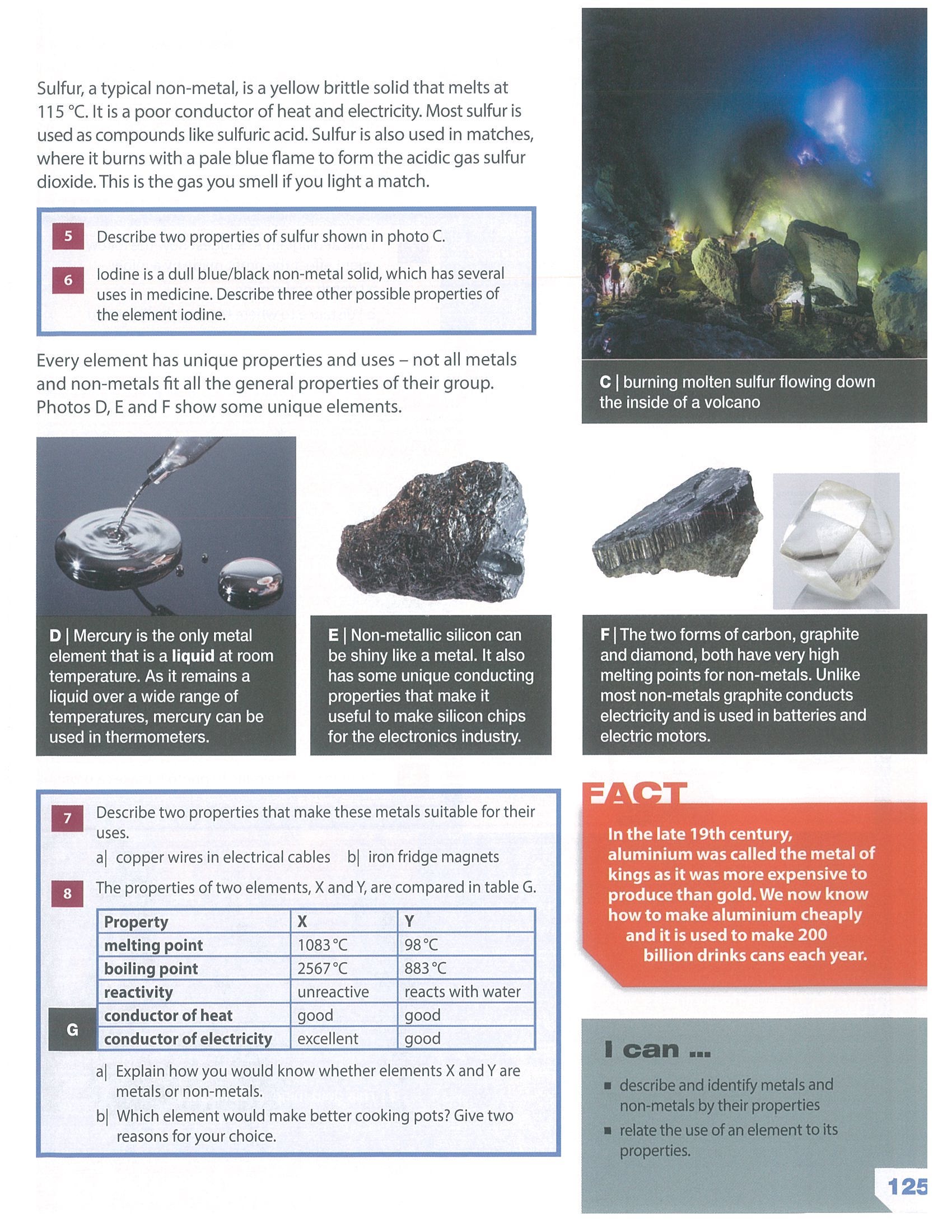
Air contains a mixture of particles.
空气含有多种粒子的混合物。
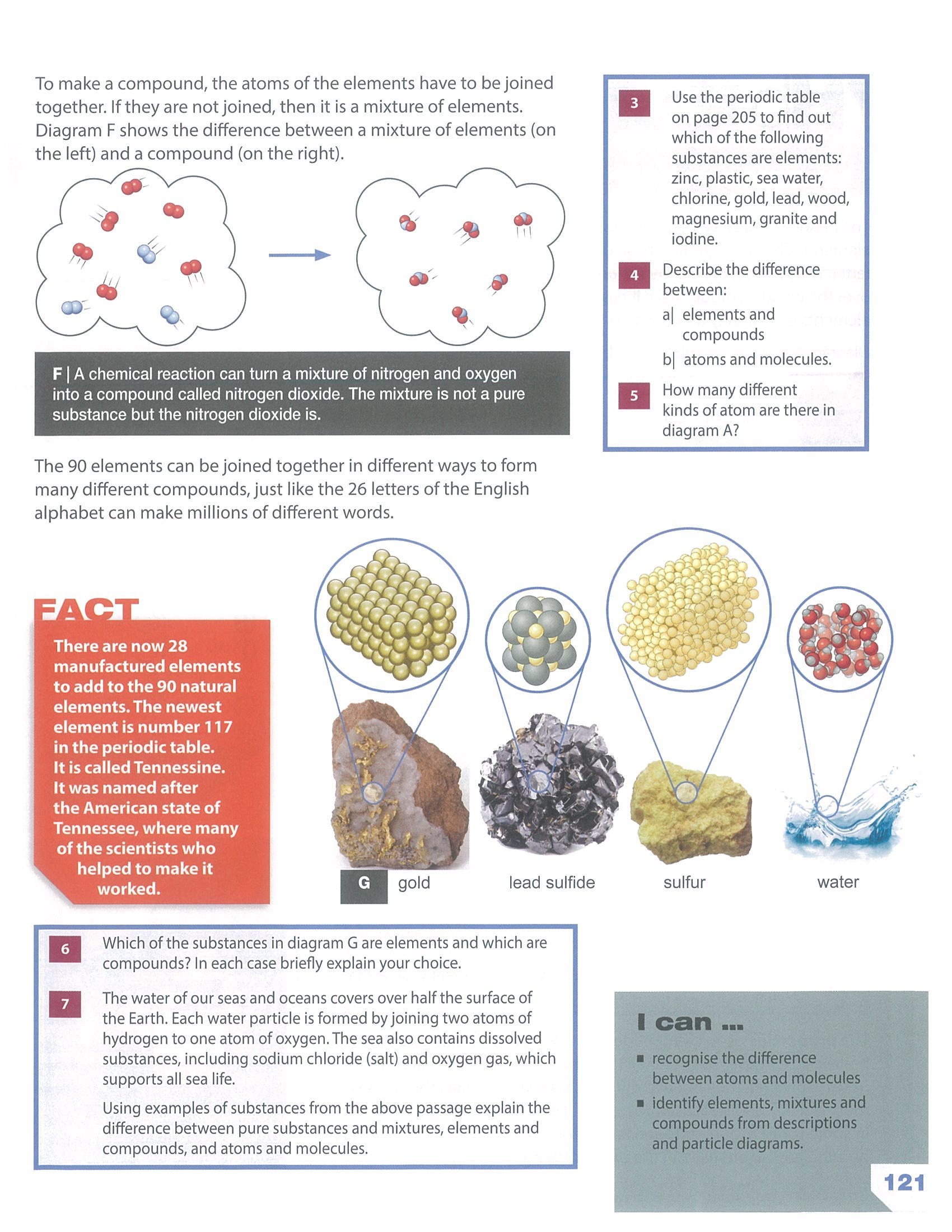
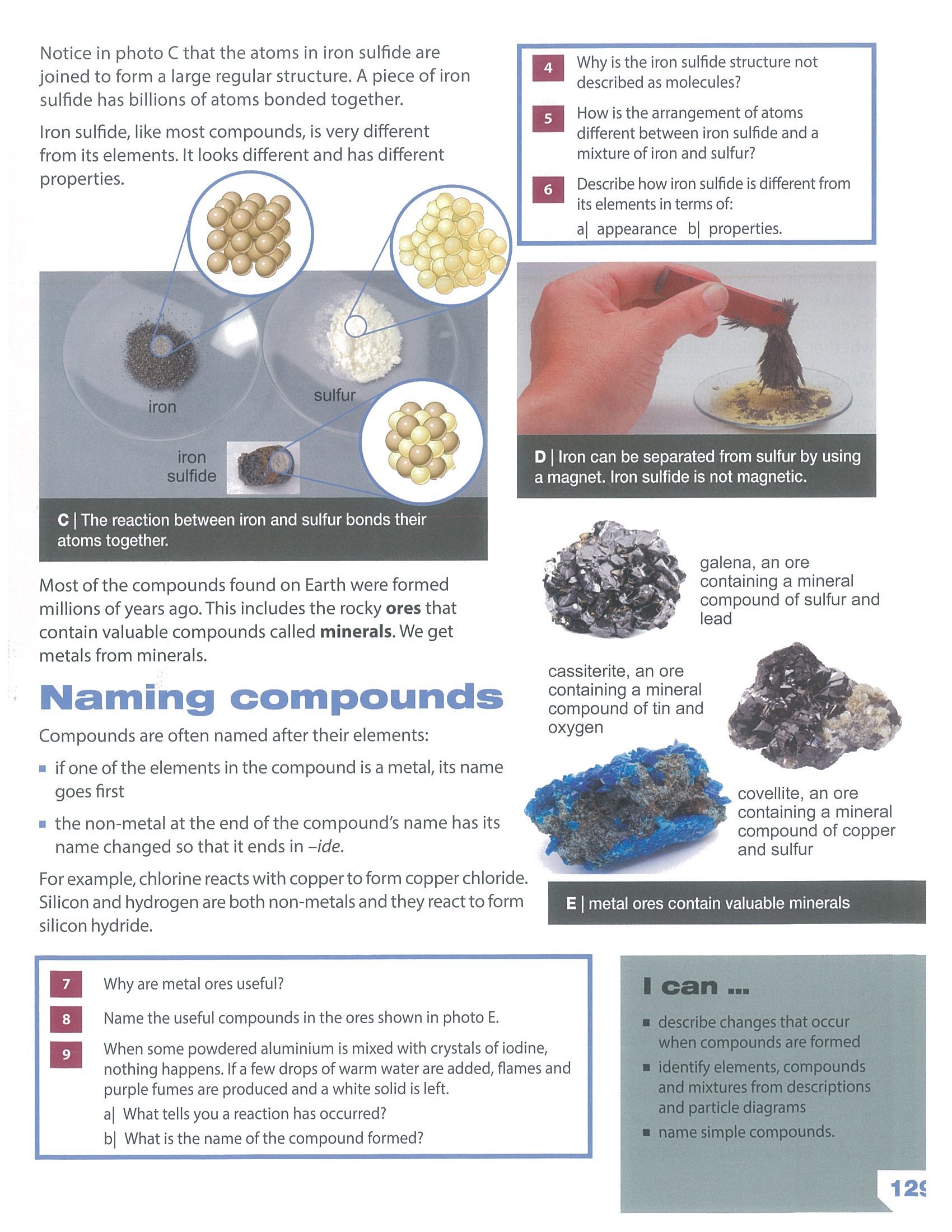
The simplest particles of matter are called atoms.
最简单的物质粒子叫作原子。
We can imagine that an atom looks like a tiny ball.
我们可以想象原子看起来像一个小球。
Argon gas is made up of atoms like the ones shown in diagram B.
氩气由像图 B 中所示那样的原子组成。
In many substances the atoms are held together in groups called molecules.
在许多物质中,原子会以一组一组的形式结合在一起,这些组叫作分子。
Oxygen molecules have two oxygen atoms joined together.
氧分子由两个连接在一起的氧原子组成。
All the molecules of a certain substance always contain the same type and number of atoms.
某种物质的所有分子总是含有相同类型和相同数量的原子。
Describe the arrangement of particles in all gases.
描述所有气体中粒子的排列方式。
State the percentage of each gas shown in diagram A.
说出图 A 中每种气体的百分比。
Explain why it is wrong to use the term "pure air" in science.
解释为什么在科学中使用“纯净空气”这个说法是不正确的。
All substances are made up of atoms.
所有物质都是由原子组成的。
If they are made up of one kind of atom, like argon, oxygen and nitrogen, they are called elements.
如果它们由一种原子组成,例如氩、氧和氮,它们就叫作元素。
Atoms and elements are the building blocks of all matter.
原子和元素是所有物质的基本组成部分。
There are about 90 different types of atom found naturally.
自然界中大约有 90 种不同类型的原子。
So there are only about 90 different naturally occurring elements.
因此,自然存在的元素只有大约 90 种。
They are listed in the periodic table.
它们被列在元素周期表中。
Atoms of argon.
氩原子。
Molecules of nitrogen.
氮分子。
Molecules of oxygen.
氧分子。
Molecules of the compound carbon dioxide.
化合物二氧化碳的分子。
The word "elementary" means simple.
“elementary” 这个词的意思是简单的、基础的。
Elements are simple substances.
元素是简单物质。
You cannot split an element into anything simpler using a chemical reaction.
你不能用化学反应把元素分解成更简单的东西。
Most substances, however, can be broken down because they contain more than one kind of atom.
然而,大多数物质可以被分解,因为它们含有不止一种原子。
If different kinds of atoms are joined together in a substance, the substance is a compound.
如果一种物质中连接着不同种类的原子,这种物质就是化合物。
Of the four important gases in air only carbon dioxide is a compound.
在空气中的四种重要气体中,只有二氧化碳是化合物。
It contains molecules made up of two elements, carbon and oxygen, joined together.
它含有由两种元素连接而成的分子,这两种元素是碳和氧。
💡 7Ha 物质世界 / 原子 / 空气核心英文术语 · 含音标 / 词性 / 词源 / 教材原句 / 现代延伸 / 易错。
⚛️ 原子结构
atom
/ˈætəm/
n.
原子
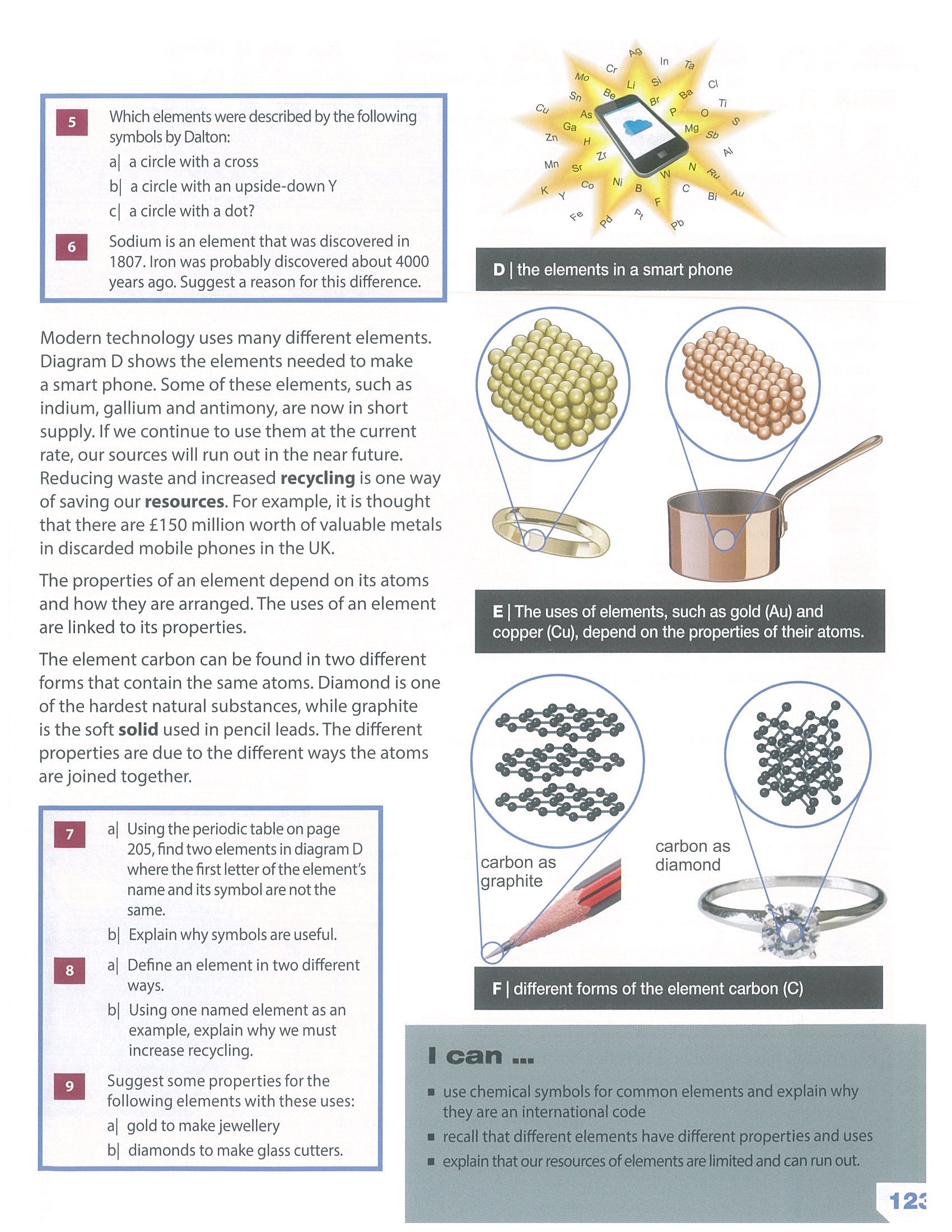
拆词希腊 a-(不)+ tomos(切)= "不可切分"。古希腊人 Democritus 以为原子是最小颗粒(虽然后来发现还能再分成 proton/neutron/electron)。
教材"All substances are made of atoms."(所有物质都由原子构成)
延伸① atomic bomb 原子弹 ② atomic energy 原子能 ③ atomic clock 原子钟(极精确)
atom vs molecule:atom 是单个原子(H, O, C),molecule 是几个原子捆在一起(H₂O, O₂)。一个 H₂O 分子里有 3 个原子(2 H + 1 O)。
nucleus
/ˈnjuːkliəs/
n.
原子核
词源拉丁 nucleus = "果核、核心"(如核桃的核)→ 原子中心
教材原子由中心 nucleus(含 protons + neutrons)+ 外层 electrons(绕核运动)组成
延伸① 生物 cell nucleus 细胞核(同根,"核心") ② 复数 nuclei /ˈnjuːkliaɪ/ ③ nuclear adj. 核的(核能 nuclear energy)
proton / neutron / electron
/ˈproʊtɒn/ /ˈnjuːtrɒn/ /ɪˈlektrɒn/
n.
质子 / 中子 / 电子
拆词proton = "first"(希腊 protos 第一)/ neutron = "neutral 中性的"(不带电)/ electron 来自 electrum(希腊"琥珀",古希腊人摩擦琥珀发现静电 → 这就是"电"这个词的起源!)
带电proton + 正电 / neutron 0 不带电 / electron − 负电
位置proton + neutron 在原子核内;electron 在核外绕着转
记忆口诀"正质中中负电外"(正电的是质子、不带电的是中子、负电的电子在外)。考试常画原子结构图。
🌍 物质 + 空气
substance
/ˈsʌbstəns/
n.
物质
词源拉丁 sub-(在下)+ stare(站立)= "在下面站着的东西" → 万物的基础
教材"A substance is a type of matter with the same properties throughout."
延伸① chemical substance 化学物质 ② 日常 style without substance 中看不中用 ③ substance abuse 物质滥用(指毒品)
mixture
/ˈmɪkstʃər/
n.
混合物
词源拉丁 miscere(混合)+ -ure(结果)= "混合产生的东西"
教材"Air is a mixture of gases — mainly nitrogen and oxygen."(空气是混合气体)
例子① air 空气 ② sea water 海水(水+盐物理混合)③ sand and salt 沙和盐
mixture vs compound:mixture 比例可变、可用物理方法分离(蒸发、过滤、磁铁);compound 比例固定、只能用化学反应拆开。
nitrogen / oxygen / argon
/ˈnaɪtrədʒən/ /ˈɒksɪdʒən/ /ˈɑːrɡɒn/
n.
氮 / 氧 / 氩
词源nitrogen = "nitre 硝石 + gen 生成" → 生成硝酸盐的气体 / oxygen = "oxy 酸 + gen 生成"(曾以为是产生酸的气体)/ argon = 希腊"argos 懒惰的"(惰性气体不反应)
空气比例N₂ ≈ 78 % / O₂ ≈ 21 % / Ar ≈ 1 % + 少量 CO₂、水汽(必考!)
延伸① nitrogen fertilizer 氮肥 ② liquid nitrogen 液氮(−196 °C) ③ argon 用在灯泡里防氧化
property
/ˈprɒpərti/
n.
性质、属性
词源拉丁 proprius(自己的)→ "属于某物自身的特征"
教材"Different materials have different properties."(不同材料有不同性质)
延伸① 化学 physical properties(颜色 / 熔点 / 密度)vs chemical properties(反应性)② 日常 property = 房产("属于你的东西")