🚪 学习前导 · 先看这里再开始
🎯 学完你能干什么
- 能区分 solution / suspension / colloid 三种混合物并各举一例
- 能在过滤装置图上标出 residue(残渣)和 filtrate(滤液)
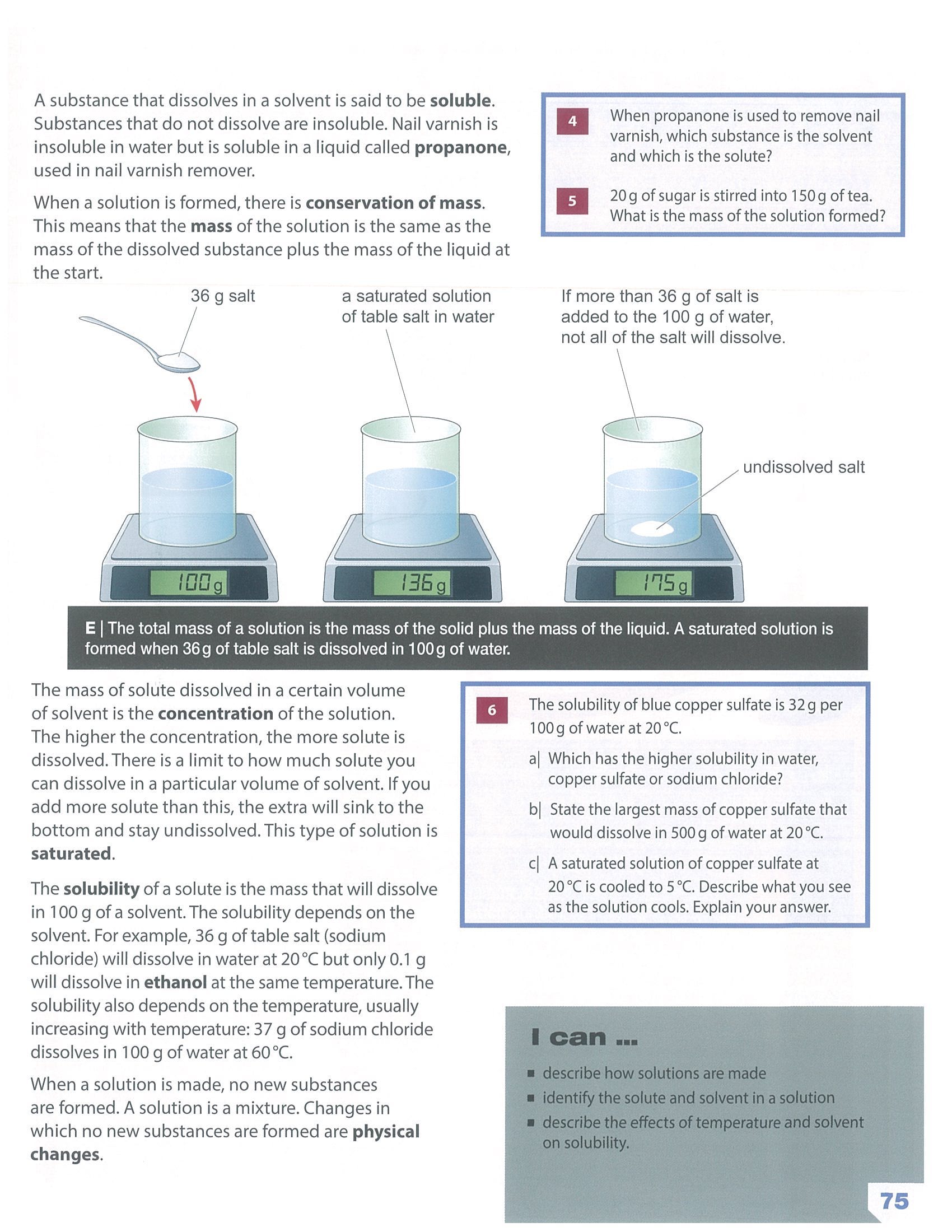
- 能解释 solubility 与温度、溶剂的关系,并算简单的溶质质量
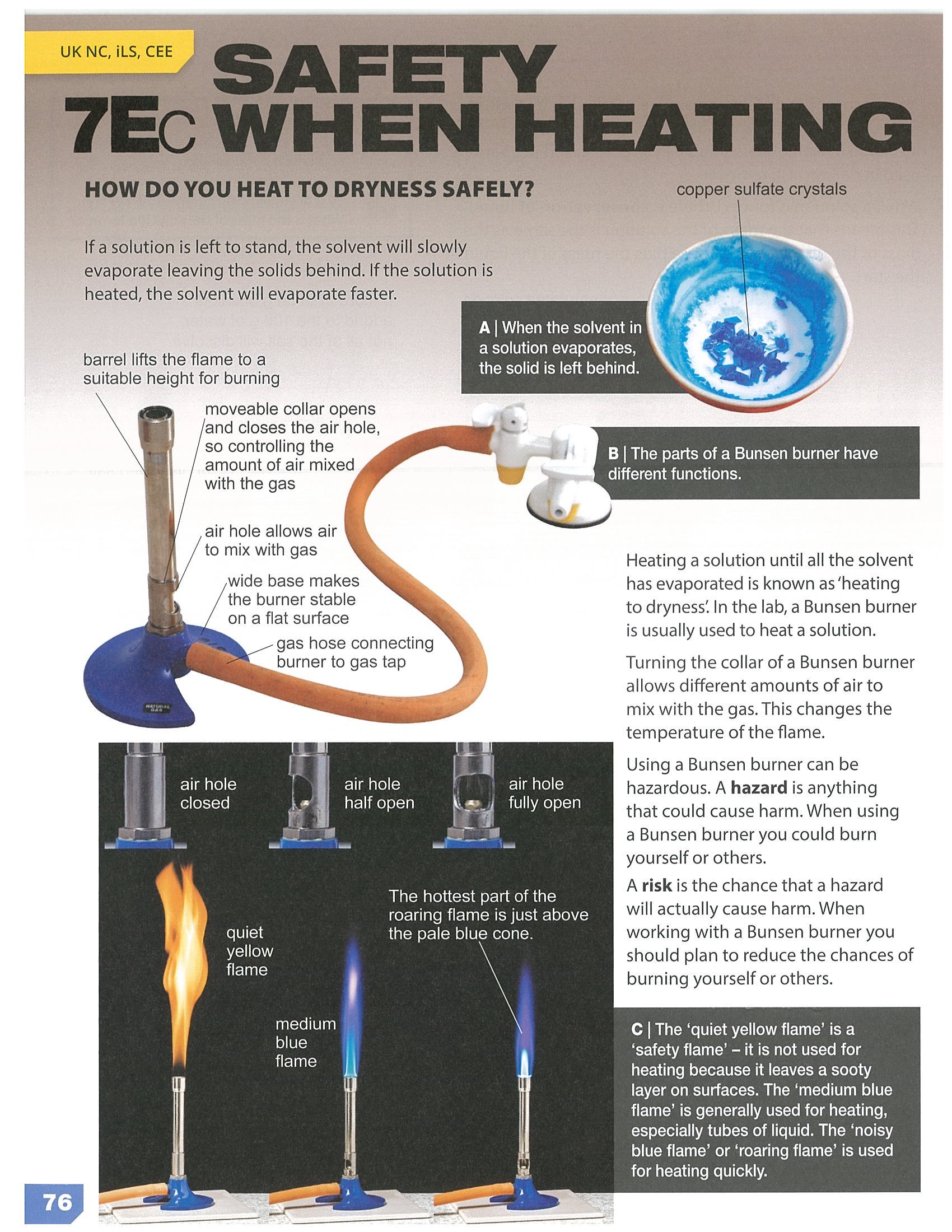
- 能区分 hazard 危险源 与 risk 风险,并安全使用 Bunsen burner
- 能解释 evaporation 与 boiling 的区别(表面 vs 全液体)
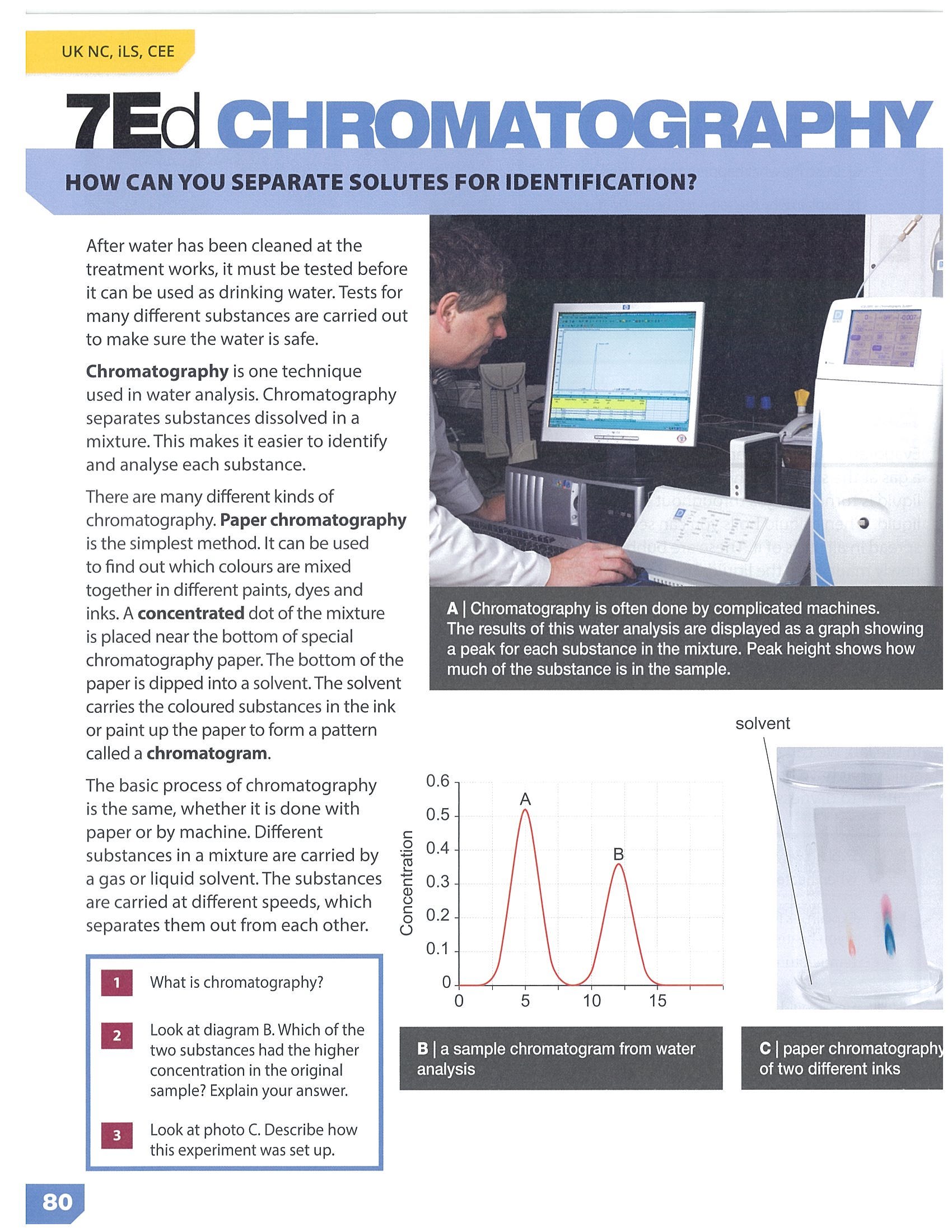
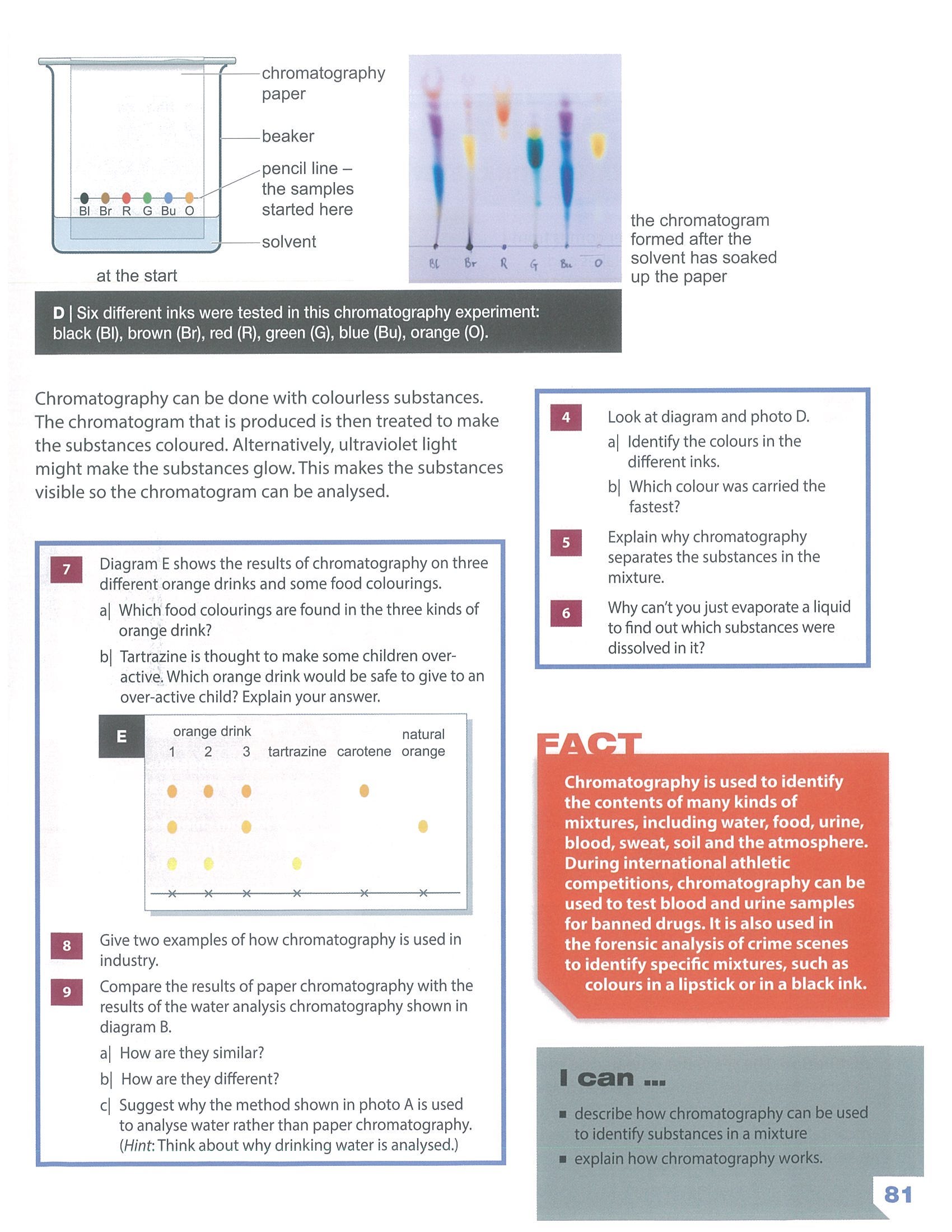
- 能用 chromatography 判断混合物含哪些颜色 / 哪种跑得最快
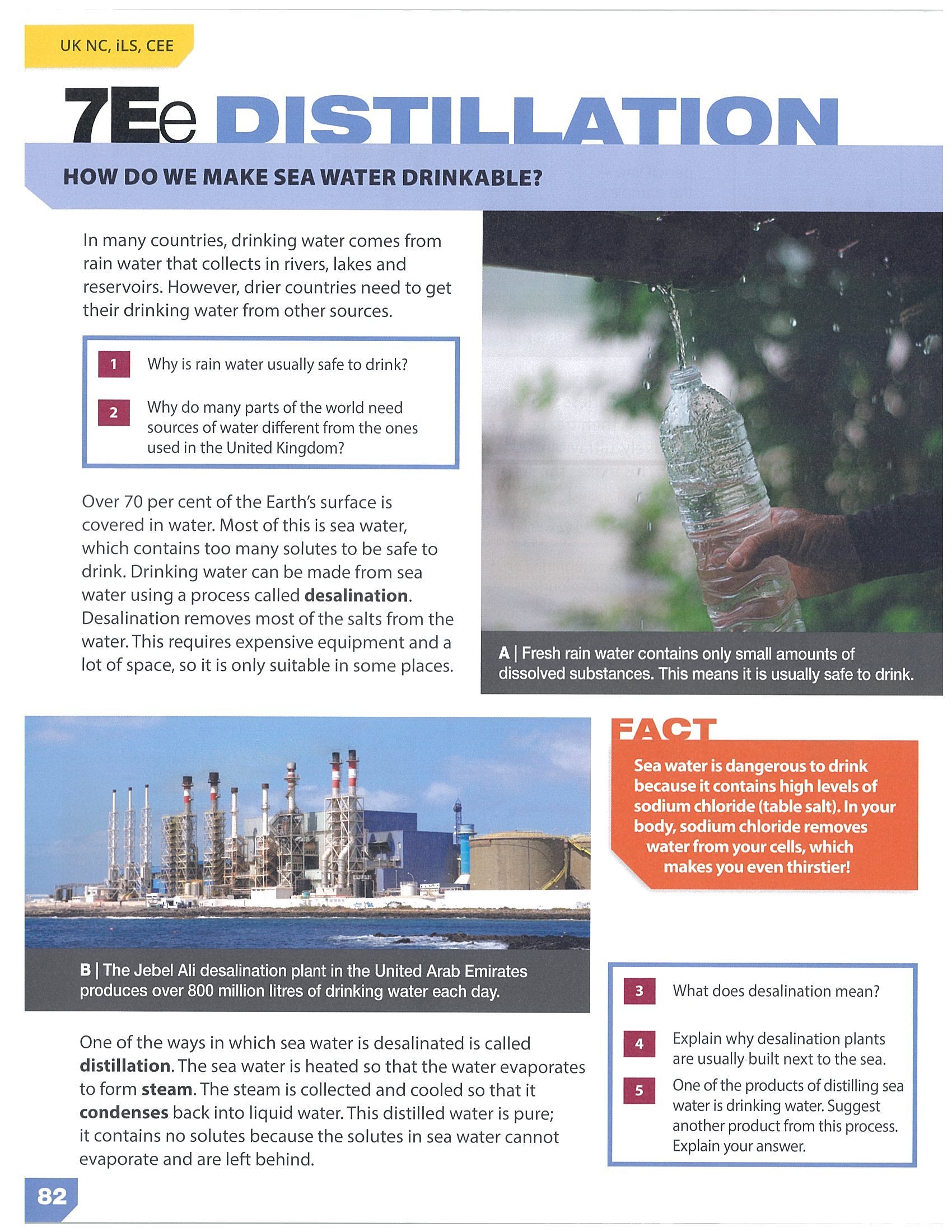
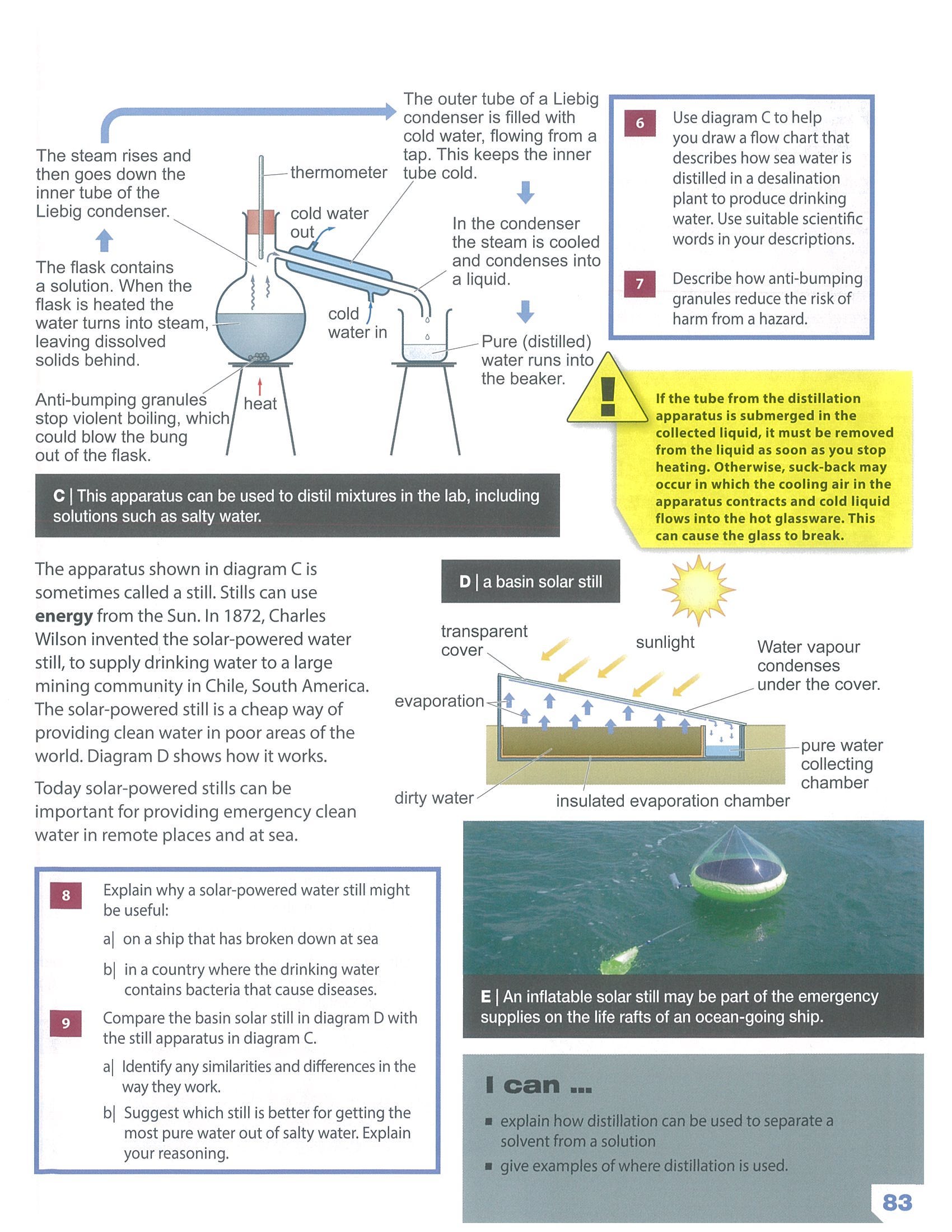
- 能画并解释蒸馏装置如何把 sea water 变成 pure water(desalination)
🛣️ 推荐学习路径
- 通读教材 16 页(不查词,速读 30 分钟)
- 跟读本视图:左边看教材图,右边看笔记(约 2.5 小时)
- 做 Workbook 7E 全部题目(约 1.5 小时)
- 专项训练:拼写卡 + 蒸馏装置标注 + 答题规范(30 分钟)
- 挑战分级练习 L1→L2→L3(约 1 小时)
- 查漏错题本 + 自检清单(考前 30 分钟)
⚠️ 老师常考
- 必考 mixture 分类(solution / suspension / colloid)+ 各自例子
- 必考 蒸馏装置图标注(flask / condenser / 冷水进出方向)
- 必考 hazard vs risk 区分 + Bunsen burner 三种火焰
- 高频 conservation of mass:20g 糖 + 150g 茶 = 170g
- 高频 色谱图分析:哪种颜色跑得最快、含 tartrazine 哪种饮料不安全
- 高频 evaporation vs boiling 差别(表面/全体;任意温度/在沸点)
- 高频 Method 写法(命令词开头、分步、一句一动作)—— WS 必考
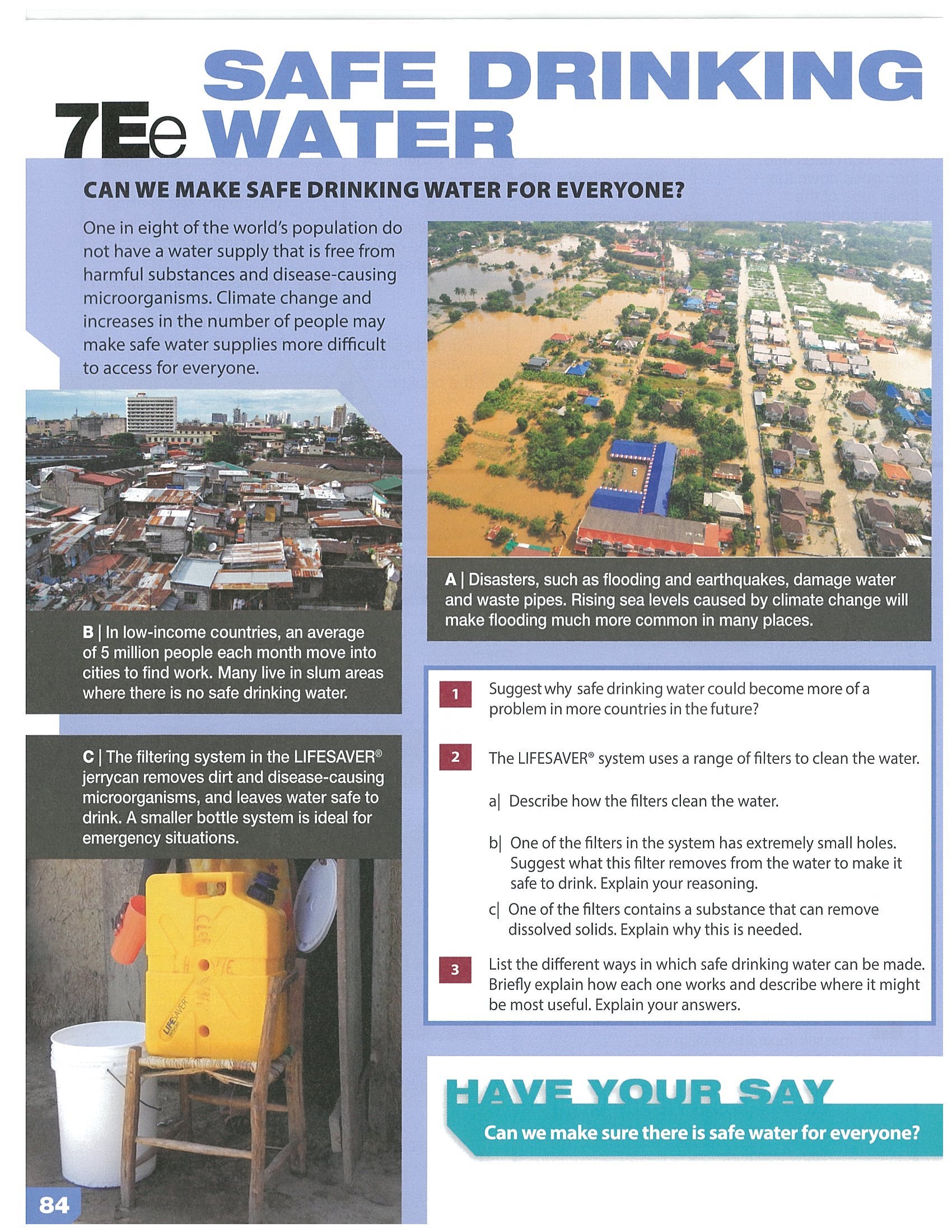
- 拓展 STEM:forensic science、LIFESAVER、solar still、desalination plant
🧭 前置回顾(来自 7A、7B)
- scientific method 6 阶段(7B)—— 设计 7E 分离实验时还要用
- independent / dependent variable(7B/7D)—— 写 Method 时要明确
- state of matter 固液气(小学常识)—— mixture 分类的基础
- physical change vs chemical change—— solution 是物理变化(无新物质生成)
- command words(7C 答题规范)—— Method 用 command word 开头
📖 教材跟读 · 左图右注
📄 教材 p.69–73
📝 学习内容
核心理解:混合物的三种类型 + 过滤
1. Pure substance vs mixture
Pure substance 纯净物:只有一种物质(如纯水、纯盐)。Mixture 混合物:两种或两种以上物质混在一起,没有发生化学反应(如海水 = 水 + 盐)。Waste water(废水)和 sea water(海水)都是混合物。
2. 三种 mixture(必考!)
| 类型 | 特征 | 例子 | 外观 |
|---|---|---|---|
| Solution 溶液 | solid 完全溶解在 liquid 里,颗粒极小 | 盐水、糖水、fizzy drink(CO₂ 溶在水里) | 透明 transparent(光可穿过) |
| Suspension 悬浊液 | 两种物质,不搅拌就分层,颗粒较大 | 沙 + 水、泥水 | 不透明,静置会分层 |
| Colloid 胶体 | 一物质分散在另一物质中,不容易分离,颗粒中等 | 牛奶、雾、Styrofoam 泡沫、发胶 | 浑浊 / 不透明 opaque |
海水是 solution、suspension 还是 colloid?为什么?
💡 海水里盐已经溶解了(颗粒小到光能穿过)→ solution。海水是透明的(虽然蓝色,但你能看到水底)。但是!如果你舀一勺河口浑浊海水,里面带泥沙,那就是 suspension(静置后沙会沉底)。
3. Filtration 过滤(分离 suspension 用)
过滤装置:filter paper(滤纸) + filter funnel(滤斗) + conical flask(锥形瓶)
- Residue 残渣:留在滤纸上的不溶固体(sand)
- Filtrate 滤液:穿过滤纸的液体(可能还含溶解的物质)
📌 过滤只能分离 不溶于水的固体(如沙)。溶解了的盐穿过滤纸,仍在 filtrate 里。
4. Forensic science 法医科学(STEM)
法医从犯罪现场采集 soil、burnt material、hair、body fluids,回实验室用分离技术分析。
- 采土壤 → 过滤 → 测 filtrate 里的物质 → 判断土来自哪里
- 用 chromatography(7Ed 会讲)鉴定物质种类
5. 写 Method 的 4 条规则(WS 必考!)
- 分步骤,每步标字母(A、B、C…)
- 每步只描述一个动作(不要混着写)
- 每步用 command word(命令词 / 祈使动词)开头:Fold、Place、Stir、Pour、Open…
- 必要时配 diagram
⚠️ 陷阱:考试常给一段写得不好的 Method,让你"找出可以改进的地方"。多数失分点是没用命令词开头(如写成 "You should fold the paper"),或一步混了多个动作。
✅ 学完小检查(3 题)
1. 我能区分 solution / suspension / colloid 并各举一例
2. 我能在过滤装置图上区分 residue 和 filtrate
3. 我能写出一个好的 Method 必须满足的 3 个条件
💡 句子级中英对照。
📄 教材 p.69 · 7Ea Mixtures and Separation
To remain healthy, we need water. Your body loses water all the time and you can only live for a few days without drinking.
为了保持健康,我们需要水。身体一直在失水——不喝水只能活几天。
Water for drinking must be clean, because dirty water can contain harmful substances and microorganisms.
饮用水必须干净——脏水可能含有有害物质和微生物(microorganisms)。
In many dry parts of the world, people struggle to get enough suitable drinking water. Even in wetter parts of the world, there is sometimes too little rain to keep water reservoirs filled.
世界许多干燥地区的人为了足够的饮用水而挣扎。即使在多雨地区,有时也降雨太少——水库蓄水不足。
Hosepipe bans can limit the water we use and make sure enough water is left for essential needs, such as drinking.
"水管禁令(hosepipe bans)"能限制用水——确保足够的水留给饮水等必需用途。
Water is a liquid in which many different substances can dissolve. Sources of water, such as rivers and streams, may also carry solids such as sand, gravel or mud.
水能溶解许多不同的物质。河流和小溪等水源还可能携带固体——如沙、砾石、泥。
To make water safe and suitable for drinking, water must be treated in different ways to remove unwanted substances.
为了让水安全可饮用,必须用不同方法处理,去除不需要的物质。
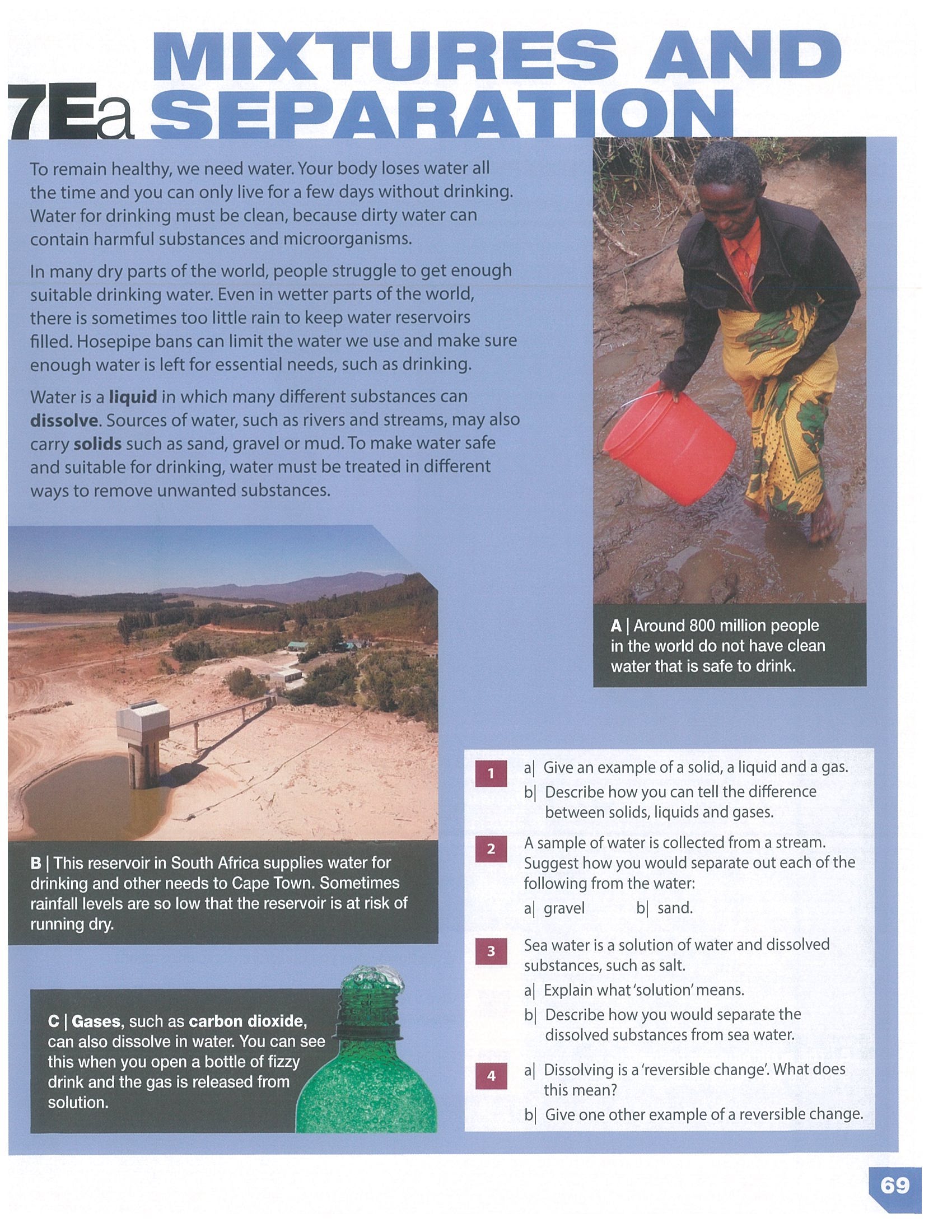
A | 800 million people without clean water
图 A | 全球约 8 亿人没有安全的饮用水
B | Cape Town reservoir at risk of running dry
图 B | 南非开普敦水库——可能干涸
C | gases dissolved in water
图 C | 气体(如二氧化碳)也能溶在水里——打开汽水瓶时气体从溶液中释放出来
Q1 a) Give an example of a solid, a liquid and a gas. b) Describe how you can tell the difference between solids, liquids and gases.
第 1 题 a) 各举一个固体、液体、气体的例子。 b) 描述怎么区分固液气。(答:固体有固定形状和体积;液体有体积但形状随容器;气体没固定形状和体积,会扩散)
Q2 A sample of water is collected from a stream. Suggest how you would separate out each of the following from the water: a) gravel b) sand.
第 2 题 从溪水中采样。怎么分离 a) 砾石?(答:用筛子(sieve)或大网) b) 沙?(答:过滤(filtration)或静置后倒掉上层水)
Q3 Sea water is a solution of water and dissolved substances, such as salt. a) Explain what 'solution' means. b) Describe how you would separate the dissolved substances from sea water.
第 3 题 海水是水和溶解物质(如盐)的溶液。a) "溶液"的意思?(答:物质溶解在液体里形成的透明混合物) b) 如何分离海水中溶解的物质?(答:蒸发 evaporation——加热让水蒸发,盐留下;或蒸馏得到纯水)
Q4 a) Dissolving is a reversible change. What does this mean? b) Give one other example of a reversible change.
第 4 题 a) 溶解是可逆变化是什么意思?(答:可以反向——蒸发水就能让盐回来) b) 另一个可逆变化的例子。(答:冰融化↔水结冰;水蒸发↔水蒸气凝结)
📄 教材 p.70 · 7Ea Forensic Science (STEM)
HOW DOES A FORENSIC SCIENTIST PREPARE EVIDENCE FOR A COURT?
法医如何为法庭准备证据?
Forensic scientists collect materials from crime scenes. They may collect soil, burnt or broken materials, hairs and body fluids.
法医(forensic scientists)从犯罪现场采集材料——包括土壤、烧焦或破碎物、毛发、体液。
The scientists then examine and test the materials in a lab. Their results can be used as evidence in a court of law.
然后在实验室检查和测试这些材料。结果可作为法庭证据使用。
For example, the evidence could be used to show whether a person or vehicle was in a certain place.
例如证据可用来证明某人或某车是否到过某地。
Using knowledge of chemistry
运用化学知识
Most forensic scientists have a university degree in forensic science, or other science followed by forensic science training.
大多数法医有法医学的大学学位,或先学其他科学再接受法医训练。
A forensic scientist needs a good understanding of the techniques used to separate and identify small amounts of substances (samples).
法医必须熟练掌握分离和鉴定少量物质(样本)的技术。
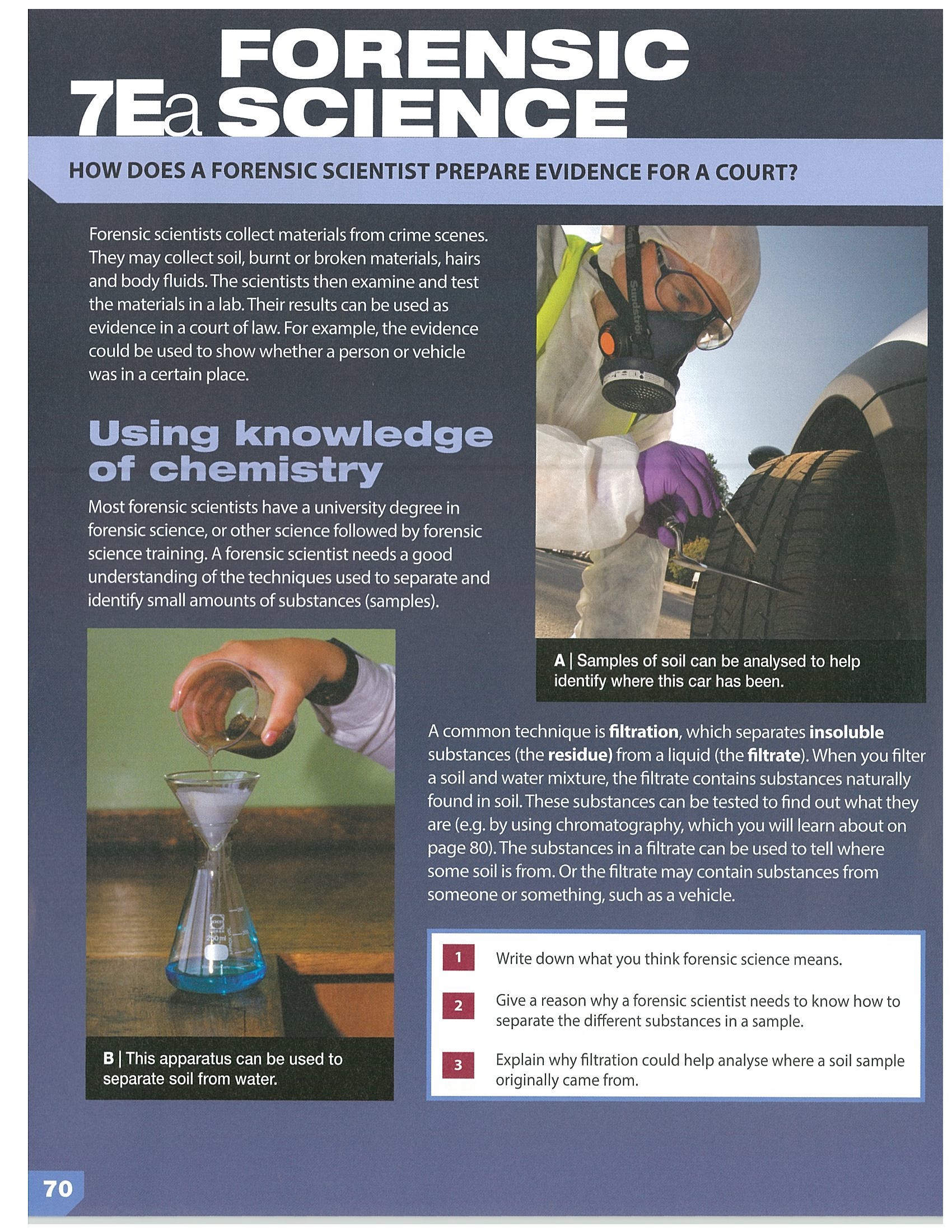
A common technique is filtration, which separates insoluble substances (the residue) from a liquid (the filtrate).
常用技术是过滤(filtration)——把不溶(insoluble)物质(残渣 residue)从液体(滤液 filtrate)中分开。
When you filter a soil and water mixture, the filtrate contains substances naturally found in soil. These substances can be tested to find out what they are (e.g. by using chromatography).
过滤土+水混合物时,滤液含土壤中本来就有的物质——可以通过色谱法等技术检测它们是什么。
The substances in a filtrate can be used to tell where some soil is from. Or the filtrate may contain substances from someone or something, such as a vehicle.
滤液中的物质能判断土壤的来源地——或者滤液可能含某人或某物(如车辆)的物质。
A | soil samples / B | filtering apparatus
图 A | 土壤样本帮助识别车辆去过的地方 / 图 B | 过滤装置(用来分离土和水)
Q1 Write down what you think forensic science means.
第 1 题 你认为"法医科学"是什么?(答:把科学技术用于犯罪调查——分析犯罪现场的材料,为法庭提供证据)
Q2 Give a reason why a forensic scientist needs to know how to separate the different substances in a sample.
第 2 题 为什么法医需要懂分离样本里不同物质?(答:先分开才能分别识别每种物质——确定其来源或属性)
Q3 Explain why filtration could help analyse where a soil sample originally came from.
第 3 题 解释过滤如何帮助分析土壤来源。(答:过滤后滤液含土壤里溶解的物质——不同地方土壤化学不同 → 用色谱等比对就能匹配地点)
📄 教材 p.71 · 7Ea Clear Method Writing (WS)
Clear STEM communication
清晰的 STEM 表达
Forensic scientists need to explain clearly what they have done. An important part of this is their method, which is a set of written instructions showing how an experiment is carried out.
法医必须清楚说明自己做了什么。一个重要部分是实验方法(method)——一份书面指令说明实验如何进行。
The method may also include a diagram of the apparatus. A clear method lets other scientists repeat an experiment exactly, to check the results. It also allows people in a court to understand easily what a forensic scientist has done.
方法也可以包含装置图。清晰的方法让其他科学家能精确重复实验,也让法庭上的人容易理解法医做了什么。
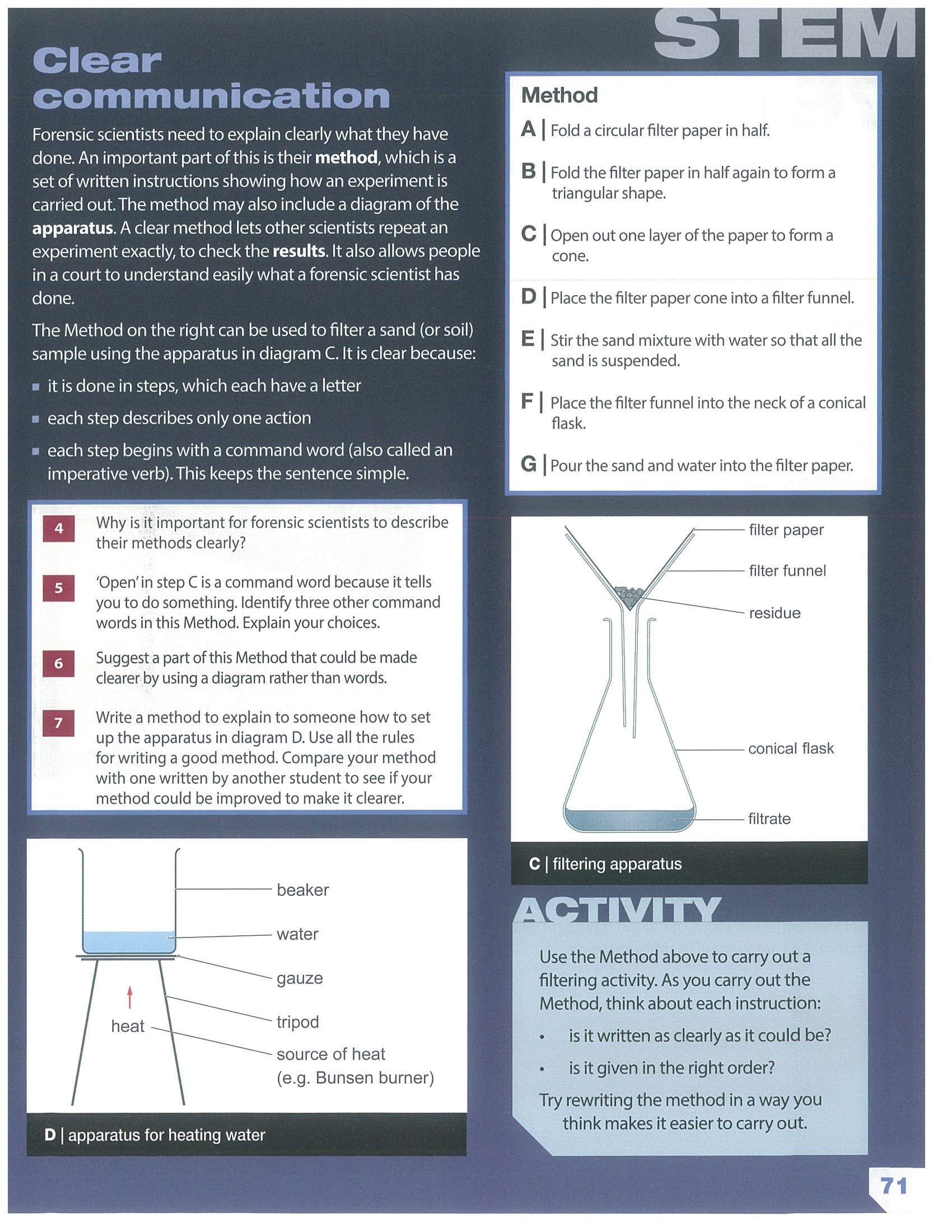
Method — filtering sand/soil
方法 — 过滤沙/土
A | Fold a circular filter paper in half. B | Fold the filter paper in half again to form a triangular shape. C | Open out one layer of the paper to form a cone. D | Place the filter paper cone into a filter funnel.
A | 把圆形滤纸对折。 B | 再次对折成三角形。 C | 打开一层形成锥形。 D | 把锥形滤纸放进漏斗。
E | Stir the sand mixture with water so that all the sand is suspended. F | Place the filter funnel into the neck of a conical flask. G | Pour the sand and water into the filter paper.
E | 搅拌沙和水的混合物让沙悬浮。 F | 把漏斗放进锥形瓶口。 G | 把沙和水倒入滤纸。
The Method is clear because: it is done in steps (each with a letter); each step describes only one action; each step begins with a command word (also called an imperative verb) — this keeps the sentence simple.
这份方法之所以清晰:分步骤(每步标字母);每步只描述一个动作;每步以命令词(command word,又叫祈使动词)开头——让句子简洁。
C | filtering apparatus / D | heating apparatus — labels
图 C | 过滤装置:滤纸 / 漏斗 / 残渣 / 锥形瓶 / 滤液 / 图 D | 加热装置:烧杯 / 水 / 石棉网 / 三脚架 / 热源(本生灯)
Q4 Why is it important for forensic scientists to describe their methods clearly?
第 4 题 为什么法医清楚描述方法很重要?(答:让其他科学家能重复实验核对结果;让法庭理解证据怎么得到的)
Q5 'Open' in step C is a command word because it tells you to do something. Identify three other command words in this Method. Explain your choices.
第 5 题 步骤 C 的 "Open" 是命令词。说出方法里另外 3 个命令词,并解释。(答:Fold(A、B)、Place(D、F)、Stir(E)、Pour(G)——都是直接告诉你做某个动作的祈使动词)
Q6 Suggest a part of this Method that could be made clearer by using a diagram rather than words.
第 6 题 这份方法的哪一部分用图比文字更清楚?(如:步骤 C 折锥形——用图能让"打开一层成锥"更直观)
Q7 Write a method to explain how to set up the apparatus in diagram D. Use all the rules for writing a good method.
第 7 题 写一份方法说明如何搭建图 D 加热装置。用好方法的规则。(分步骤 + 一句一动作 + 命令词开头,如:Place tripod on bench; Put gauze on tripod; Place beaker of water on gauze; …)
📄 教材 p.72 · 7Ea Mixtures (Solution / Suspension / Colloid)
WHAT KINDS OF MIXTURES ARE THERE?
混合物有哪些种类?
Waste water is not a single substance — it is not a pure substance. It is a mixture of water and solid substances.
废水不是单一物质——不是纯净物。它是水和固体物质的混合物(mixture)。
Mixtures are grouped depending on whether the substances in them are solids, liquids or gases, and on how the substances can be separated.
混合物按里面的物质是固/液/气、以及如何分离 来分类。
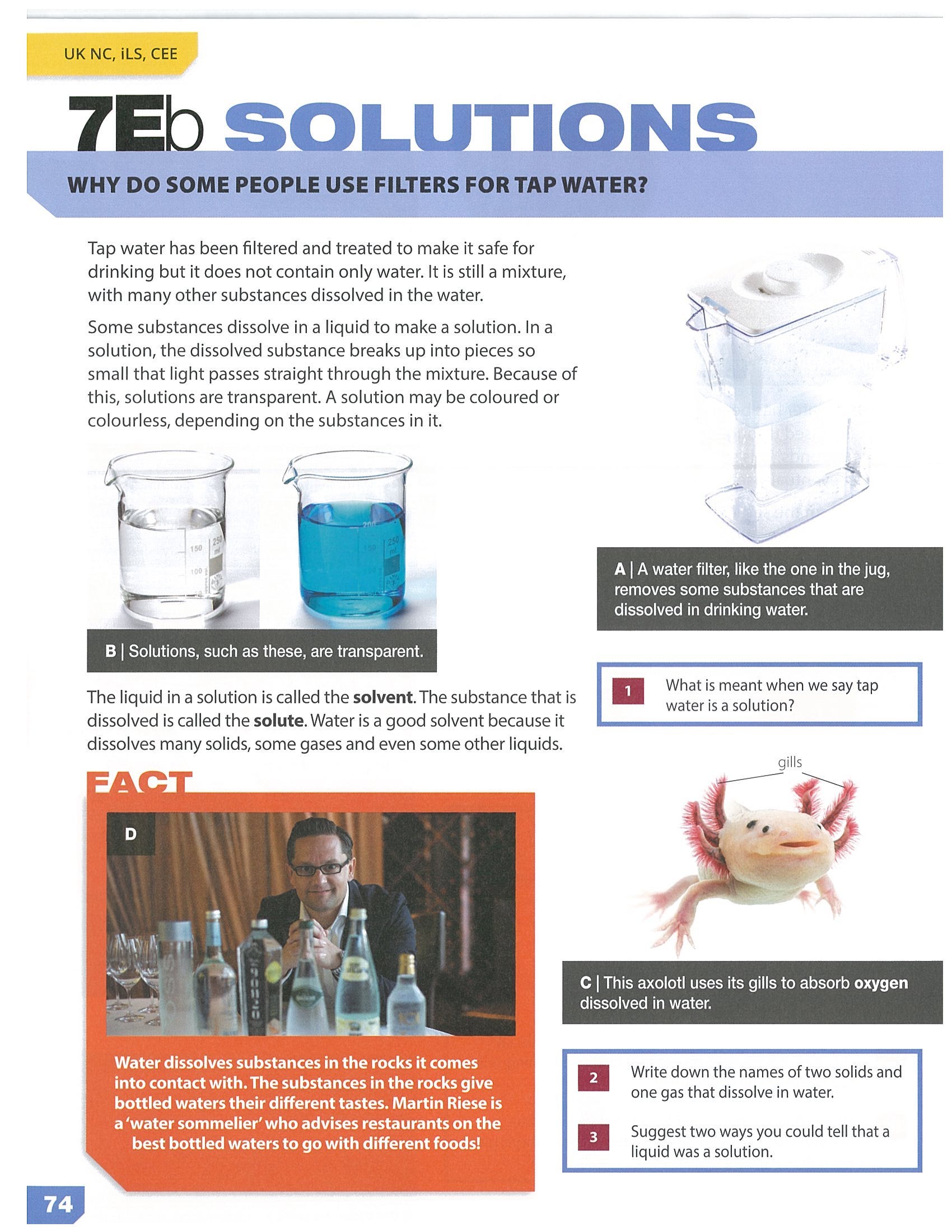
A solution is a mixture in which the solid dissolves in the liquid. This makes the mixture clear or transparent.
溶液(solution)是固体溶解(dissolves)在液体里的混合物——使混合物清澈或透明(transparent)。
A suspension is a mixture of two substances that separate if the mixture is not stirred. These two substances are often a solid and a liquid. When they are mixed, we say that one substance is suspended in the other. An example is sand mixed with water.
悬浊液(suspension)是两种物质的混合物——不搅就分层。通常是固体和液体——我们说一种物质悬浮在另一种里。例子:沙+水。
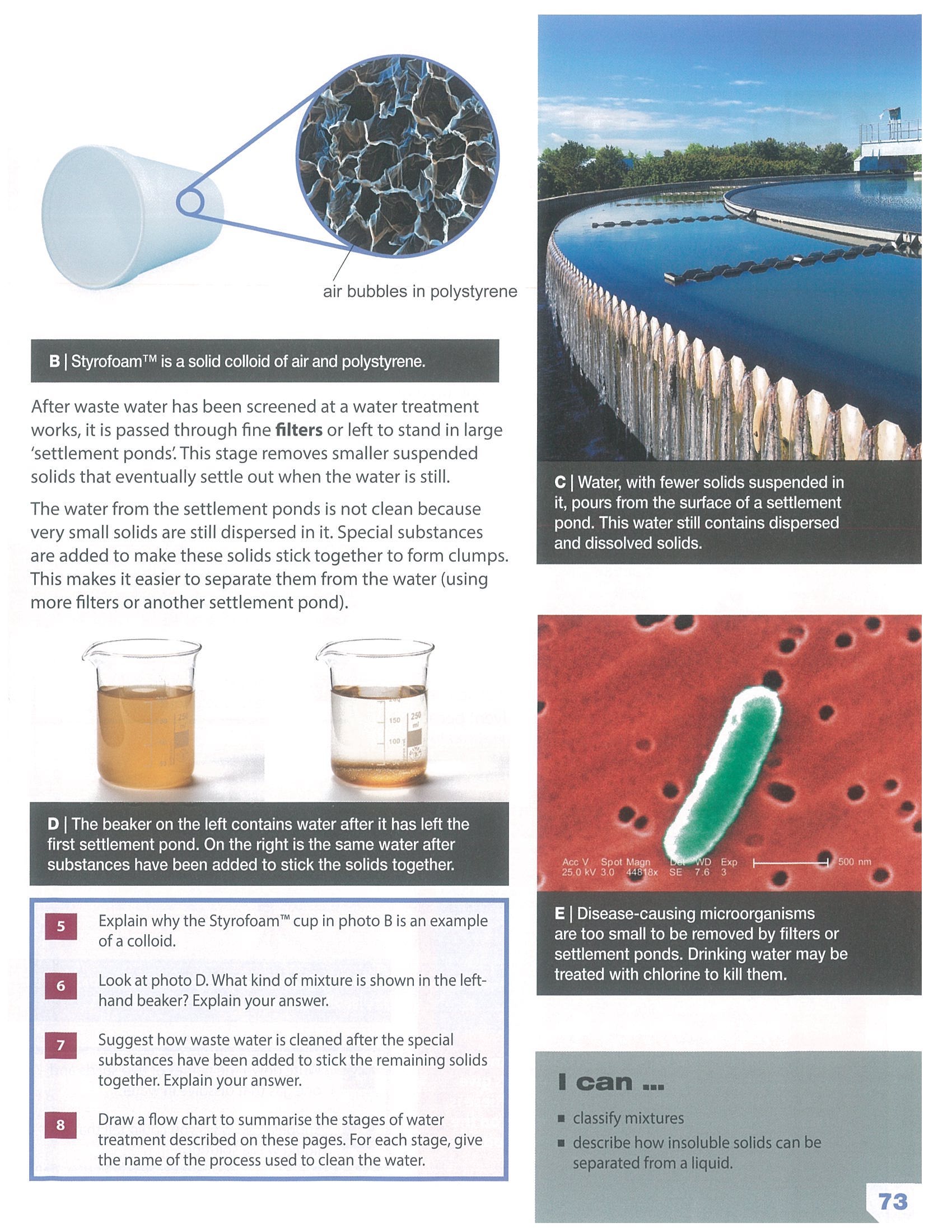
In a colloid, one substance is dispersed in another substance and the two substances will not separate easily. Either substance may be a solid, liquid or gas. A colloid is cloudy or opaque, so it is easy to see that it is a mixture.
胶体(colloid)中一种物质分散(dispersed)在另一种里,两者不易分离。任一物质都可以是固液气。胶体浑浊或不透明(opaque)——一眼能看出是混合物。
Milk is a colloid of different milk solids dispersed in water. Many mixtures we use are colloids, such as hair spray, hand cream, Styrofoam™ cups, paint and gel inks.
牛奶是奶固体分散在水中的胶体。我们用的许多混合物都是胶体——发胶、护手霜、Styrofoam 杯、油漆、凝胶墨水。
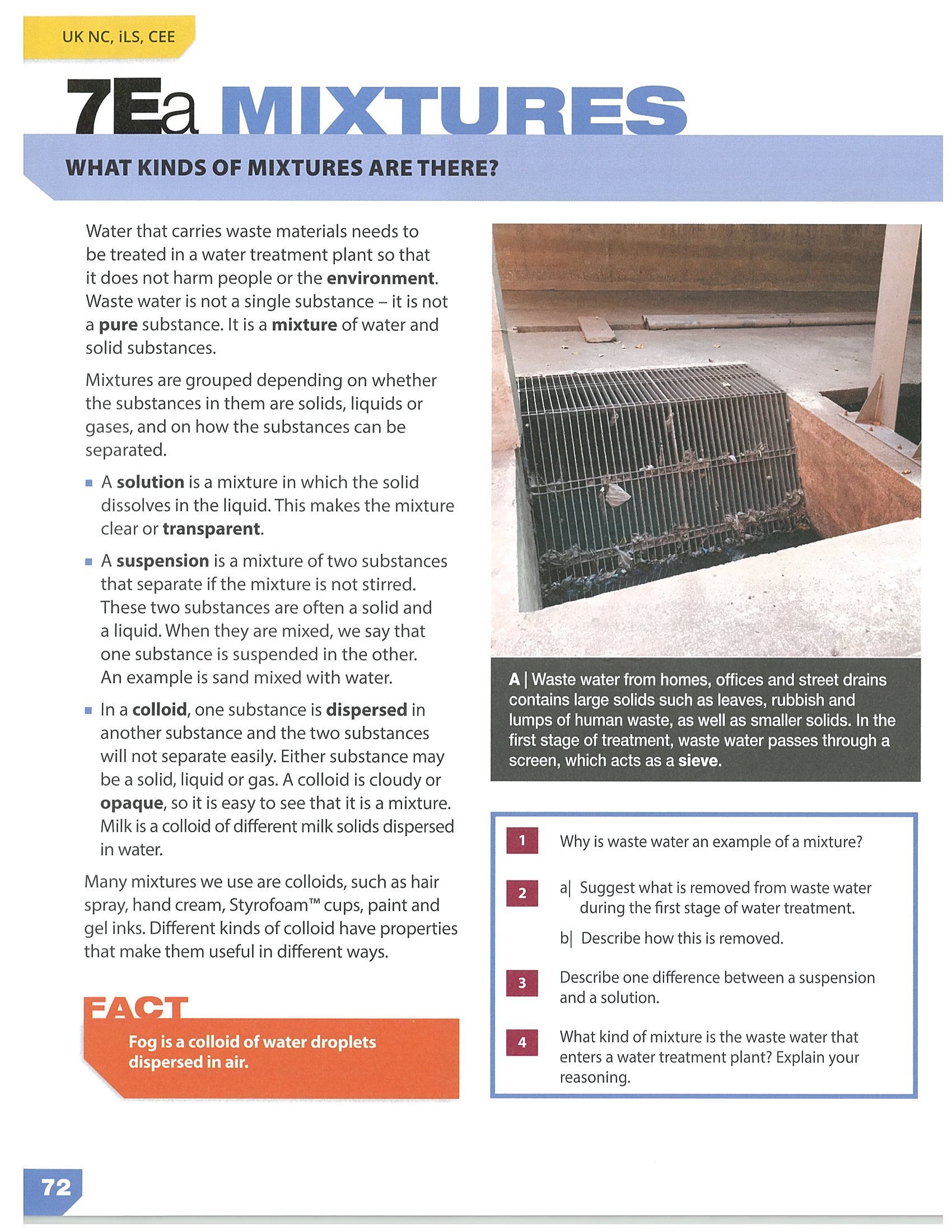
A | waste water mixture / B | Styrofoam™ — solid colloid
图 A | 废水:含树叶、垃圾、人类排泄物等大固体,经筛网(screen)初步处理 / 图 B | Styrofoam™ 是空气分散在聚苯乙烯中的固体胶体
FACT — Fog
FACT 框 — 雾
Fog is a colloid of water droplets dispersed in air.
雾是水滴分散在空气中的胶体。
Q1 Why is waste water an example of a mixture?
第 1 题 为什么废水是混合物?(答:因为它含多种不同物质——水 + 固体(垃圾、粪便)+ 溶解物质——不是纯净物)
Q2 a) Suggest what is removed from waste water during the first stage of water treatment. b) Describe how this is removed.
第 2 题 a) 水处理第一阶段去除什么?(答:大固体——树叶、垃圾、粪块) b) 怎么去除?(答:让水通过筛网(screen),像筛子一样)
Q3 Describe one difference between a suspension and a solution.
第 3 题 描述悬浊液和溶液的一个区别。(答:悬浊液不搅就分层且不透明;溶液不分层且透明。或:颗粒大小不同——悬浊液颗粒大、溶液颗粒小到光能穿过)
Q4 What kind of mixture is the waste water that enters a water treatment plant? Explain your reasoning.
第 4 题 进水处理厂的废水是什么类型的混合物?解释。(答:悬浊液——含大量不溶固体,静置会沉淀;也含溶解物质所以也有溶液性质)
📄 教材 p.73 · 7Ea Water Treatment (continued)
After waste water has been screened at a water treatment works, it is passed through fine filters or left to stand in large 'settlement ponds'. This stage removes smaller suspended solids that eventually settle out when the water is still.
废水在水处理厂被筛分(screened)后,经过细滤器或留在大型"沉淀池(settlement ponds)"。这一步去除较小的悬浮固体——水静止时这些固体最终沉淀下来。
The water from the settlement ponds is not clean because very small solids are still dispersed in it. Special substances are added to make these solids stick together to form clumps. This makes it easier to separate them from the water.
沉淀池出水还不干净——还有极小的固体分散在里面。加入特殊物质让这些固体粘在一起结块——更容易从水中分离。
Disease-causing microorganisms are too small to be removed by filters or settlement ponds. Drinking water may be treated with chlorine to kill them.
致病微生物太小,过滤器和沉淀池都除不掉。饮用水可能用氯(chlorine)处理来杀死它们。
C / D | settlement ponds / E | chlorine treatment
图 C | 沉淀池表面流出的水(少了悬浮固体,但仍含分散和溶解的固体)/ 图 D | 加入特殊物质后,固体粘成大块 / 图 E | 微生物太小,需要用氯杀死
Q5 Explain why the Styrofoam™ cup in photo B is an example of a colloid.
第 5 题 解释为什么 Styrofoam 杯是胶体。(答:空气分散在聚苯乙烯固体中,两者不易分离——符合胶体定义;不透明)
Q6 Look at photo D. What kind of mixture is shown in the left-hand beaker? Explain.
第 6 题 图 D 左烧杯是什么混合物?解释。(答:悬浊液 / 胶体——浑浊、有微小固体分散其中)
Q7 Suggest how waste water is cleaned after the special substances have been added to stick the remaining solids together. Explain your answer.
第 7 题 加完特殊物质后废水怎么继续净化?(答:再次过滤或经过沉淀池——结块的固体更容易被滤出或沉淀)
Q8 Draw a flow chart to summarise the stages of water treatment described on these pages.
第 8 题 画流程图总结水处理阶段。(筛分 screening → 过滤 / 沉淀 settlement → 加凝聚剂 → 再过滤 / 沉淀 → 加氯消毒 chlorination → 饮用水)
I can…
我能……
classify mixtures / describe how insoluble solids can be separated from a liquid
把混合物分类 / 描述如何把不溶固体从液体中分离
💡 7Ea 出现的 6 个核心化学术语 · 含音标 / 词性 / 词源 / 教材原句 / 现代延伸 / 易错。
🧪 物质分类
mixture
/ˈmɪkstʃər/
n.
混合物
词源拉丁 miscere(混合)+ -ure(名词后缀)= "混在一起的东西"
教材"Sea water is a mixture of water and salt."(海水是水和盐的混合物)
延伸① cake mixture 蛋糕面糊 ② a mixture of feelings 复杂感情
mixture ≠ compound:mixture 没有化学反应,可以用物理方法分开;compound 化学反应生成,要化学方法才能分。
pure substance
/pjʊər ˈsʌbstəns/
n.
纯净物
词源pure 拉丁 purus(干净的);substance 拉丁 sub-(在下面)+ stare(站立)= "底层的东西、本质"
教材"A pure substance contains only one type of particle."(纯净物只含一种粒子)
延伸① pure water 纯水 ② illegal substance 非法物质(毒品)③ in substance 实质上
反义mixture 同根purity n. 纯度
element
/ˈelɪmənt/
n.
元素
词源拉丁 elementum = "基本组成部分"(原指字母表 L-M-N)
教材"An element contains only one type of atom."(元素只含一种原子)
延伸① the element of surprise 惊喜的因素 ② weather elements 自然气候 ③ in his element 如鱼得水
element vs compound:element 只含一种原子(如 O₂、Fe);compound 不同原子化学结合(如 H₂O、NaCl)。
compound
/ˈkɒmpaʊnd/
n.
化合物
词源拉丁 com-(一起)+ ponere(放)= "放在一起的"
教材"Water is a compound of hydrogen and oxygen."(水是氢和氧的化合物)
延伸① chemical compound 化合物 ② compound interest 复利 ③ compound word 复合词(toothbrush)
同根composition n. 组成 易错注意发音重音在 com(名词)
🔬 分离方法(引入)
separate
/ˈsepəreɪt/
v.
分离
词源拉丁 se-(远离)+ parare(准备)= "把准备好的东西分开"
教材"We can separate insoluble solids from a liquid by filtration."(用过滤把不溶固体从液体分开)
延伸① separate ways 各走各路 ② separate room 单独房间 ③ adj. 重音变到第一音节 /ˈseprət/
动词 vs 形容词:separate 作动词读 /ˈsepəreɪt/(重音 -ate);作形容词读 /ˈseprət/(短促)。
insoluble
/ɪnˈsɒljəbl/
adj.
不可溶的
词源拉丁 in-(不)+ solv-(溶解)+ -uble(能...的)= "不能被溶解的"
教材"Sand is insoluble in water — it does not dissolve."(沙子在水中不溶——不会溶解)
延伸① insoluble problem 无解的问题(引申义)② chalk, sand, oil 在水里都是 insoluble
soluble vs insoluble:soluble 能溶(盐、糖);insoluble 不能溶(沙、粉笔)。前缀 in- 一加就反义。
🎯 隐性技能专项 · 考试不教但必丢分的能力
💡 点卡片翻面看答案。本章 25 个高频术语(化学分离术语多易混 / 易拼错),考试拼写错就直接丢分。
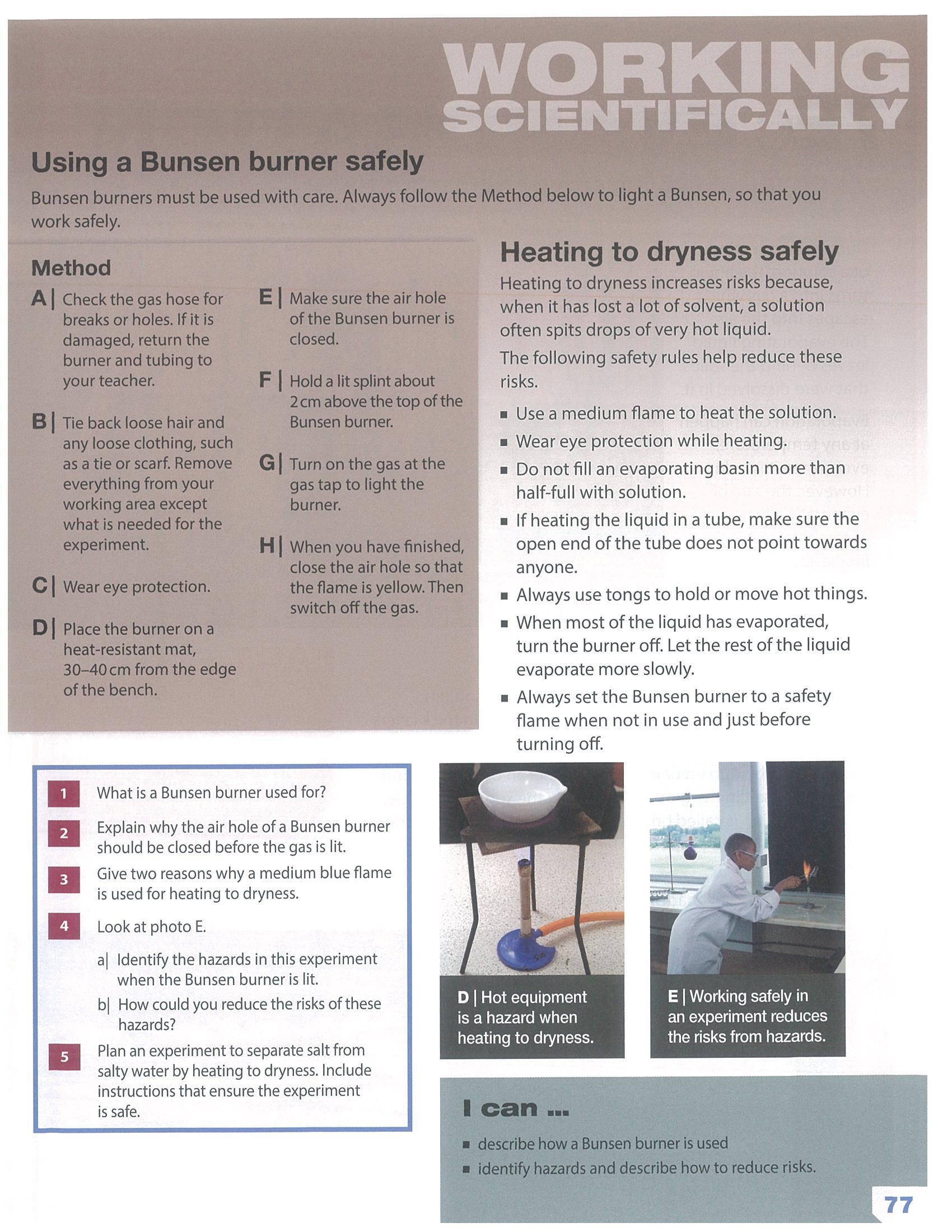
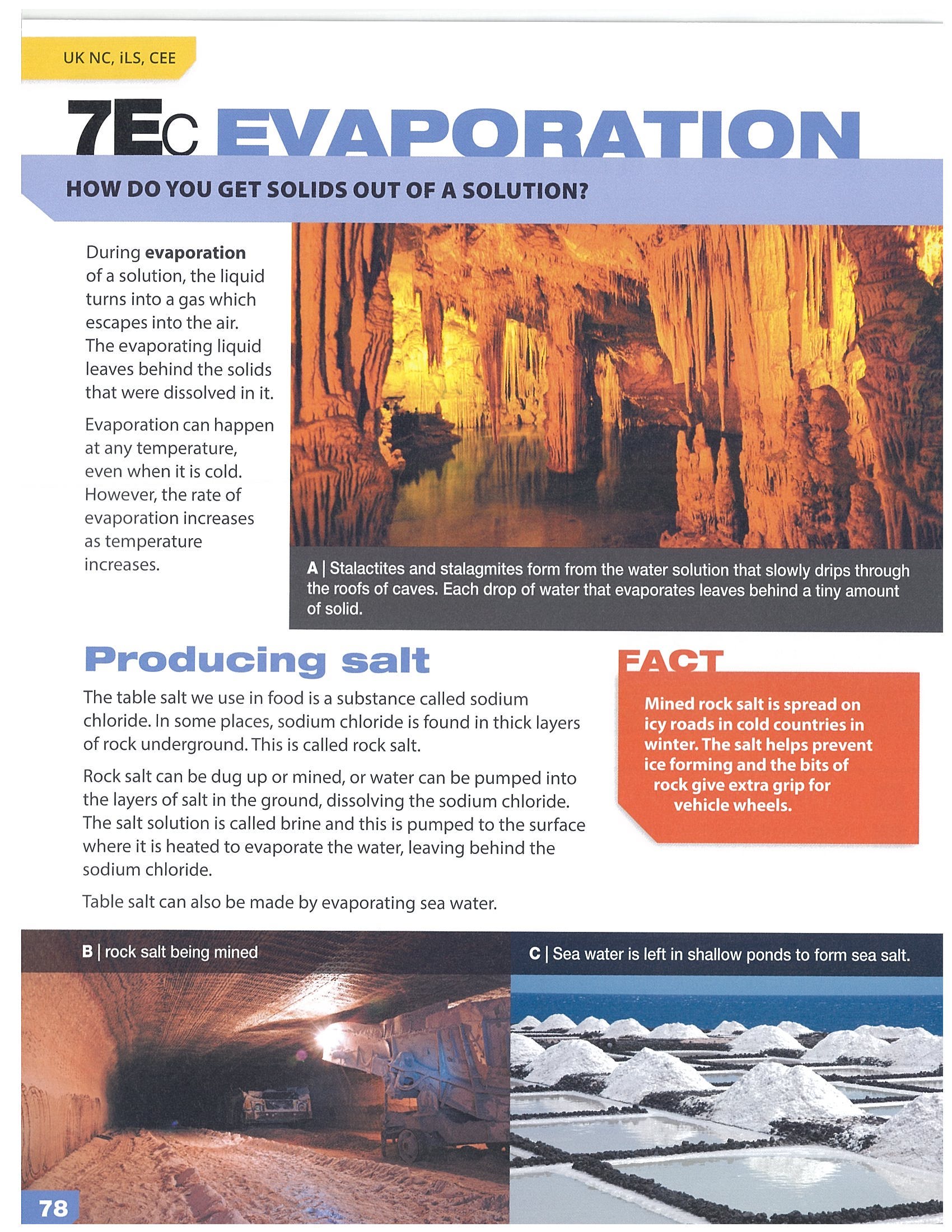
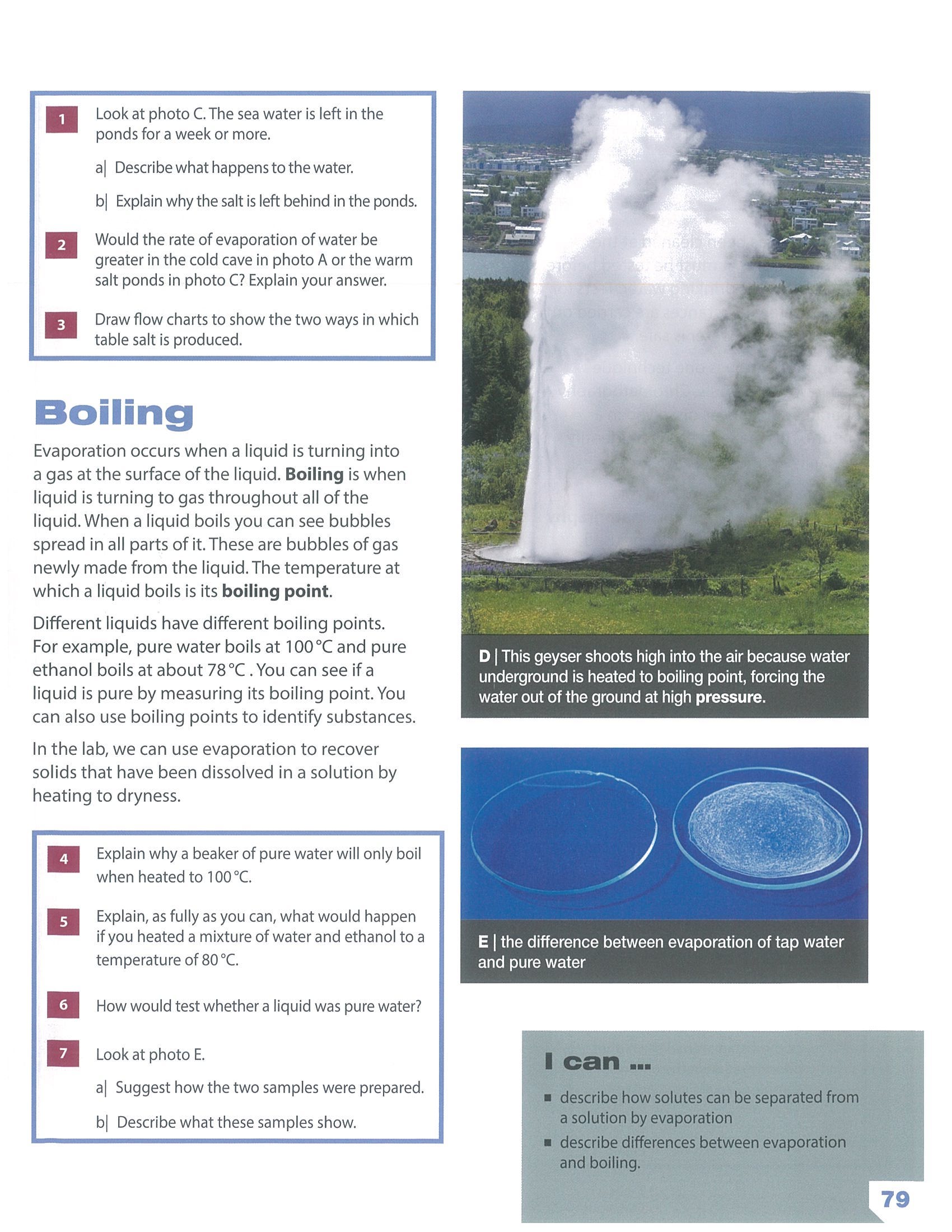
💡 玩法:先点一个英文标签(变金色高亮),再点蒸馏装置上对应位置。点已放好的部位会取回标签。本图考察 Liebig condenser 蒸馏装置各部位——SUIS Chemistry 实验题必出。
把这些标签点到正确位置:
flask
thermometer
condenser
cold water in
cold water out
distillate
filter paper
chromatography paper
💡 注意:bank 里有 8 个标签,但图上只有 6 个空——多出来的是干扰项(filter paper / chromatography paper 属于过滤和色谱装置,不属于蒸馏)。考试也是这样。
💡 看清楚题干用的指令词,答题方式完全不同。化学题尤其爱考 Explain(要 because)和 Suggest(要敢猜)。
| 指令词 | 要求 | 错误示范 | 正确示范 |
|---|---|---|---|
| State | 用一个完整句子说清事实 | "100"(光这一个数字不行) | "The boiling point of pure water is 100 °C." |
| Name | 给一个单词或短语即可 | "the condenser"(前面冠词常加分) | "condenser" 或 "Liebig condenser" |
| List | 给几个项目(数字明示) | 只写 1 个但题目问 3 个 | 分行编号 i, ii, iii 写出确切数目 |
| Describe | 说出"是什么样",需要细节 | "It dissolves."(太短) | "The salt dissolves in the water to form a transparent salt solution." |
| Explain | 必须说"为什么",要有 because | "The salt is left behind." 没说为什么 | "The salt is left behind because the boiling point of salt is much higher than that of water, so only water evaporates." |
| Suggest | 给合理猜测(题目没标准答案) | 留白不写 | "The filter could be made of fine sand, which would trap small particles." 大胆给合逻辑的回答 |
| Compare | 同时说相同点和不同点 | 只说不同点 | "Both methods produce pure water by evaporation and condensation; however, distillation uses a Bunsen flame, whereas a solar still uses sunlight." |
| Tick / Choose | 勾选一个或多个框 | 选了 2 个但题目说 one box | 仔细看 "Tick (✓) one box" |
📌 本章特别提示:实验题里题目会说 "Describe how you would separate..." —— 必须给完整 method(命令词开头 + 分步 + 一句一动作)。"State / Suggest one hazard"——给一个具体的 hazard(如"the Bunsen burner is hot")+ 一个 risk reduction(如"use tongs")。
📝 分级练习 · 由易到难闯关
❌ 错题本 · 自动收集你标错的题
还没有错题。做题时点击"做错了"会自动收集到这里。
✅ 考前自检清单 · 全勾上才能进考场
已掌握 0 / 0