🚪 学习前导 · 先看这里再开始
🎯 学完你能干什么
- 能用一句话定义 species 并解释 hybrid(如骡)为什么不是新物种
- 能区分 continuous 和 discontinuous variation 各举一例
- 能列出 5 个 abiotic factors 并解释 environmental variation
- 能解释 polar bear / cactus 各 2 个以上 adaptations
- 能区分 hibernation / migration / nocturnal 三个动物季节性适应
- 能在食物链上标 producer / primary / secondary / apex consumer
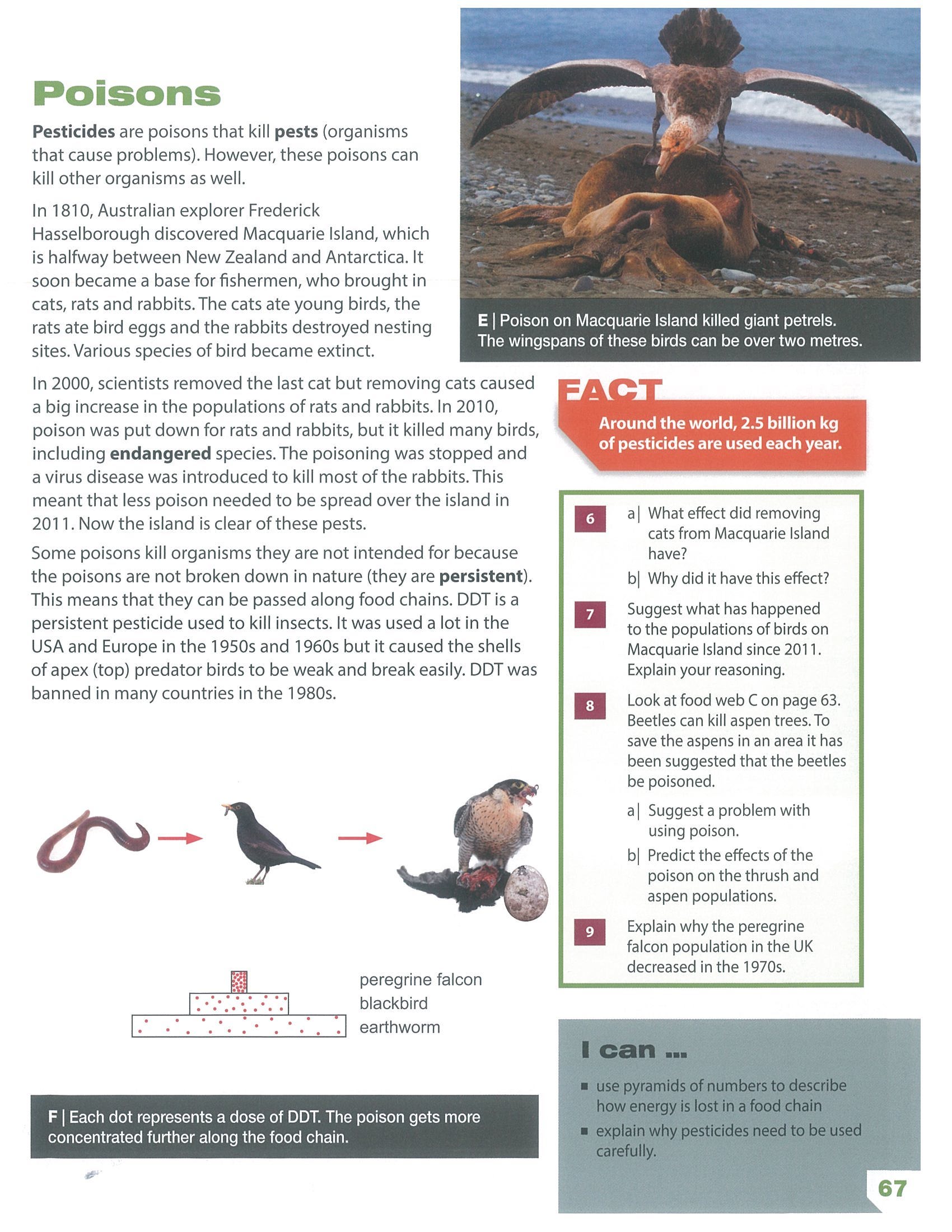
- 能解释 DDT 为什么对顶级捕食者影响最大
🛣️ 推荐学习路径
- 通读教材 16 页(不查词,速读 30 分钟)
- 跟读本视图:左边看教材图,右边看笔记(约 2.5 小时)
- 做 Workbook 7D 全部题目(约 1.5 小时)
- 专项训练:拼写卡 + 食物链标注 + 答题规范(30 分钟)
- 挑战分级练习 L1→L2→L3(约 1 小时)
- 查漏错题本 + 自检清单(考前 30 分钟)
⚠️ 老师常考
- 必考 species 定义 + hybrid 是什么
- 必考 continuous vs discontinuous variation
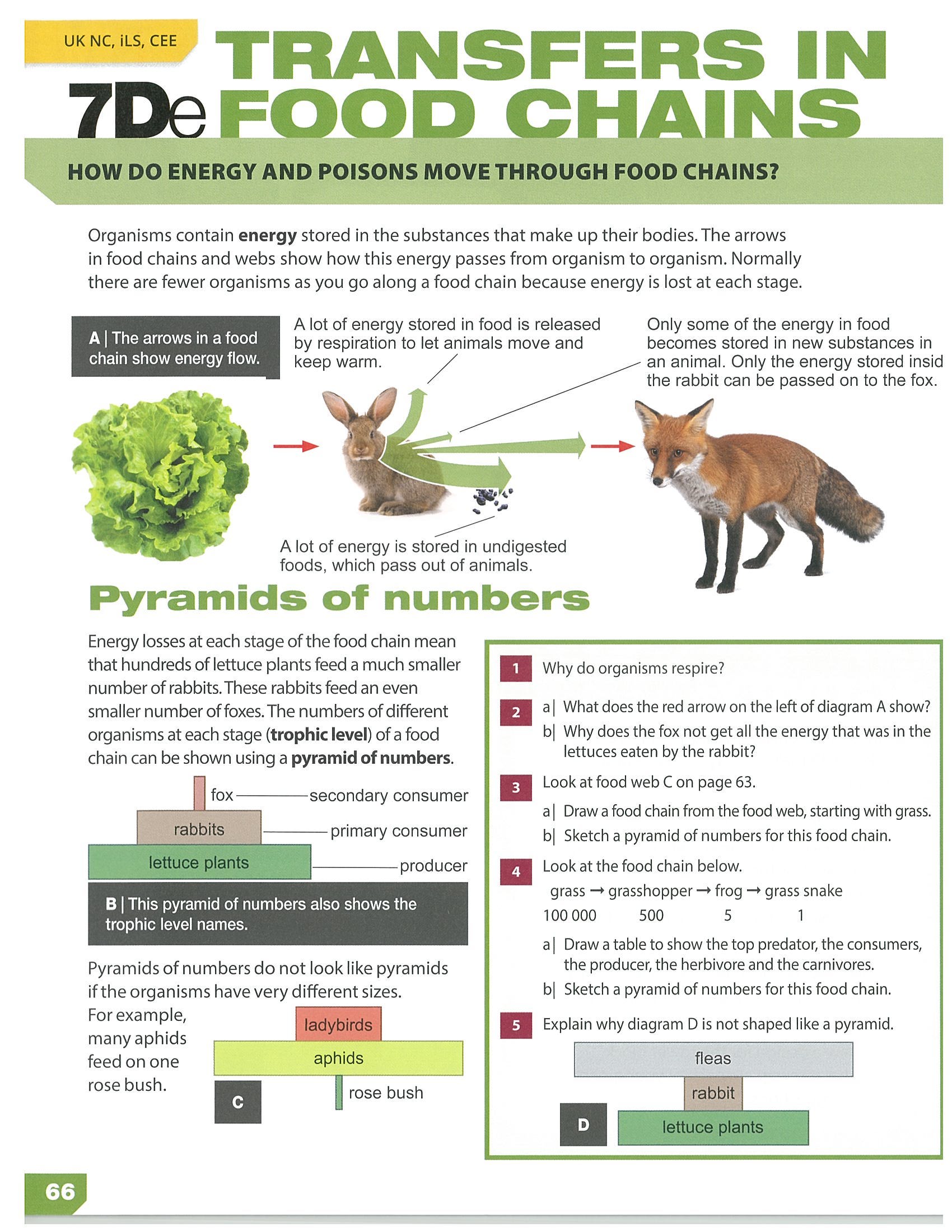
- 必考 食物链 / 食物网中的 trophic levels
- 高频 经典 adaptations(北极熊、仙人掌、长耳兔)
- 高频 predator-prey 曲线相位差解释
- 高频 DDT 持久性农药累积问题
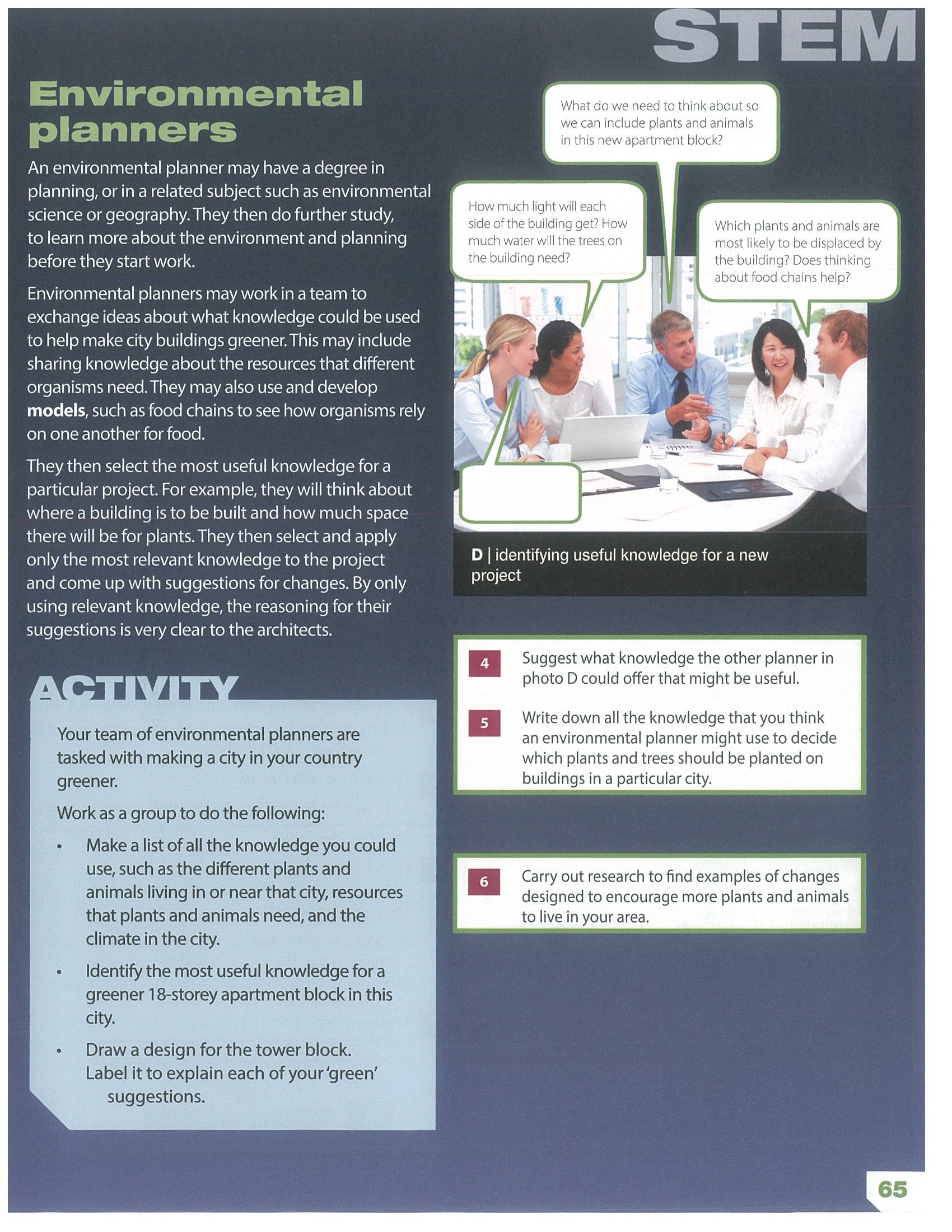
- 拓展 STEM:绿色城市设计、环境规划师
🧭 前置回顾(来自 7A、7B、7C)
- scientific method 6 阶段(7B)—— 用来设计变异/适应的实验
- independent / dependent variable(7B)—— 图表 WS 必考
- sexual reproduction(7B)—— 解释遗传变异如何形成
- photosynthesis(7A)—— 生产者怎么做食物
- respiration(7A/7C)—— 解释能量损失
📖 教材跟读 · 左图右注
📄 教材 p.53–57
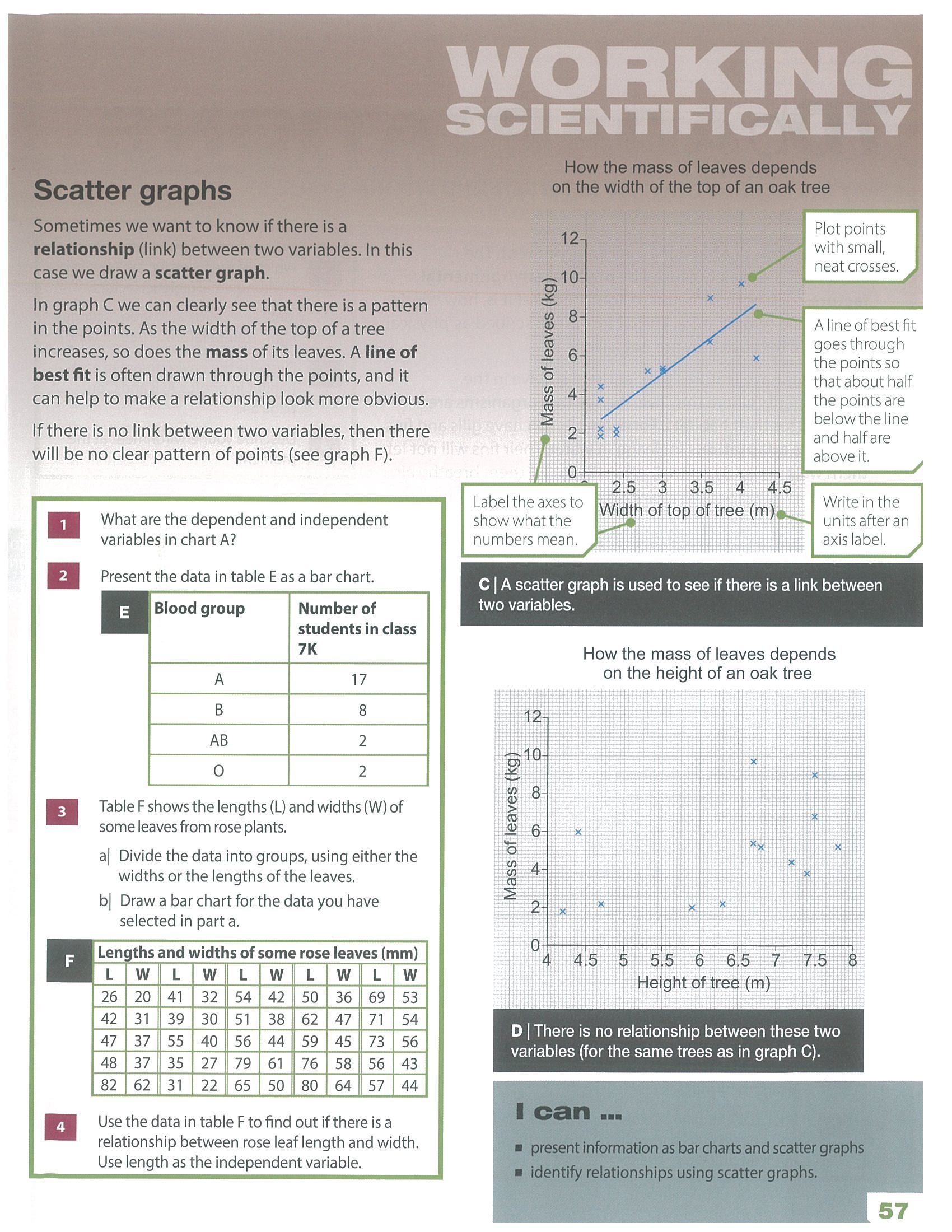
📝 学习内容
核心理解:变异 + 物种 + 图表
1. 几个核心定义
| 英文 | 中文 | 含义 |
|---|---|---|
| habitat | 栖息地 | 生物居住的地方 |
| species | 物种 | 能互相繁殖产生能再繁殖的后代的一群生物 |
| variation | 变异 | 生物之间的差异 |
| inter-specific variation | 种间差异 | 不同物种之间的差异(如狮 vs 老虎) |
| intra-specific variation | 种内差异 | 同一物种内的差异(如不同人的身高) |
| hybrid | 杂交后代 | 两个物种产生(如骡、虎狮兽)——通常不能再繁殖 |
马 + 斑马 = 斑马驴(zebroid)。为什么斑马驴不算新物种?
💡 物种的定义是"能繁殖出可继续繁殖的后代"。斑马驴是 hybrid,本身不能再繁殖,所以马和斑马是不同物种。同理:狮+虎=狮虎兽(liger),也是不能繁殖的 hybrid。
2. 两种 variation
| Continuous 连续变异 | Discontinuous 不连续变异 | |
|---|---|---|
| 数据特征 | 可任意值(限度内) | 只能落入几个固定类别 |
| 例子 | 身高、体重、脚长 | 血型(A/B/AB/O)、能否卷舌、自然卷发 |
| 图表 | 条形图(分组)→ 通常呈钟形(normal distribution 正态分布) | 条形图(每个类别一根) |
3. 图表(WS 部分必考)
- Variable 变量 = 能改变或被测量的量
- Independent variable 自变量:你主动改变的量,放 x 轴(横)
- Dependent variable 因变量:被测量的量,放 y 轴(纵)
- Bar chart 条形图:x 轴是类别(如血型),柱子之间有间隔
- Frequency diagram 频率图:连续数据分组后的条形图,柱子之间无间隔,常呈钟形
- Scatter graph 散点图:用来看两个变量之间是否有 relationship 关系
- Line of best fit 最佳拟合线:散点上的趋势线(约一半点在上、一半在下)
⚠️ 陷阱:身高是 continuous 变异,画时要用 frequency diagram(柱子之间无间隔)。如果你画成 bar chart(有间隔)就丢分。
✅ 学完小检查(3 题)
1. 我能说出 species 的科学定义
2. 我能区分 continuous / discontinuous variation 并举例
3. 我能区分 bar chart / frequency diagram / scatter graph 的用途
💡 句子级中英对照。
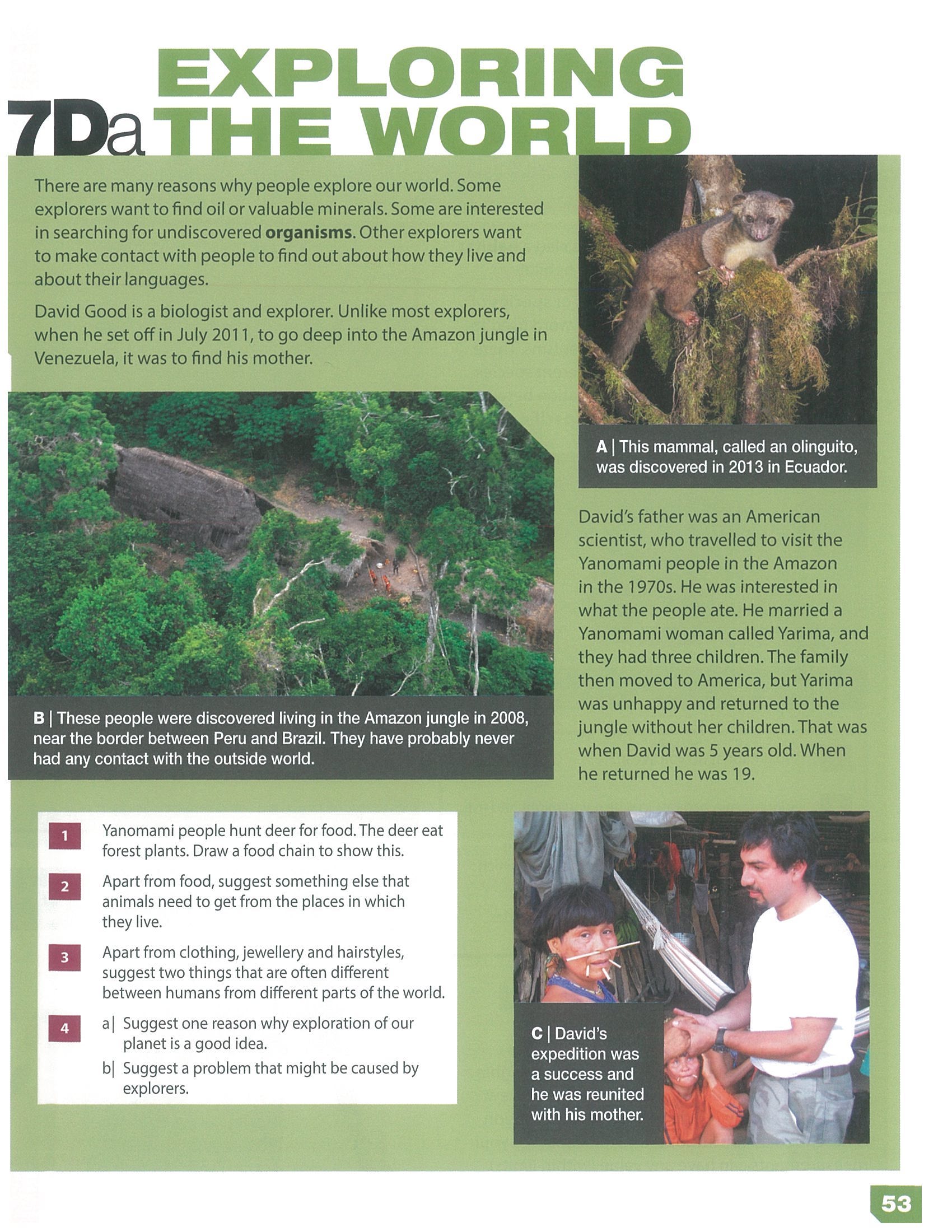
📄 教材 p.53 · 7Da Exploring the World
There are many reasons why people explore our world. Some explorers want to find oil or valuable minerals.
人们探索世界的原因有很多。一些探险家想找石油或贵重矿物。
Some are interested in searching for undiscovered organisms. Other explorers want to make contact with people to find out about how they live and about their languages.
有的对寻找未发现的生物有兴趣。还有的想接触当地人,了解他们的生活和语言。
David Good is a biologist and explorer. Unlike most explorers, when he set off in July 2011 to go deep into the Amazon jungle in Venezuela, it was to find his mother.
David Good 是生物学家也是探险家。和大多数探险家不同——2011 年 7 月他深入委内瑞拉亚马逊丛林是为了找他的母亲。
David's father was an American scientist, who travelled to visit the Yanomami people in the Amazon in the 1970s. He married a Yanomami woman called Yarima, and they had three children. The family then moved to America, but Yarima was unhappy and returned to the jungle without her children.
David 的父亲是美国科学家,1970 年代到亚马逊拜访亚诺玛米人。他娶了一位叫 Yarima 的亚诺玛米女性,生了三个孩子。后来全家搬到美国,但 Yarima 不开心——独自回到丛林,没带孩子。
A | olinguito discovered in 2013
图 A | 2013 年发现的 olinguito(小白鼻浣熊)
This mammal, called an olinguito, was discovered in 2013 in Ecuador.
这种叫 olinguito 的哺乳动物 2013 年在厄瓜多尔被发现。
B | uncontacted people, Peru–Brazil border
图 B | 秘鲁-巴西边境从未接触外界的人群
These people were discovered living in the Amazon jungle in 2008. They have probably never had any contact with the outside world.
这些人 2008 年被发现住在亚马逊丛林里——他们可能从未与外界接触过。
Q1 Yanomami people hunt deer for food. The deer eat forest plants. Draw a food chain to show this.
第 1 题 亚诺玛米人猎鹿当食物,鹿吃森林植物。画一个食物链。(答:forest plants → deer → Yanomami people)
Q2 Apart from food, suggest something else that animals need to get from the places in which they live.
第 2 题 除了食物,动物还需要从所住的地方获取什么?(答:水 water / 氧气 / 庇护所 shelter / 伴侣 mates / 空间 space)
Q3 Apart from clothing, jewellery and hairstyles, suggest two things that are often different between humans from different parts of the world.
第 3 题 除了衣着、首饰、发型外,世界不同地方的人常有哪两个不同?(答:肤色、语言、身高、饮食、节庆习俗等)
Q4 a) Suggest one reason why exploration of our planet is a good idea. b) Suggest a problem that might be caused by explorers.
第 4 题 a) 推测探索地球的一个好处。(如:发现新生物 / 寻找资源 / 了解不同文化) b) 探险者可能引起什么问题?(如:把疾病带给原住民 / 破坏栖息地 / 文化干扰)
📄 教材 p.54 · 7Da Variation
WHAT IS VARIATION?
什么是变异?
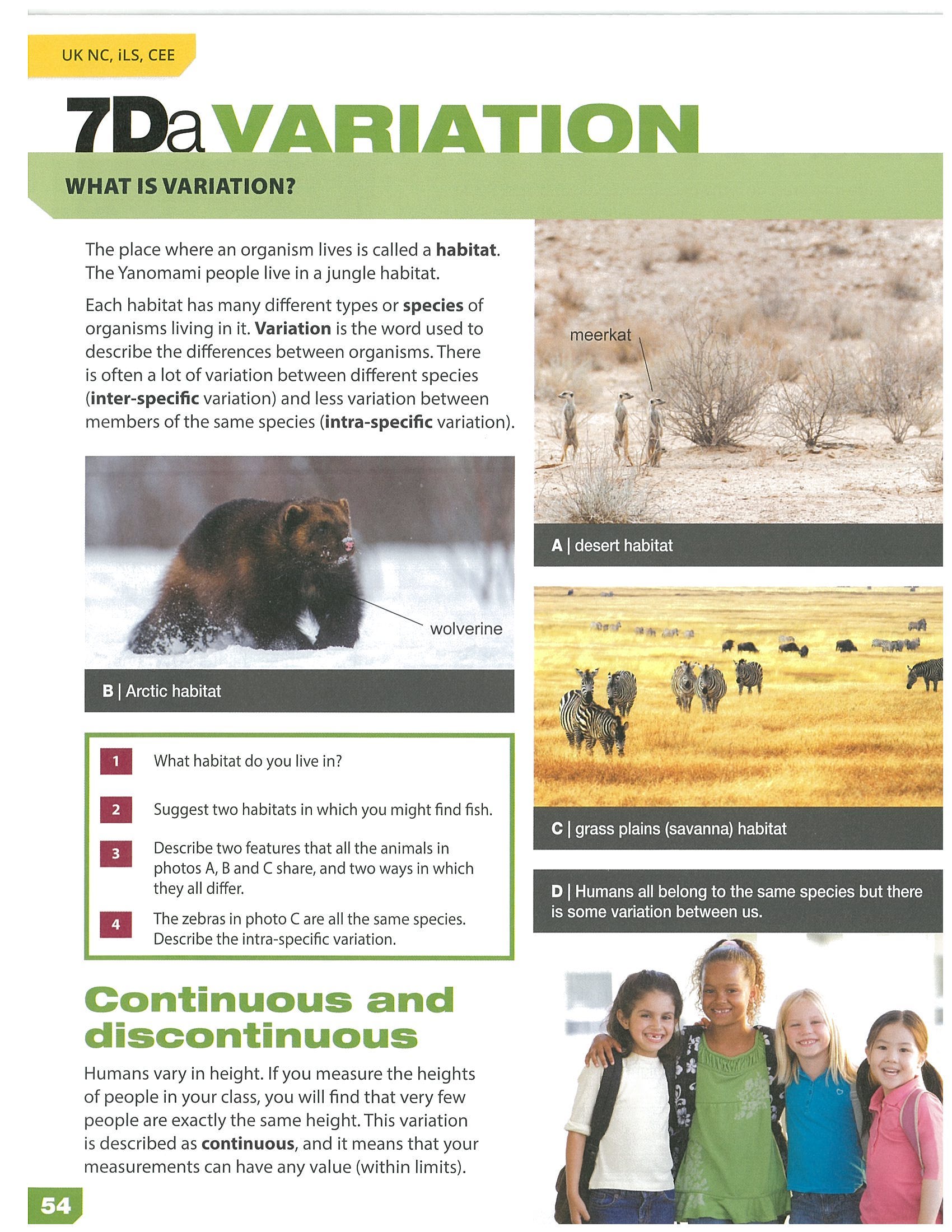
The place where an organism lives is called a habitat. The Yanomami people live in a jungle habitat.
生物居住的地方叫栖息地(habitat)。亚诺玛米人生活在丛林栖息地。
Each habitat has many different types or species of organisms living in it.
每个栖息地里都有许多不同物种(species)的生物。
Variation is the word used to describe the differences between organisms.
变异(variation)是用来描述生物之间差异的词。
There is often a lot of variation between different species (inter-specific variation) and less variation between members of the same species (intra-specific variation).
不同物种之间通常有很多变异(种间变异),同一物种成员之间变异较少(种内变异)。
A | desert habitat / B | Arctic habitat / C | savanna habitat / D | humans
图 A | 沙漠栖息地(如 meerkat 狐獴)/ 图 B | 北极栖息地(如 wolverine 狼獾)/ 图 C | 大草原 savanna 栖息地(如斑马)/ 图 D | 人类都属于同一物种,但有种内变异
Q1 What habitat do you live in?
第 1 题 你住在什么栖息地?(开放题——城市 / 乡村 / 海边 等)
Q2 Suggest two habitats in which you might find fish.
第 2 题 推测两种能找到鱼的栖息地。(如:river 河流 / lake 湖 / ocean 海洋 / pond 池塘)
Q3 Describe two features that all the animals in photos A, B and C share, and two ways in which they all differ.
第 3 题 描述图 A/B/C 动物的 2 个共同特征 + 2 个不同之处。(共同:都有 4 条腿、毛皮、需要食物;不同:体型、毛色、食物来源)
Q4 The zebras in photo C are all the same species. Describe the intra-specific variation.
第 4 题 图 C 的斑马都是同一物种。描述它们之间的种内变异。(答:身高、条纹图案、体重、年龄等不同)
Continuous and discontinuous
连续变异 vs 不连续变异
Humans vary in height. If you measure the heights of people in your class, you will find that very few people are exactly the same height.
人的身高有差异。如果你测班上所有人的身高,几乎没有人完全一样高。
This variation is described as continuous, and it means that your measurements can have any value (within limits).
这种变异叫连续变异(continuous)——意味着测量值可以是任意值(在限度内)。
📄 教材 p.55 · 7Da Discontinuous + Species
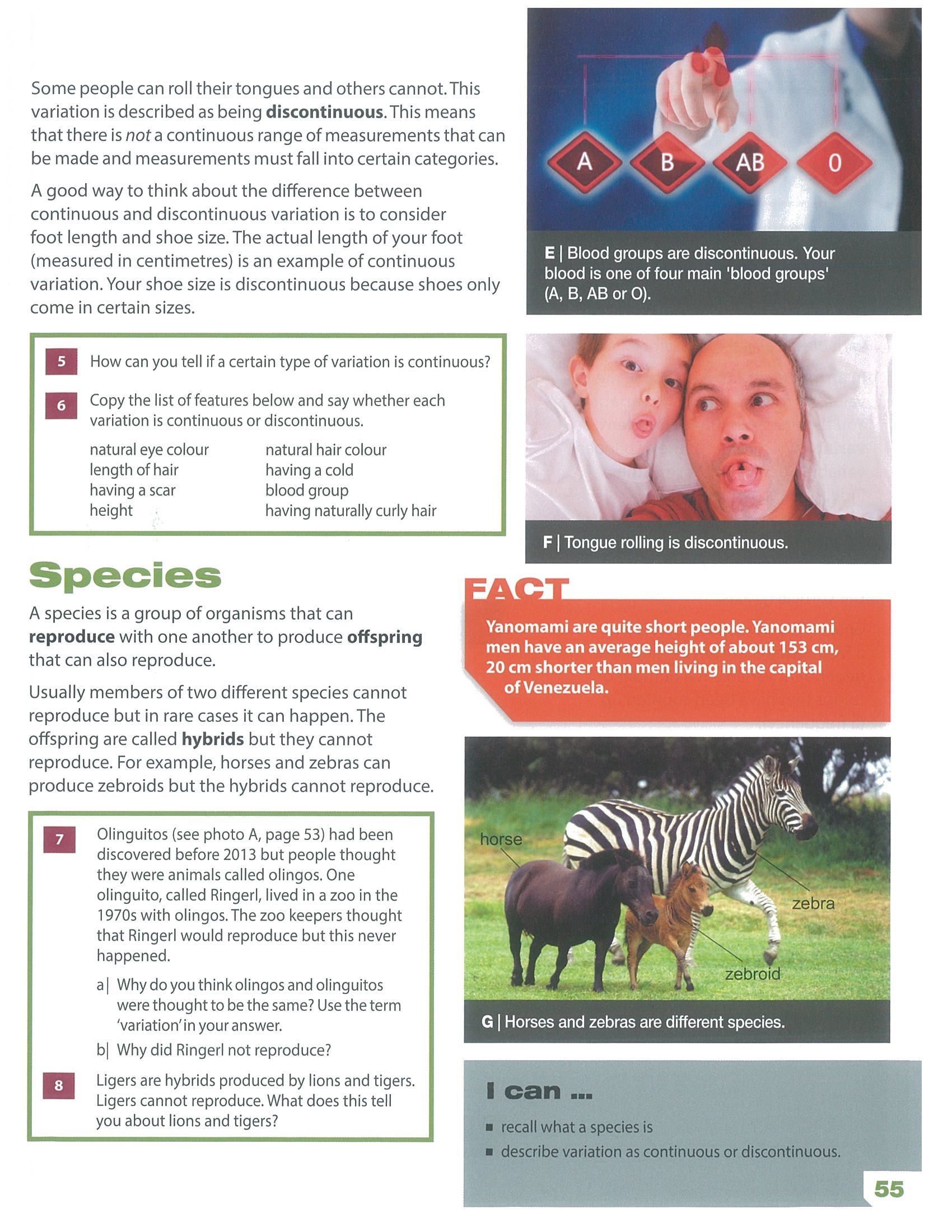
Some people can roll their tongues and others cannot. This variation is described as being discontinuous.
有些人能卷舌,有些不能——这种变异叫不连续变异(discontinuous)。
This means that there is not a continuous range of measurements that can be made and measurements must fall into certain categories.
这意味着测量值不能连续——必须落入几个固定的类别。
A good way to think about the difference between continuous and discontinuous variation is to consider foot length and shoe size. The actual length of your foot (measured in centimetres) is an example of continuous variation. Your shoe size is discontinuous because shoes only come in certain sizes.
理解两者差别的好例子是脚长和鞋码。脚长(cm)是连续变异;鞋码是不连续变异——因为鞋只有特定尺码。
E | Blood groups (A, B, AB, O) — discontinuous
图 E | 血型(A、B、AB、O)— 不连续
Blood groups are discontinuous. Your blood is one of four main 'blood groups' (A, B, AB or O).
血型是不连续变异——血属于 4 种主要血型之一(A、B、AB、O)。
F | Tongue rolling — discontinuous
图 F | 卷舌 — 不连续
Q5 How can you tell if a certain type of variation is continuous?
第 5 题 怎么判断一种变异是连续的?(答:如果测量值可以是任意值(不只是固定几个类别),就是连续)
Q6 Copy the list of features and say whether each variation is continuous or discontinuous: natural eye colour / length of hair / having a cold / height / natural hair colour / having a scar / blood group / having naturally curly hair.
第 6 题 判断每种是连续还是不连续。眼色—不连续(几种类别);头发长度—连续;是否感冒—不连续(是/否);身高—连续;发色—不连续;有疤—不连续;血型—不连续;自然卷—不连续。
Species + Hybrids
物种和杂交后代
A species is a group of organisms that can reproduce with one another to produce offspring that can also reproduce.
物种(species)是一群能相互繁殖(reproduce)、产生后代(offspring),且后代也能再繁殖的生物。
Usually members of two different species cannot reproduce but in rare cases it can happen. The offspring are called hybrids but they cannot reproduce.
通常不同物种之间不能繁殖,但偶有例外。它们的后代叫杂交后代(hybrids),但不能再繁殖。
For example, horses and zebras can produce zebroids but the hybrids cannot reproduce.
例如马和斑马能产 zebroid(斑马驴),但 hybrid 不能再繁殖——说明马和斑马是不同物种。
FACT — Yanomami height
FACT 框 — 亚诺玛米人的身高
Yanomami are quite short people. Yanomami men have an average height of about 153 cm, 20 cm shorter than men living in the capital of Venezuela.
亚诺玛米人较矮——男性平均身高约 153 cm,比委内瑞拉首都的男性矮 20 cm。
Q7 Olinguitos had been discovered before 2013 but people thought they were olingos. Ringerl lived in a zoo with olingos in the 1970s — zoo keepers thought Ringerl would reproduce but this never happened. a) Why were olingos and olinguitos thought to be the same? Use 'variation'. b) Why did Ringerl not reproduce?
第 7 题 2013 年前小白鼻浣熊已经被发现,但被当成 olingos。Ringerl 在 70 年代和 olingos 一起在动物园里,但从没繁殖。a) 为什么误以为是同种?(答:两者长得很像——种间变异不大) b) Ringerl 为什么没繁殖?(答:因为 olinguito 和 olingo 是不同物种,不能成功繁殖)
Q8 Ligers are hybrids produced by lions and tigers. Ligers cannot reproduce. What does this tell you about lions and tigers?
第 8 题 狮虎兽(ligers)是狮子和老虎的杂交后代。狮虎兽不能繁殖——这告诉你狮子和老虎是什么关系?(答:是不同物种)
📄 教材 p.56 · 7Da Charts and Graphs (WS)
HOW ARE BAR CHARTS AND SCATTER GRAPHS USED?
条形图和散点图怎么用?
Variation is the term for the differences between organisms. When we make measurements of variation, what we measure is a variable. A variable is anything that can change and be measured.
变异是生物间的差异。测量变异时,我们测的是变量(variable)——变量是任何可变化且可测量的东西。
In an investigation, you choose the values of the independent variable. You then measure the dependent variable.
实验时,你选定自变量(independent variable)的值,然后测量因变量(dependent variable)。
The values of the dependent variable depend on those of the independent variable.
因变量的值取决于自变量的值。
On a chart or a graph, the independent variable goes on the horizontal (x) axis and the dependent variable goes on the vertical (y) axis.
图表中,自变量放横轴 (x),因变量放纵轴 (y)。
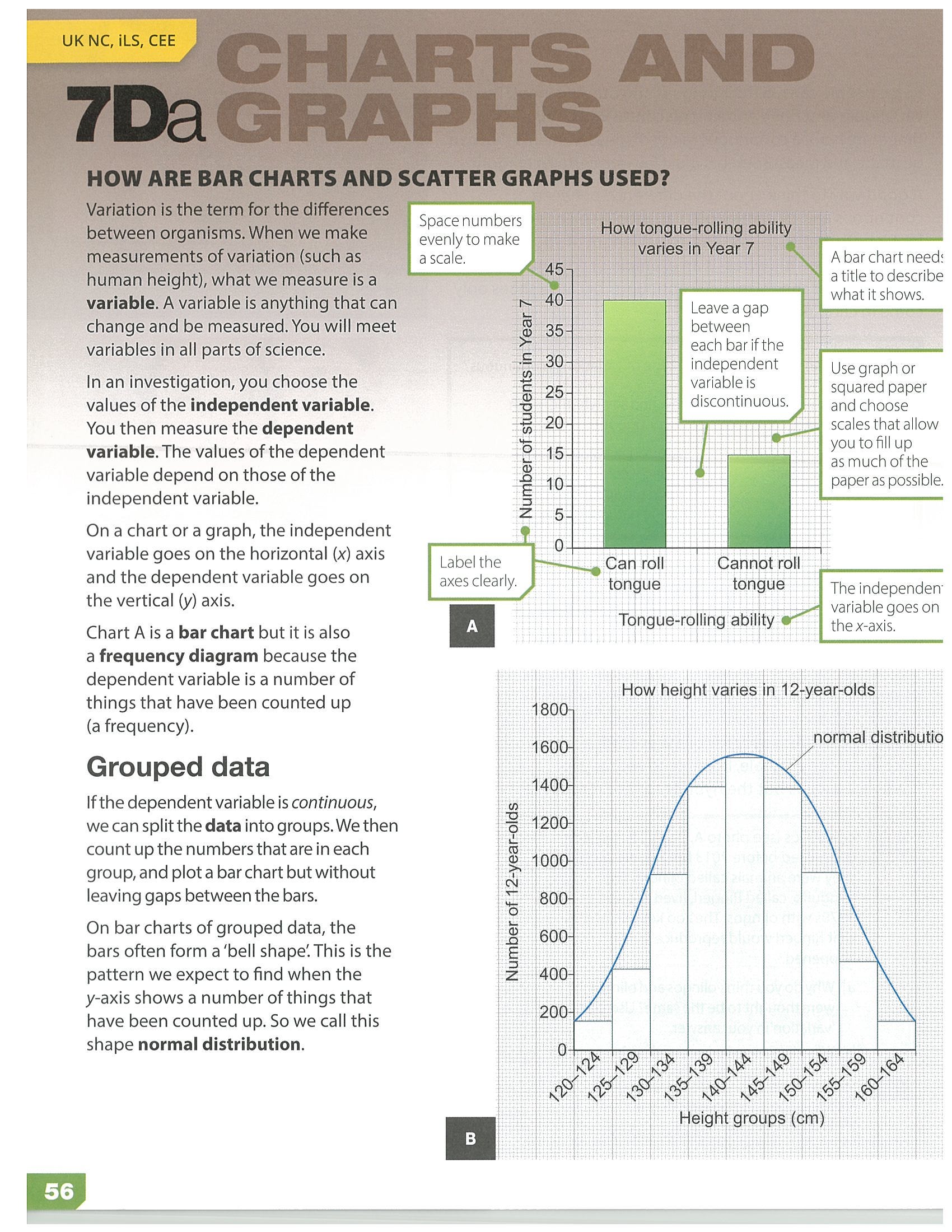
A | bar chart — tongue rolling
图 A | 条形图 — 卷舌能力
Chart A is a bar chart but it is also a frequency diagram because the dependent variable is a number of things that have been counted up (a frequency).
图 A 是条形图,也是频率图(frequency diagram)——因为因变量是数出来的"频次"。
A bar chart needs: a title; numbers spaced evenly to make a scale; clear axis labels; the independent variable on the x-axis. Leave a gap between each bar if the variable is discontinuous.
条形图需要:标题、均匀间距的刻度、清晰的坐标轴标签、自变量放 x 轴。如果变量不连续——柱子之间要留间隙。
Grouped data
分组数据
If the dependent variable is continuous, we can split the data into groups. We then count up the numbers that are in each group, and plot a bar chart but without leaving gaps between the bars.
如果因变量是连续的,可以把数据分组。然后数每组个数,画条形图——柱子之间没有间隙。
On bar charts of grouped data, the bars often form a 'bell shape'. This is the pattern we expect to find when the y-axis shows a number of things counted up. So we call this shape normal distribution.
分组数据的条形图常呈"钟形"——我们预期 y 轴是计数时会出现这种模式。这种形状叫正态分布(normal distribution)。
B | bar chart — height in 12-year-olds (normal distribution)
图 B | 条形图——12 岁孩子身高(呈正态分布)
📄 教材 p.57 · 7Da Scatter Graphs (WS)
Scatter graphs
散点图
Sometimes we want to know if there is a relationship (link) between two variables. In this case we draw a scatter graph.
有时我们想知道两个变量之间有没有关系(relationship)——这时画散点图(scatter graph)。
C | scatter graph — tree width vs leaf mass
图 C | 散点图——树冠宽度 vs 叶子质量
In graph C we can clearly see that there is a pattern in the points. As the width of the top of a tree increases, so does the mass of its leaves.
图 C 里点的模式很明显——树冠越宽,叶子质量越大。
A line of best fit is often drawn through the points, and it can help to make a relationship look more obvious. About half the points are below the line and half are above it.
常画一条最佳拟合线(line of best fit)穿过点——让关系看起来更明显。大约一半点在线上方、一半在下方。
If there is no link between two variables, then there will be no clear pattern of points.
如果两个变量之间没有联系,点就不会有清晰的模式。
D | no relationship — tree height vs leaf mass
图 D | 没有关系——树高 vs 叶子质量(这两个变量之间没有联系)
Q1 What are the dependent and independent variables in chart A?
第 1 题 图 A 中的因变量和自变量是?(答:自变量 = 卷舌能力(能 / 不能);因变量 = 人数(次数))
Q2 Present the data in table E as a bar chart.
第 2 题 把表 E 的数据(7K 班的血型分布:A 17, B 8, AB 2, O 12 或类似)画成条形图——血型是不连续变量,柱子之间要留间隙。
Q3 Table F shows the lengths (L) and widths (W) of some leaves from rose plants. a) Divide the data into groups, using either the widths or lengths of the leaves. b) Draw a bar chart for the data you have selected in part a.
第 3 题 表 F 是玫瑰叶的长度(L)和宽度(W)。a) 用长或宽给数据分组。 b) 画条形图——因为是连续变量,柱子之间不留间隙。
Q4 Use the data in table F to find out if there is a relationship between rose leaf length and width. Use length as the independent variable.
第 4 题 用表 F 数据找玫瑰叶长度和宽度的关系。把长度作自变量——画散点图,加最佳拟合线。如果点呈现明显趋势就有关系(事实上长度越大宽度也越大)。
I can…
我能……
recall what a species is / describe variation as continuous or discontinuous / present information as bar charts and scatter graphs / identify relationships using scatter graphs
记住物种的定义 / 描述变异是连续还是不连续 / 用条形图和散点图呈现信息 / 用散点图识别关系
💡 7Da 出现的 5 个核心英文术语 · 含音标 / 词性 / 词源 / 教材原句 / 现代延伸 / 易错。
🧬 物种 + 变异核心词
species
/ˈspiːʃiːz/
n.
物种
词源拉丁 species(外貌、种类)→ "看起来同类的东西"
教材"a species is a group of organisms that can breed together to produce fertile offspring"(物种=能互相繁殖产生可育后代的生物群)
延伸① special 特别的(同源:种类)② endangered species 濒危物种 ③ 拉丁学名 Homo sapiens(智人=人这个种)
拼写陷阱:species 单复数同形!一个 species、十个 species 都不加 s。读音 /ˈspiːʃiːz/ 不是 /ˈspeɪsɪs/。
variation
/ˌveəriˈeɪʃn/
n.
变异;差异
词源拉丁 variare(变化)→ "不一样"
教材"variation is the differences between organisms"(变异=生物之间的差异)
延伸① various 各种各样的 ② variety 多样性 ③ 数学里 variable 变量
两种 variation 必考:① continuous(连续,如身高)画 frequency diagram(柱子无间隔)② discontinuous(不连续,如血型)画 bar chart(柱子有间隔)。
habitat
/ˈhæbɪtæt/
n.
栖息地
词源拉丁 habitare(居住)→ "住的地方"
教材"a habitat is the place where an organism lives"(栖息地=生物居住的地方)
延伸① inhabit v. 居住 ② inhabitant 居民 ③ habit 习惯(住惯了)
habitat vs environment:habitat 是地点(沙漠、极地);environment 是条件(光/温/水)。环境里包含很多 abiotic factors。
hybrid
/ˈhaɪbrɪd/
n.
杂交后代
词源拉丁 hybrida(混血、杂种)
教材"a mule is a hybrid of a horse and a donkey"(骡子是马和驴的杂交后代)
延伸① hybrid car 混合动力车(电+油)② hybrid work 混合办公(在家+办公室)
判物种的关键:hybrid 通常不能再繁殖(如骡、liger 狮虎兽、zebroid 斑马驴)。所以马 vs 驴 = 两个 species。考试反复考!
📊 图表术语
variable
/ˈveəriəbl/
n./adj.
变量;可变的
词源同 variation 同根(vary = 变)+ -able(能…的)= "能变的"
教材"the independent variable goes on the x-axis"(自变量放 x 轴)
延伸① independent variable 自变量(你改的)放 x 轴 ② dependent variable 因变量(被测的)放 y 轴
记忆口诀"我改 x,测 y"。independent = 你独立决定改它;dependent = 它依赖于自变量。摆错轴直接丢分!
🎯 隐性技能专项 · 考试不教但必丢分的能力
💡 点卡片翻面看答案。本章 25 个高频术语(生态学概念多易混),考试拼写错就直接丢分。
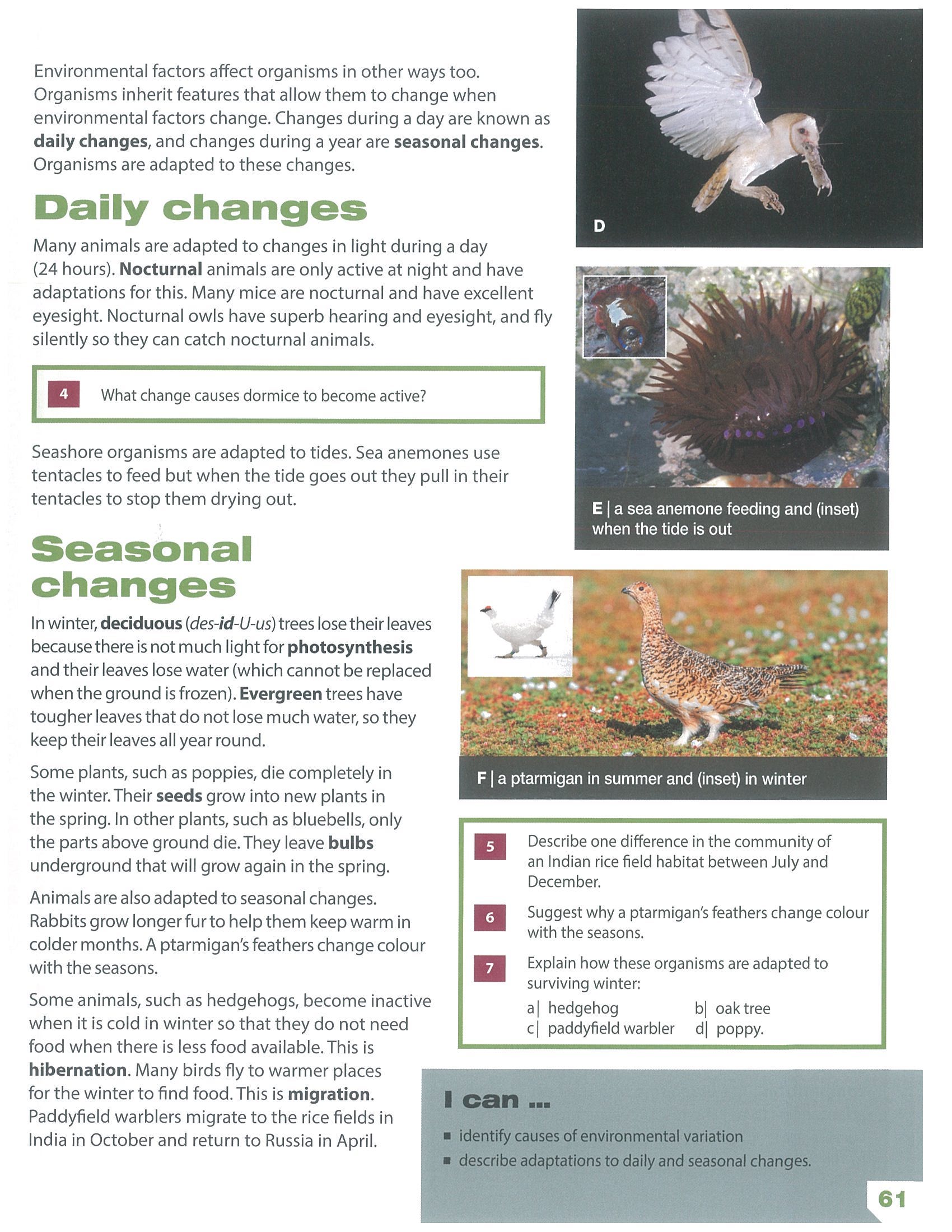
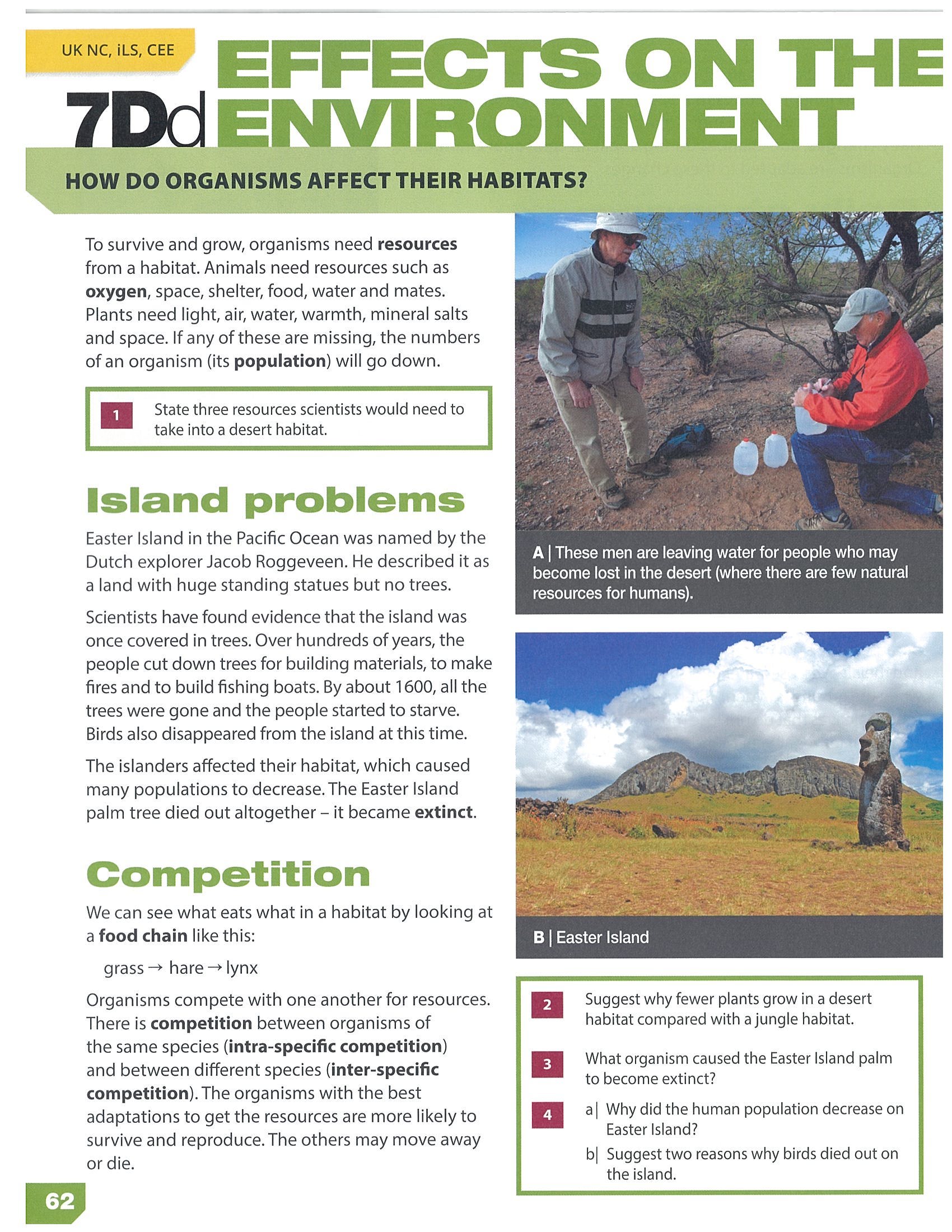
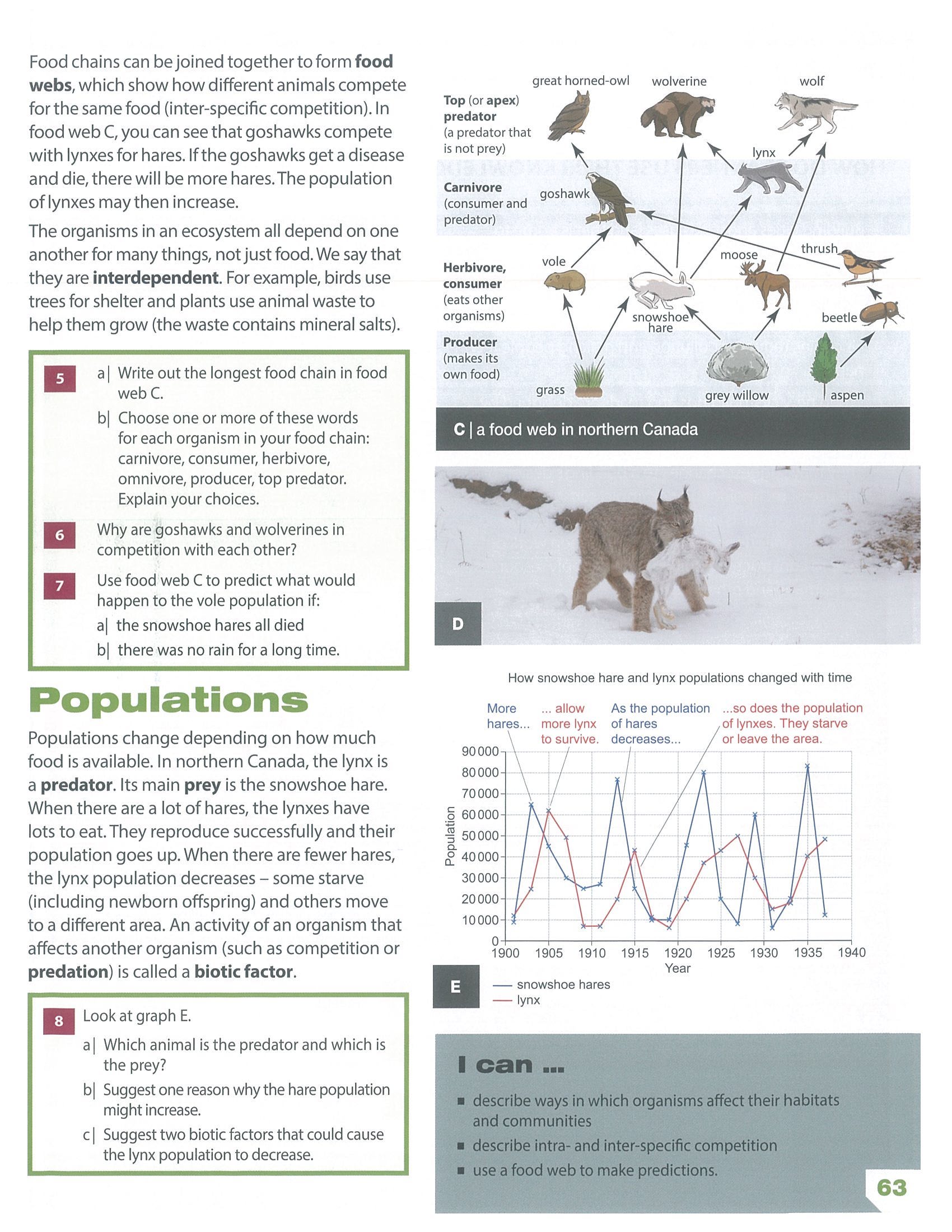
💡 玩法:先点一个英文标签(变金色高亮),再点正确的食物链位置即可放入。点已放好的部位会取回标签。本图考察 trophic levels 的识别——SUIS 必出题型。
把这些标签点到正确位置:
producer
primary consumer
secondary consumer
apex predator
herbivore
omnivore
decomposer
parasite
💡 注意:bank 里有 8 个标签,但图上只有 4 个空——多出来的是干扰项(herbivore/omnivore 是饮食分类、decomposer/parasite 不在主食物链)。考试也是这样。
💡 看清楚题干用的指令词,答题方式完全不同。
| 指令词 | 要求 | 错误示范 | 正确示范 |
|---|---|---|---|
| State | 用一个完整句子说清事实 | "control"(光这一个词不行) | "The control variable is the temperature of the water." |
| Name | 给一个单词或短语即可 | "the heart"(前面冠词常加分) | "heart" 或 "the heart" |
| List | 给几个项目(数字明示) | 只写 1 个但题目问 3 个 | 分行写出确切数目,编号 i, ii, iii |
| Describe | 说出"是什么样",需要细节 | "It's an organ."(太短) | "The heart is a muscular organ that pumps blood around the body." |
| Explain | 必须说"为什么",要有 because | "It's important." 没说为什么 | "This is important because blood carries oxygen to cells." |
| Suggest | 给合理猜测(题目没标准答案) | 留白不写 | 大胆给一个有逻辑的回答,写完整句子 |
| Compare | 同时说相同点和不同点 | 只说不同点 | "Both X and Y have...; however, X has..., whereas Y has..." |
| Tick / Choose | 勾选一个或多个框 | 选了 2 个但题目说 one box | 仔细看 "Tick (✓) one box" / "two boxes" |
📌 实战提示:考试翻到一题,先圈出指令词(state / explain / suggest...),再答题。这一步能让你少丢 5–10 分。
📝 分级练习 · 由易到难闯关
❌ 错题本 · 自动收集你标错的题
还没有错题。做题时点击"做错了"会自动收集到这里。
✅ 考前自检清单 · 全勾上才能进考场
已掌握 0 / 0