🚪 学习前导 · 先看这里再开始
🎯 学完你能干什么
- 能说出 4 个 S-factors 并对应运动类型
- 能区分 breathing / ventilation / gas exchange / respiration 四个易混词
- 能比较 artery / vein / capillary 的结构和功能
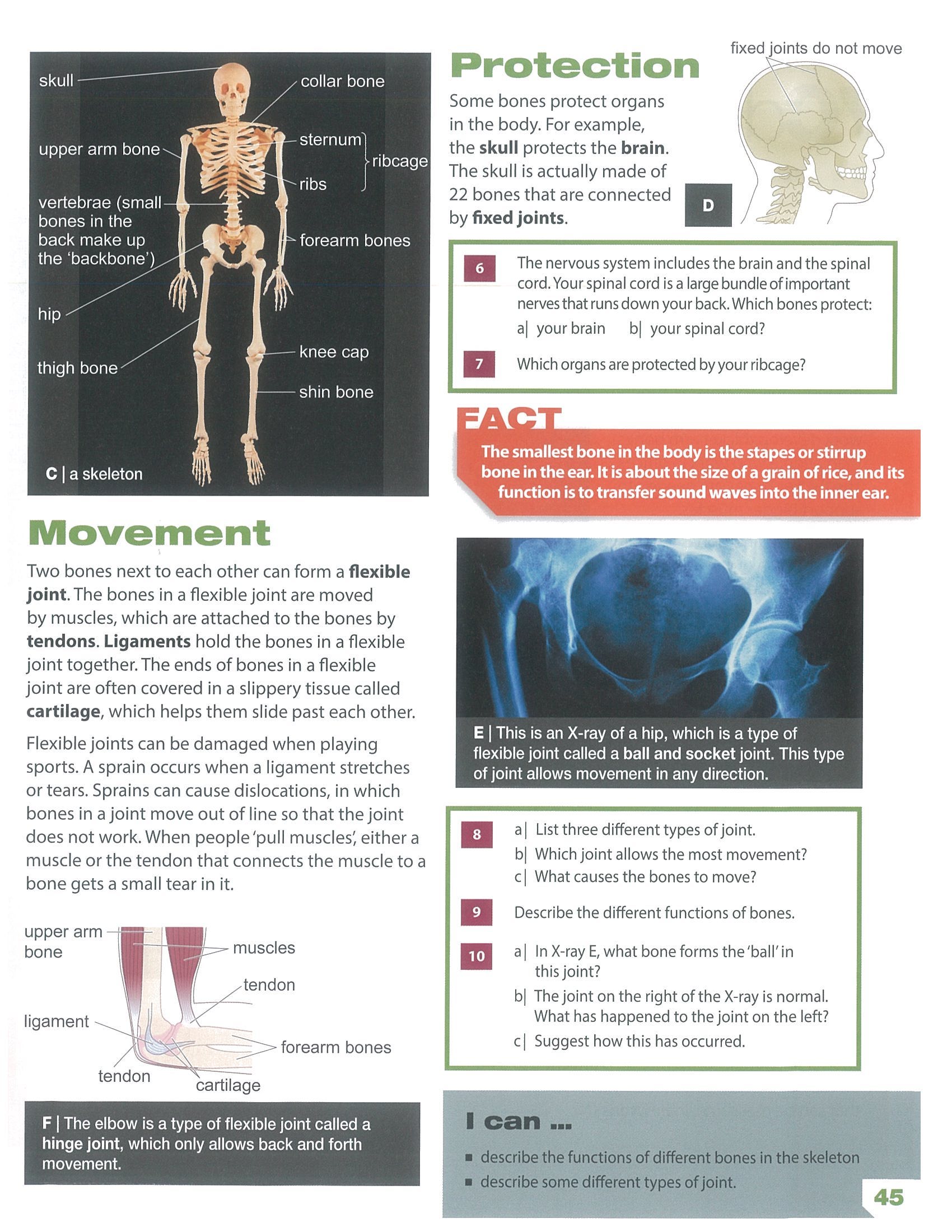
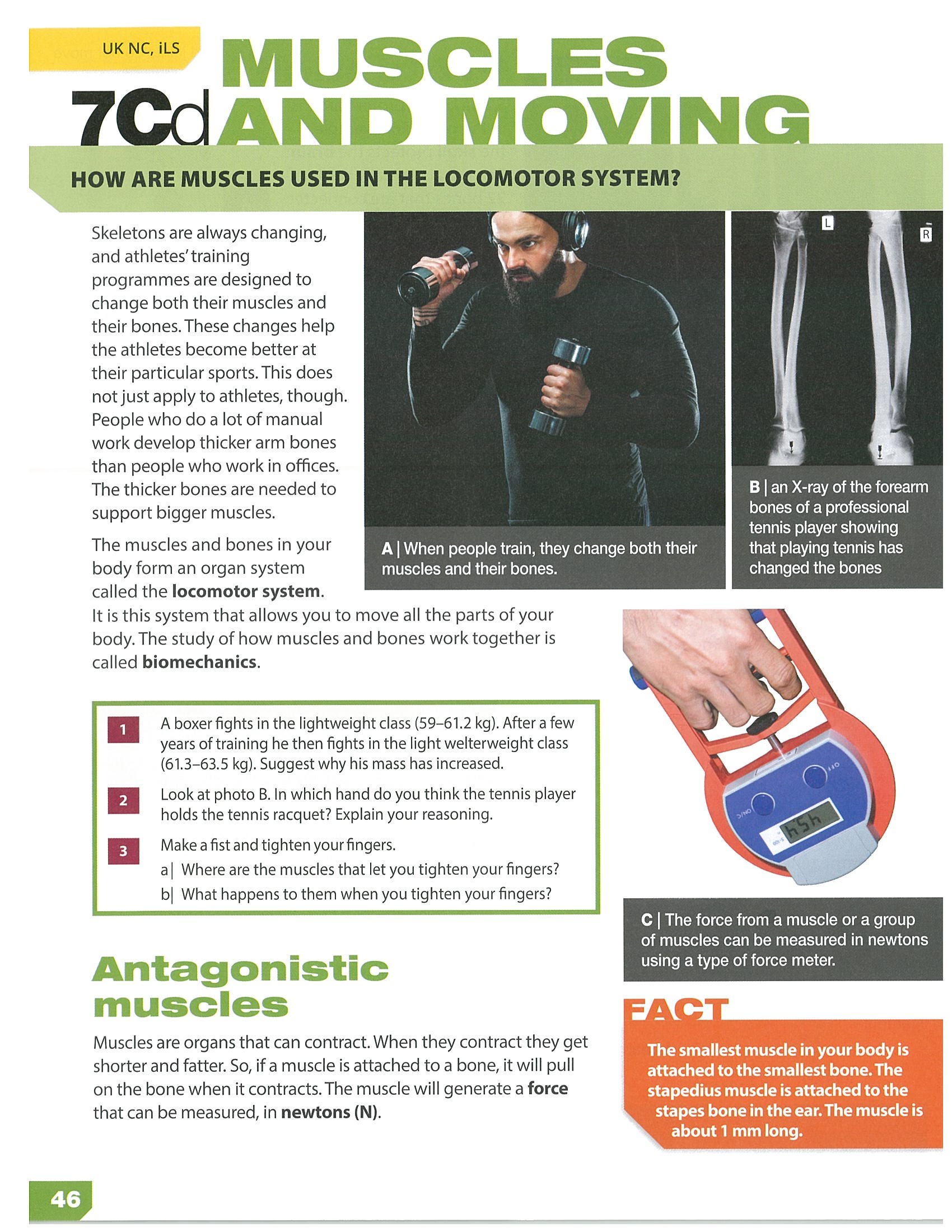
- 能在骨骼图上标至少 6 个主要骨骼,列出 5 个功能
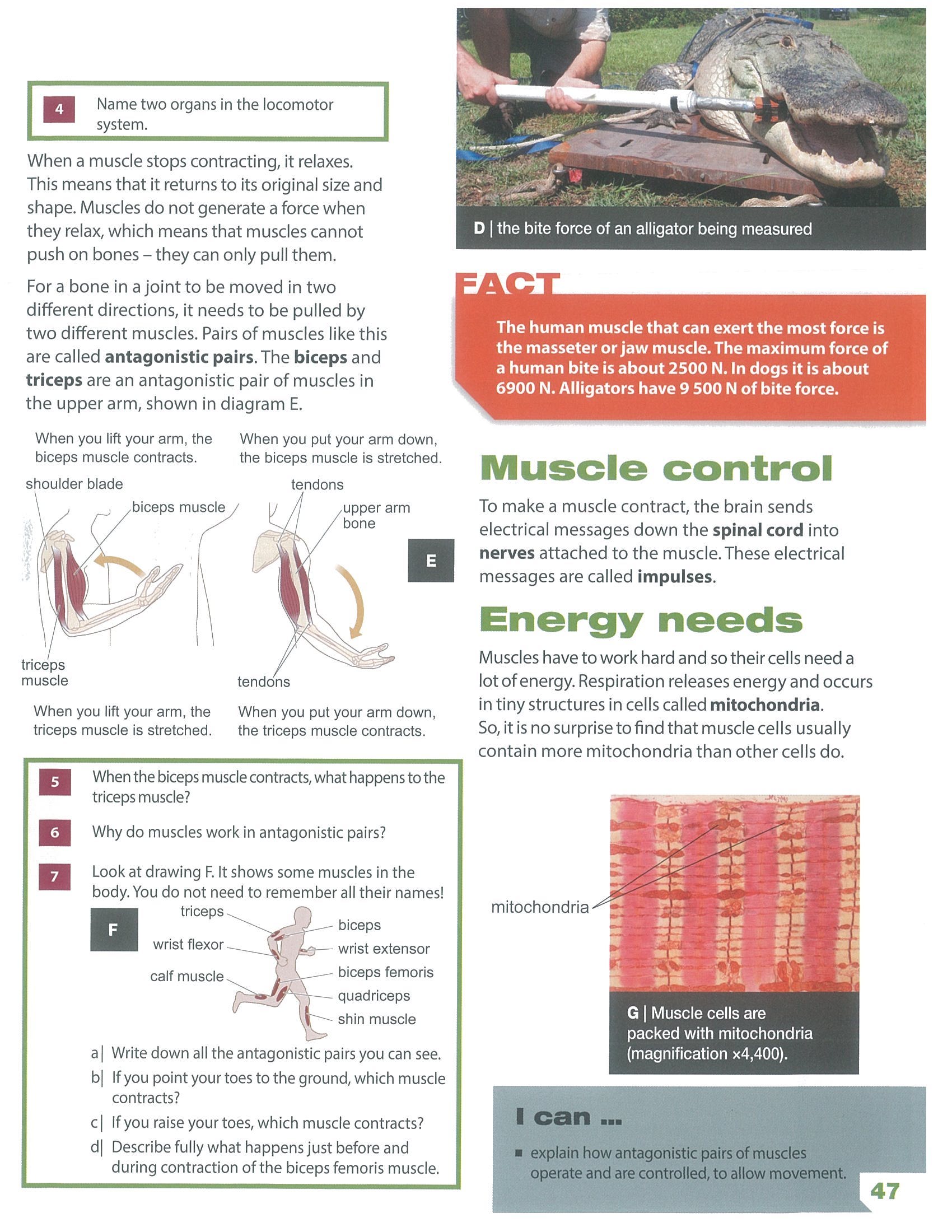
- 能用 biceps / triceps 解释 antagonistic pairs(对抗肌)
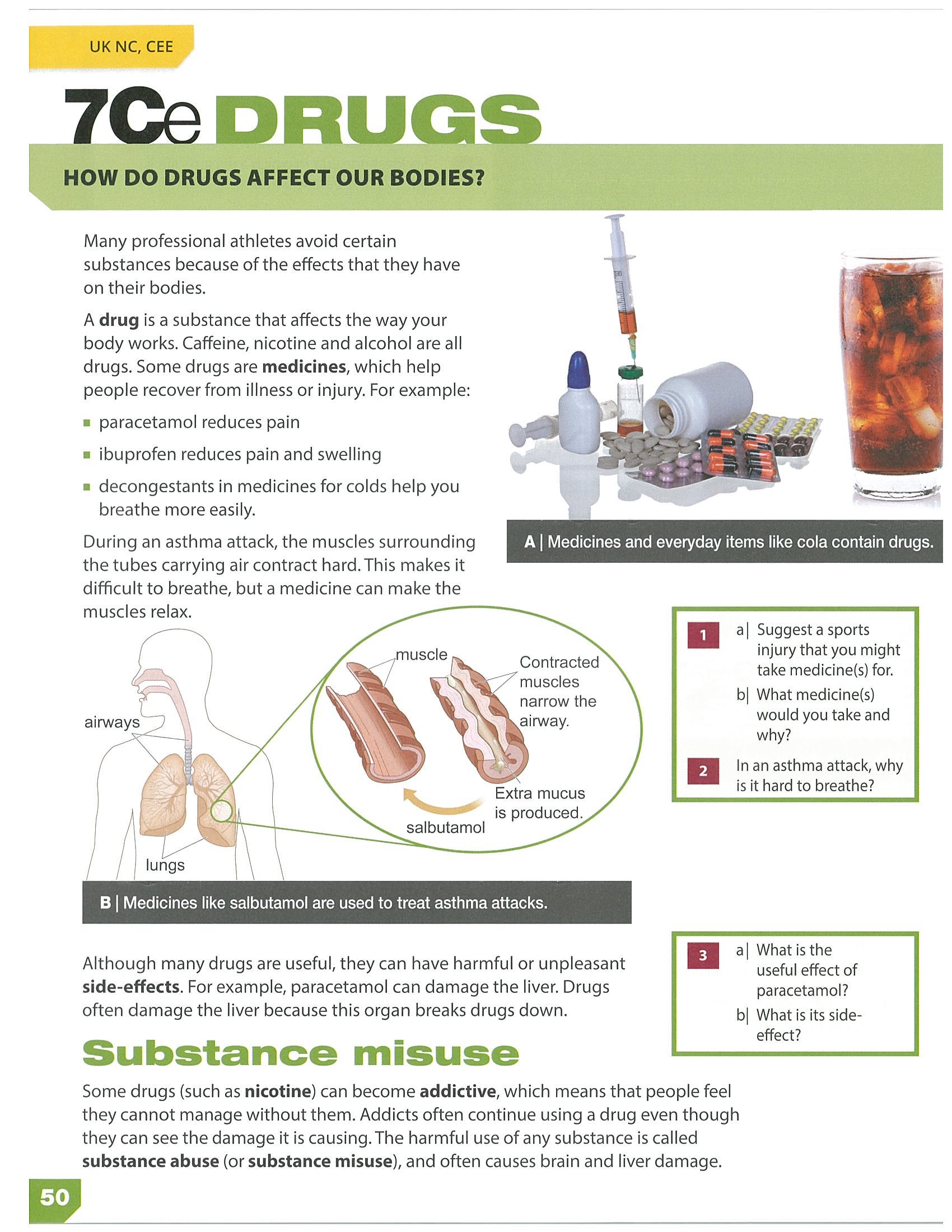
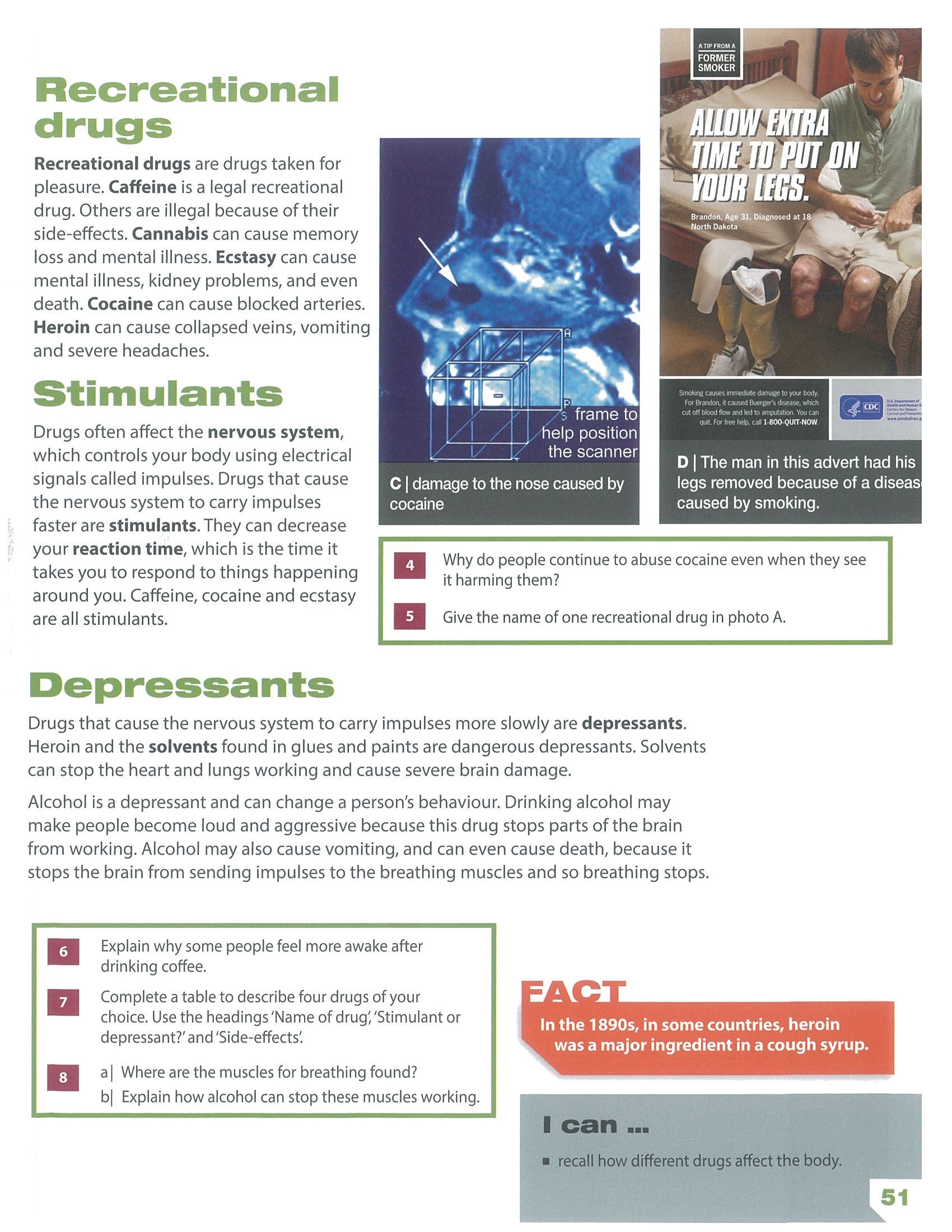
- 能区分 stimulant 和 depressant,各举一个例子
- 能解释红细胞如何 specialised(无核 + 盘状)
🛣️ 推荐学习路径
- 通读教材 16 页(不查词,速读 30 分钟)
- 跟读本视图:左边看教材图,右边看笔记(约 2.5 小时)
- 做 Workbook 7C 全部题目(约 1.5 小时)
- 专项训练:拼写卡 + 骨骼图标注 + 答题规范(30 分钟)
- 挑战分级练习 L1→L2→L3(约 1 小时)
- 查漏错题本 + 自检清单(考前 30 分钟)
⚠️ 老师常考
- 必考 主要骨骼名称 + 骨骼 5 个功能
- 必考 artery vs vein vs capillary 三种血管对比
- 必考 吸气 / 呼气时肌肉变化(横膈膜 + 肋间肌)
- 高频 红细胞为什么没 nucleus + 盘状 = 大表面积
- 高频 antagonistic pairs(biceps / triceps)
- 高频 stimulant vs depressant 对 reaction time 的影响
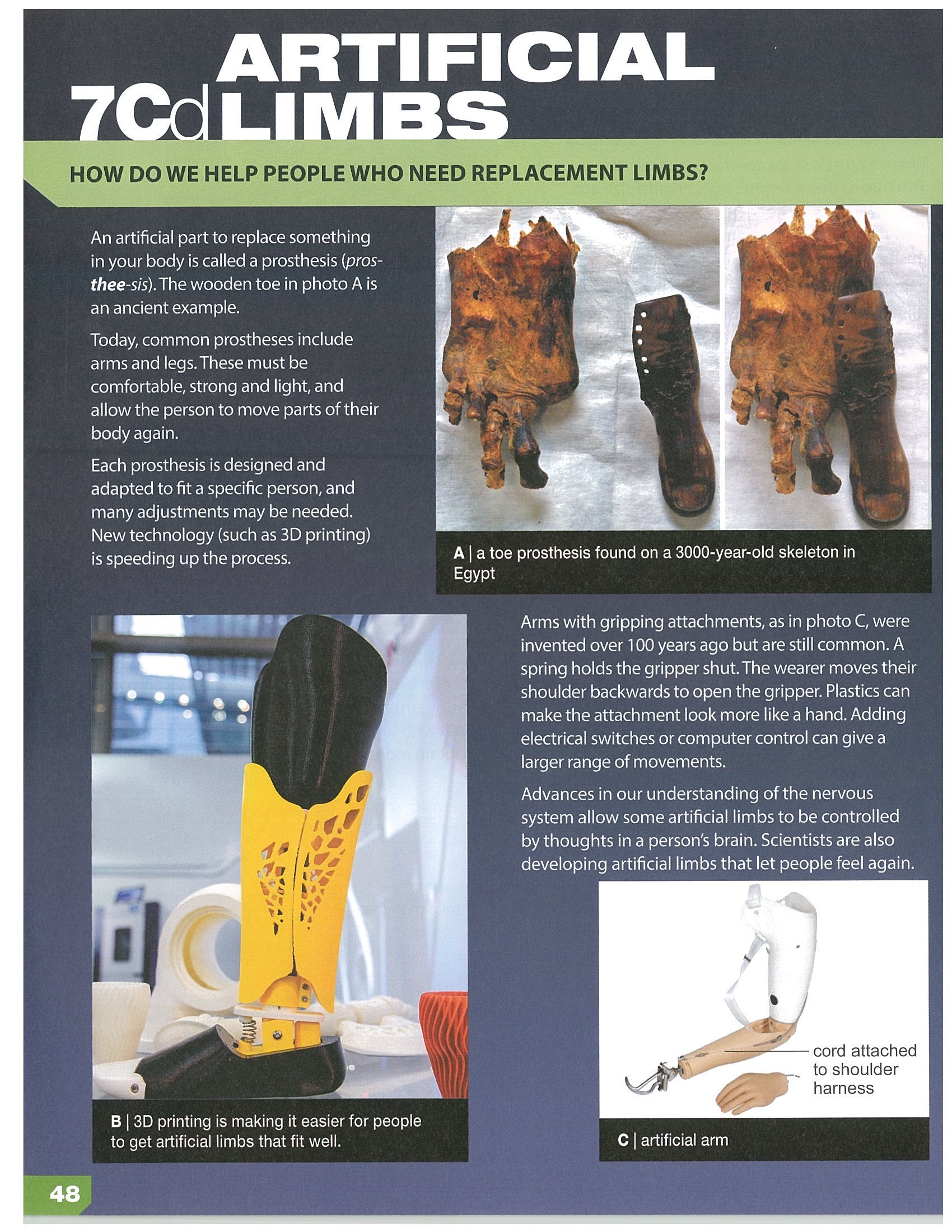
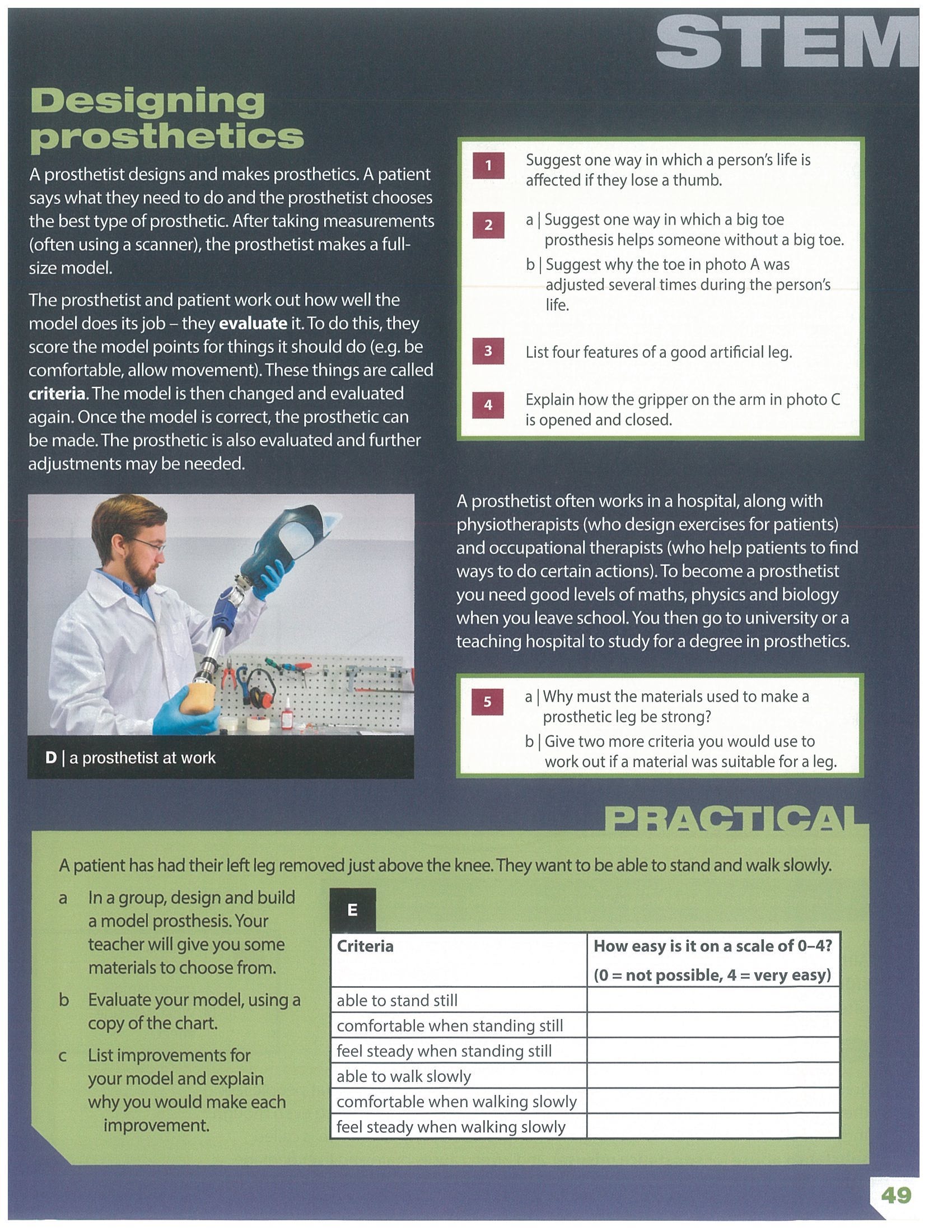
- 拓展 STEM:假肢设计 criteria;EPO + 类固醇禁药
🧭 前置回顾(来自 7A、7B)
- cell → tissue → organ → organ system 五层级(7A)
- specialised cell(特化细胞)—— 红细胞是另一个典型例子
- cell 结构里的 mitochondria(线粒体)—— 肌肉细胞含很多
- life processes 中的 respiration(呼吸作用,不是 breathing!)
- scientific method 6 阶段(7B)
📖 教材跟读 · 左图右注
📄 教材 p.37–39
📝 学习内容
核心理解:健身 + 呼吸(气体交换)
1. Being 'fit' 是什么意思?
"Fit" = 能完成日常活动(如爬楼不喘、举东西不累)。Fitness 包含 4 个核心因素,称为 S-factors:
| 英文 | 中文 | 例子 |
|---|---|---|
| Suppleness | 柔韧 | 体操、舞蹈 |
| Strength | 力量 | 举重 |
| Speed | 速度 | 短跑、自行车 |
| Stamina | 耐力 | 长跑、马拉松 |
criteria 标准 = 用来判断 fit 程度的尺度(如"能跑 5 km 不停")。
2. 为什么需要 oxygen?
所有细胞需要 respiration(呼吸作用)释放能量。
⚠️ 注意:respiration ≠ breathing!
- respiration:在细胞内分解食物释放能量(产生 carbon dioxide 作为废物)
- breathing / ventilation:肺吸入和呼出空气
- gas exchange 气体交换:在肺里氧进血液,二氧化碳出血液
空气含 oxygen 的百分比是?呼出的气还含 oxygen 吗?
💡 空气约 20%(1/5)是 oxygen。呼出气里还有约 16% oxygen——因为我们不能 100% 吸收,所以可以做人工呼吸。
3. Breathing 系统的器官
- trachea(气管,= windpipe):空气进出肺的管道
- lungs:发生气体交换的地方(肺里约 2400 km 的气管!)
- ribs 肋骨:保护肺和心脏
- diaphragm 横膈膜:肺下方的肌肉
- intercostal muscles 肋间肌:连接肋骨之间
4. 吸气 / 呼气的肌肉运动
| Inhalation 吸气(= inspiration) | Exhalation 呼气(= expiration) | |
|---|---|---|
| 肋间肌 | 收缩,肋骨向上向外 | 放松,肋骨向下向内 |
| 横膈膜 | 收缩,向下 | 放松,向上 |
| 肺 | 扩张,空气进入 | 收缩,空气排出 |
肌肉只能 contract(收缩),不能 push(推)。那为什么呼气时肌肉"放松"也能让气出去?
💡 肌肉本身没有 push。当肋间肌和横膈膜放松时,肋骨靠重力下沉、横膈膜被腹腔器官顶起 → 肺体积变小 → 空气被挤出。是压力差把气推出,不是肌肉推。
⚠️ 高频陷阱:考试题问 "What happens during inhalation?" 时,要写明多个步骤(肌肉变化 + 体积变化 + 气体流向)。只写"air enters the lungs"会丢分。
✅ 学完小检查(3 题)
1. 我能说出 4 个 S-factors 的英文名和例子
2. 我能区分 respiration / breathing / gas exchange
3. 我能描述吸气时肌肉和肺的变化
💡 句子级中英对照。建议先关掉翻译试读英文,卡住再切回。
📄 教材 p.37 · 7Ca Fitness
Being 'fit' means that your body is able to do the activities that your lifestyle demands.
"健壮(fit)"是指你的身体能完成你的生活方式所要求的活动。
This includes things like being able to run upstairs without getting out of breath or being strong enough to lift things.
包括像能跑上楼不喘气、有足够力气搬东西这样的事。
Fitness therefore means different things to different people, but we can think of fitness being made up of four S-factors: 'suppleness', 'strength', 'speed' and 'stamina'.
所以 fitness 对不同人意义不同——我们可以把它分成四个 S-factor:suppleness(柔韧)、strength(力量)、speed(速度)、stamina(耐力)。
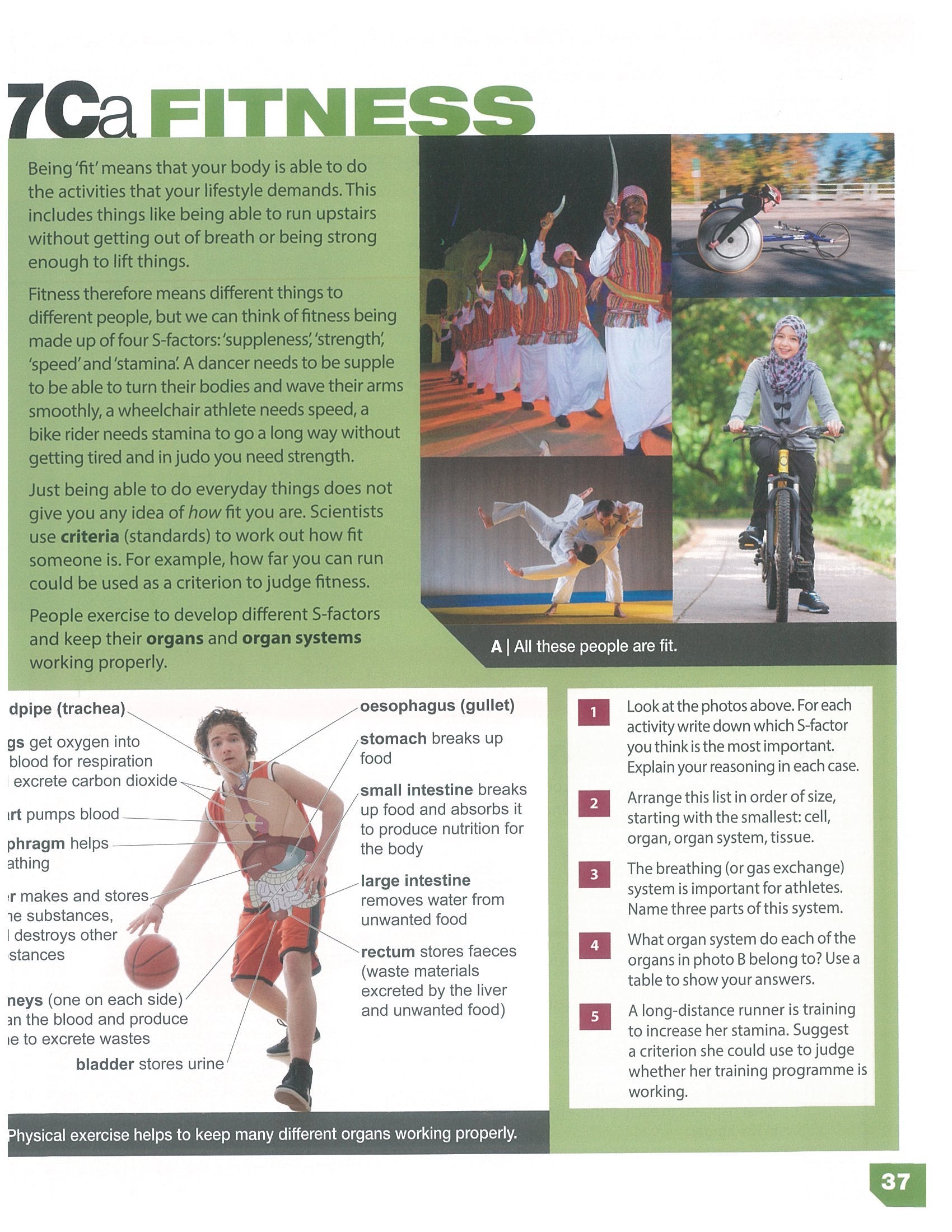
A dancer needs to be supple to be able to turn their bodies and wave their arms smoothly, a wheelchair athlete needs speed, a bike rider needs stamina to go a long way without getting tired and in judo you need strength.
舞者需要柔韧才能流畅地转动身体、挥舞手臂;轮椅运动员需要速度;自行车手需要耐力骑长距离不累;柔道需要力量。
Just being able to do everyday things does not give you any idea of how fit you are.
仅仅能做日常活动并不能告诉你你有多 fit。
Scientists use criteria (standards) to work out how fit someone is. For example, how far you can run could be used as a criterion to judge fitness.
科学家用标准(criteria,单数 criterion)来判断一个人有多 fit。例如,能跑多远可以作为评估 fitness 的标准。
People exercise to develop different S-factors and keep their organs and organ systems working properly.
人们通过锻炼来发展不同的 S-factor,并保持器官和器官系统正常工作。
A | All these people are fit.
图 A | 这些人都很 fit(健壮)。
Q1 Look at the photos above. For each activity write down which S-factor you think is the most important. Explain your reasoning in each case.
第 1 题 看上面的照片。对每项活动写出你认为最重要的 S-factor,并解释理由。
Q2 Arrange this list in order of size, starting with the smallest: cell, organ, organ system, tissue.
第 2 题 按从小到大排序:cell(细胞)、organ(器官)、organ system(器官系统)、tissue(组织)。(答:cell → tissue → organ → organ system)
Q3 The breathing (or gas exchange) system is important for athletes. Name three parts of this system.
第 3 题 呼吸系统(气体交换系统)对运动员很重要。说出其中 3 个部分。(答:气管 trachea、肺 lungs、横膈膜 diaphragm,还有肋骨 ribs、肋间肌 intercostal muscles)
Q4 What organ system do each of the organs in photo B belong to? Use a table to show your answers.
第 4 题 图 B 中每个器官分别属于哪个器官系统?用表格回答。(肺→呼吸;心→循环;胃/肠/肝→消化;肾/膀胱→泌尿)
Q5 A long-distance runner is training to increase her stamina. Suggest a criterion she could use to judge whether her training programme is working.
第 5 题 一位长跑运动员在训练增加耐力。建议一个标准来判断训练效果。(如:跑同样距离用时变短 / 不喘气能跑的最大距离变长 / 静息脉搏率下降)
📄 教材 p.38 · 7Ca Muscles and Breathing
HOW DO MUSCLES HELP WITH GAS EXCHANGE?
肌肉如何帮助气体交换?
About one-fifth or 20 per cent of the air is oxygen.
空气中约 1/5(20%)是氧气。
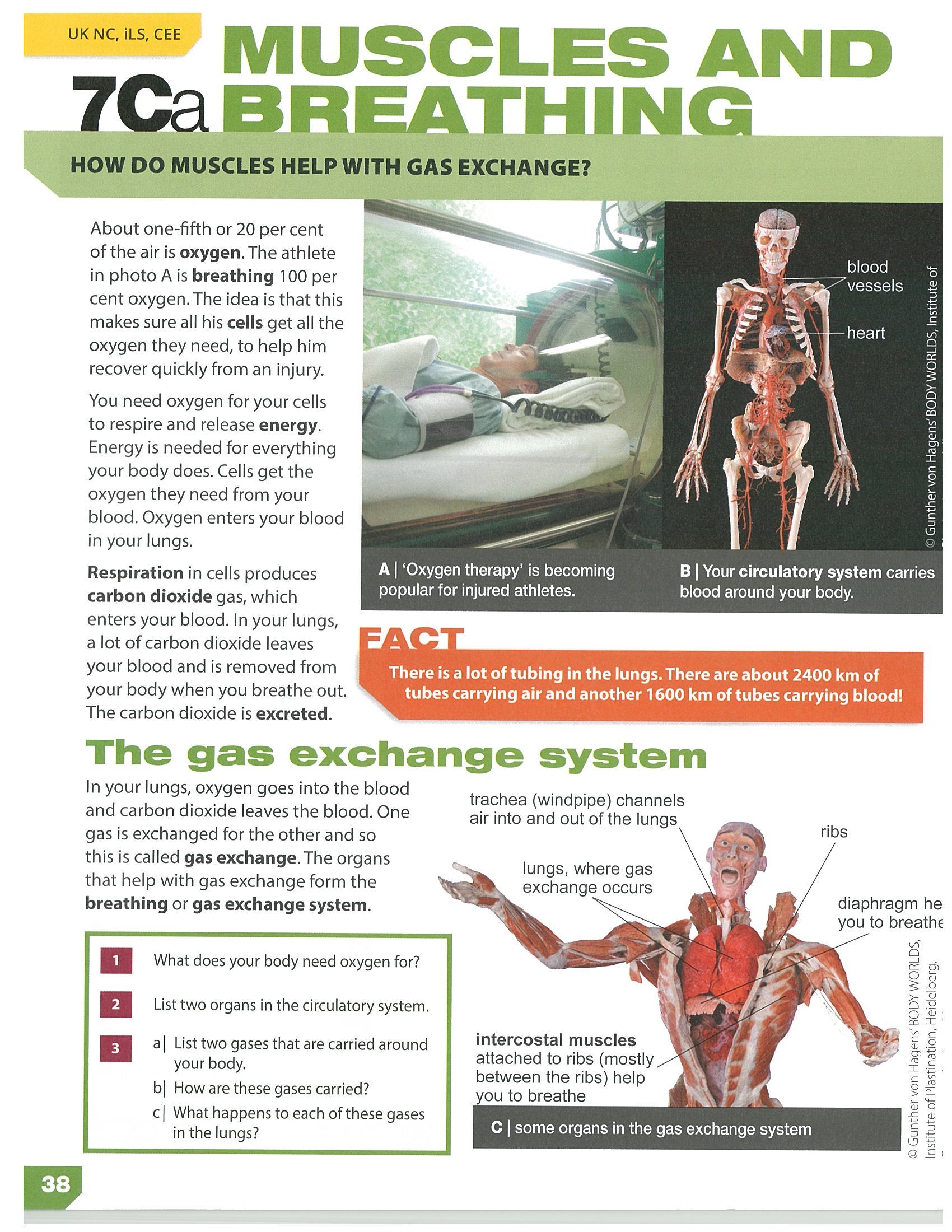
The athlete in photo A is breathing 100 per cent oxygen. The idea is that this makes sure all his cells get all the oxygen they need, to help him recover quickly from an injury.
图 A 里的运动员在吸纯氧(100% oxygen)。原理是确保所有细胞获得足够氧气,帮助他从伤痛中快速恢复。
A | 'Oxygen therapy'
图 A | "氧疗(Oxygen therapy)"——在受伤运动员中变得流行
You need oxygen for your cells to respire and release energy. Energy is needed for everything your body does.
细胞需要氧气来呼吸作用(respire)、释放能量。身体做任何事都需要能量。
Cells get the oxygen they need from your blood. Oxygen enters your blood in your lungs.
细胞从血液中获取氧气。氧气在肺里进入血液。
Respiration in cells produces carbon dioxide gas, which enters your blood. In your lungs, a lot of carbon dioxide leaves your blood and is removed from your body when you breathe out. The carbon dioxide is excreted.
细胞内的呼吸作用产生二氧化碳气体,进入血液。在肺里,大量二氧化碳离开血液,呼气时被排出体外——二氧化碳被排泄。
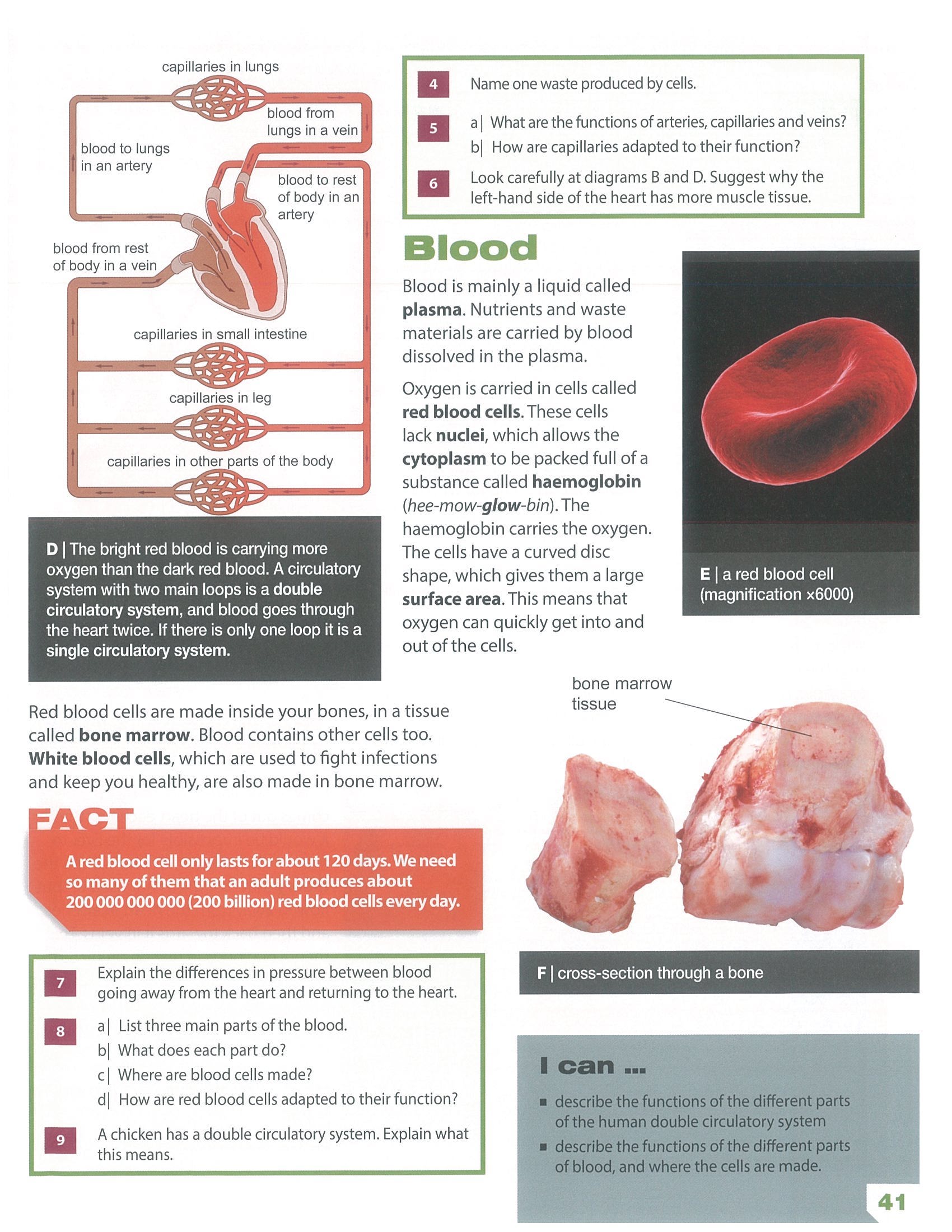
B | Your circulatory system carries blood around your body.
图 B | 你的循环系统在全身输送血液(标签:blood vessels 血管 / heart 心脏)
FACT
FACT 框
There is a lot of tubing in the lungs. There are about 2400 km of tubes carrying air and another 1600 km of tubes carrying blood!
肺里有大量管道——约 2400 km 输送空气的管,还有 1600 km 输送血液的管!
The gas exchange system
气体交换系统
In your lungs, oxygen goes into the blood and carbon dioxide leaves the blood. One gas is exchanged for the other and so this is called gas exchange.
在肺里,氧气进入血液,二氧化碳离开血液。一种气体被换成另一种——这叫气体交换(gas exchange)。
The organs that help with gas exchange form the breathing or gas exchange system.
帮助气体交换的器官组成呼吸系统(breathing system)或气体交换系统(gas exchange system)。
C | some organs in the gas exchange system — labels
图 C | 气体交换系统中的一些器官 — 标签
trachea (windpipe) channels air into and out of the lungs
气管(trachea / windpipe)把空气送入和送出肺
ribs
肋骨(ribs)
lungs, where gas exchange occurs
肺(lungs)——气体交换发生的地方
intercostal muscles attached to ribs (mostly between the ribs) help you to breathe
肋间肌(intercostal muscles)连接在肋骨上(大多在肋骨之间),帮助呼吸
diaphragm helps you to breathe
横膈膜(diaphragm)帮助呼吸
Q1 What does your body need oxygen for?
第 1 题 身体为什么需要氧气?(答:让细胞进行呼吸作用 respiration,释放能量)
Q2 List two organs in the circulatory system.
第 2 题 列出循环系统的两个器官。(答:heart 心脏 + blood vessels 血管)
Q3 a) List two gases that are carried around your body. b) How are these gases carried? c) What happens to each of these gases in the lungs?
第 3 题 a) 列出全身运输的两种气体。(氧气 + 二氧化碳) b) 怎么运输?(由血液) c) 各自在肺里发生什么?(氧气从空气进入血液;二氧化碳从血液进入空气并被呼出)
📄 教材 p.39 · 7Ca Breathing (Muscle Cells + Ventilation)
Breathing
呼吸
Breathing is when muscles between the ribs and in the diaphragm change the size of the lungs.
呼吸是肋间和横膈膜的肌肉改变肺的大小的过程。
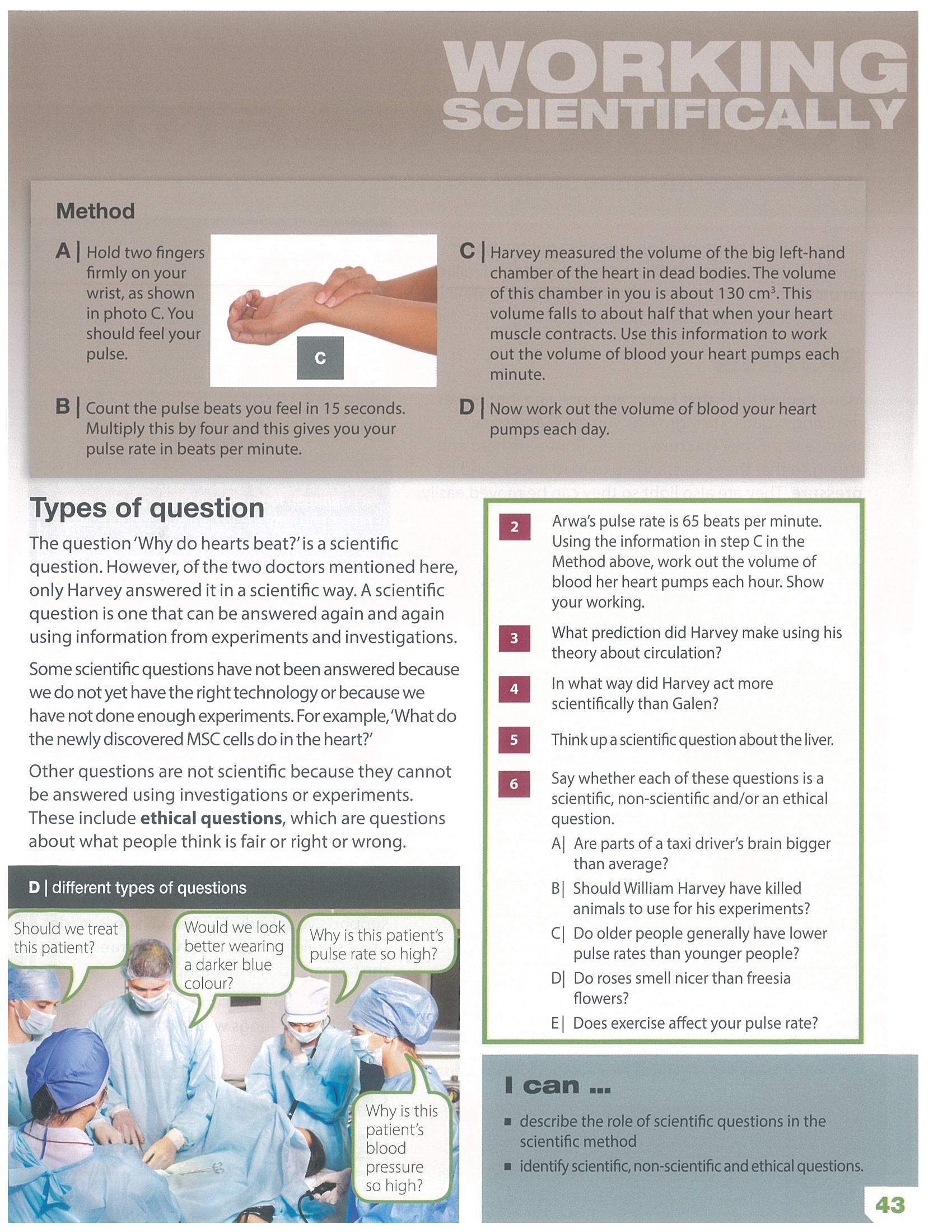
Muscles contain different types of tissue, including nerve tissue and muscle tissue.
肌肉里含有多种组织——包括神经组织和肌肉组织。
Muscle tissue is made of muscle cells, which can change shape.
肌肉组织由肌肉细胞(muscle cells)组成——它们能改变形状。
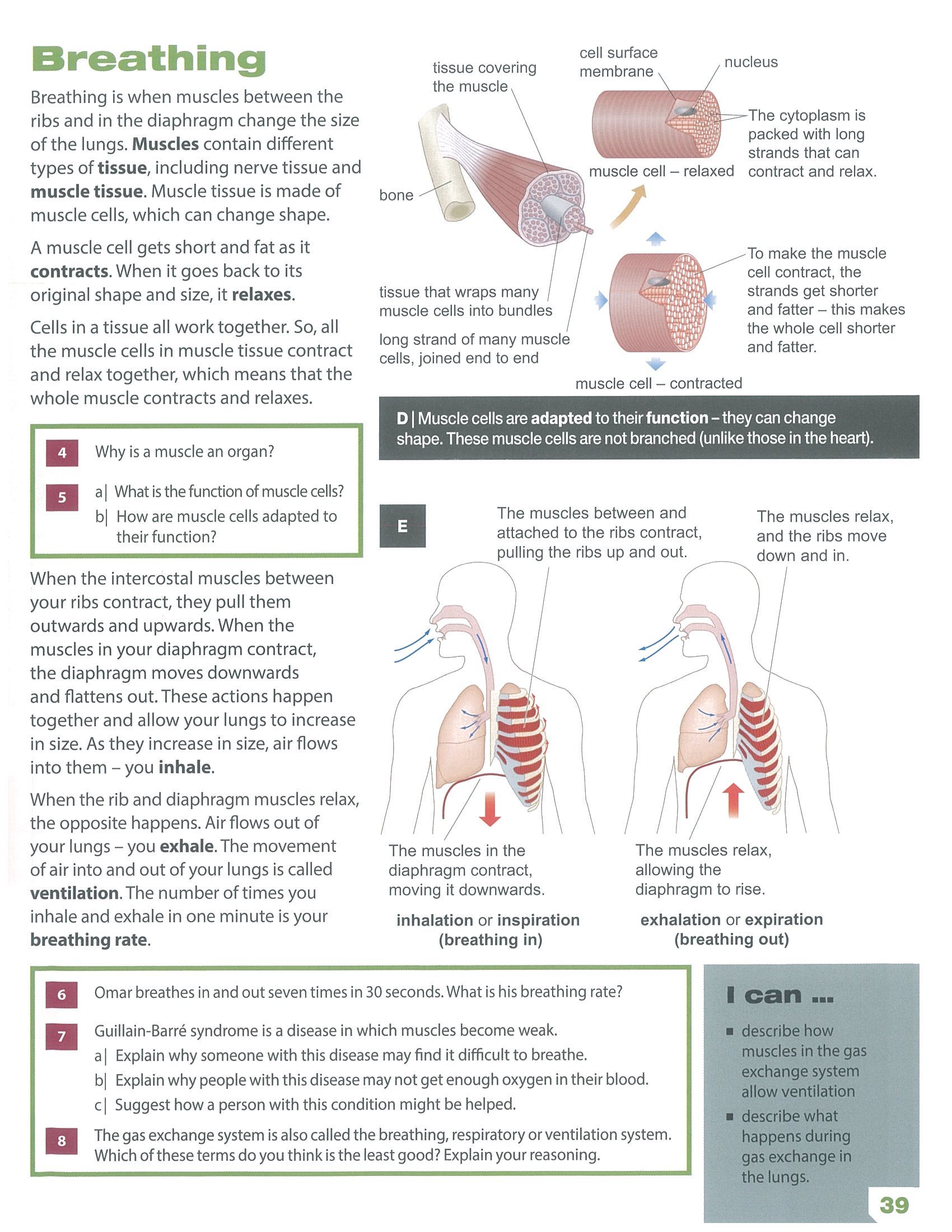
A muscle cell gets short and fat as it contracts. When it goes back to its original shape and size, it relaxes.
肌肉细胞收缩(contract)时变得短而胖。回到原来形状和大小时叫放松(relax)。
Cells in a tissue all work together. So, all the muscle cells in muscle tissue contract and relax together, which means that the whole muscle contracts and relaxes.
组织里的细胞一起工作。所以肌肉组织里所有肌肉细胞同步收缩和放松——意味着整块肌肉一起收缩放松。
D | Muscle cells (relaxed → contracted)
图 D | 肌肉细胞(放松 → 收缩)
The cytoplasm is packed with long strands that can contract and relax. To make the muscle cell contract, the strands get shorter and fatter — this makes the whole cell shorter and fatter.
细胞质里塞满了能伸缩的长丝。肌肉细胞收缩时,这些长丝变短变胖——让整个细胞也变短变胖。
Muscle cells are adapted to their function — they can change shape. These muscle cells are not branched (unlike those in the heart).
肌肉细胞适应(adapted)了自己的功能——它们能改变形状。这些肌肉细胞不分叉(与心肌细胞不同——心肌会分叉)。
A long strand of many muscle cells, joined end to end — and tissue that wraps many muscle cells into bundles.
许多肌肉细胞首尾相连成长丝,再由组织把多个细胞包成束。
Q4 a) Why is a muscle an organ? b) What is the function of muscle cells? c) How are muscle cells adapted to their function?
第 4 题 a) 为什么肌肉是器官?(答:由不同组织组成——肌肉组织 + 神经组织等) b) 肌肉细胞的功能?(收缩产生力) c) 它们如何适应功能?(细胞质里有可伸缩的长丝,让细胞能变短变胖)
E | Inhalation vs exhalation
图 E | 吸气与呼气
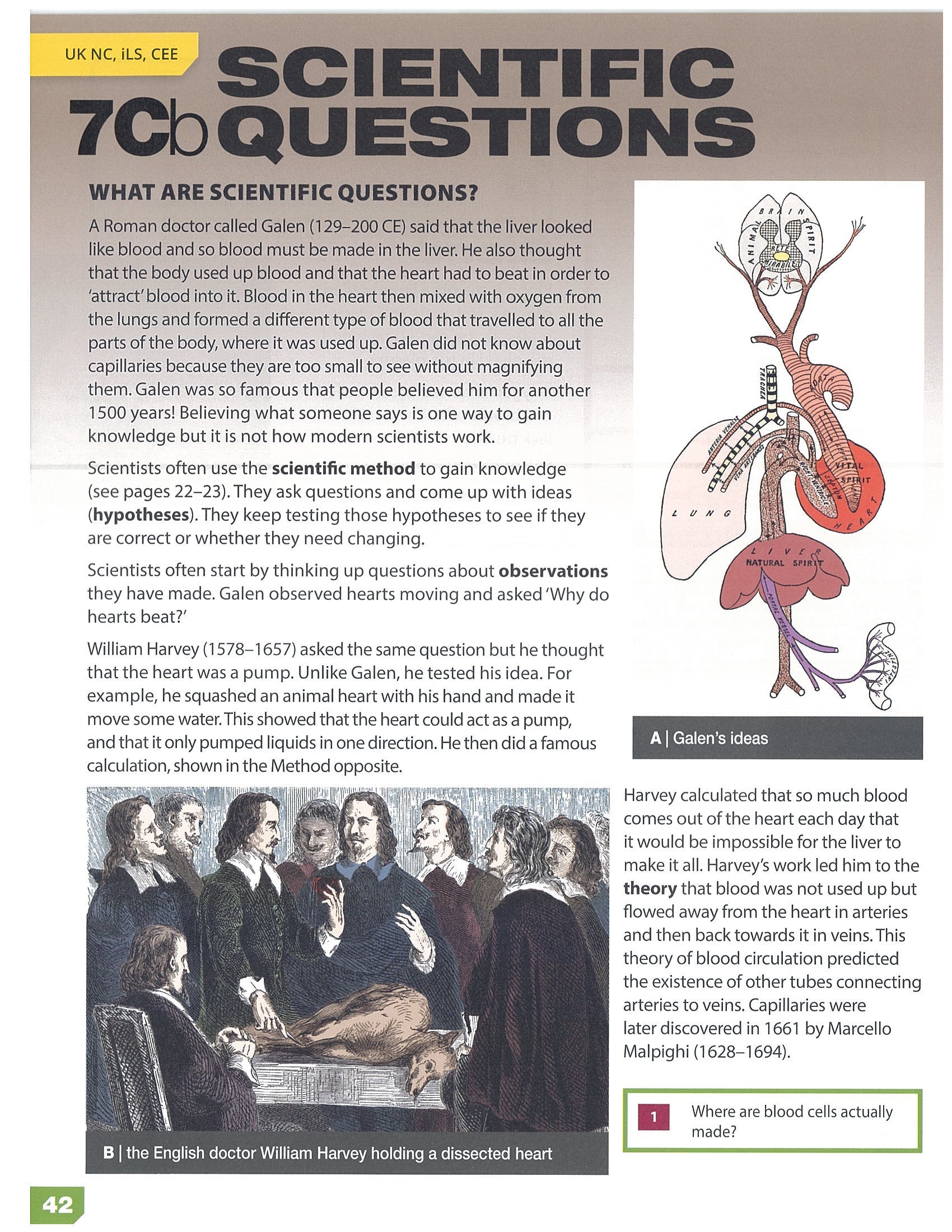
When the intercostal muscles between your ribs contract, they pull them upwards and outwards. When the muscles in your diaphragm contract, the diaphragm moves downwards and flattens out.
肋间的肋间肌收缩时,把肋骨拉向上、向外。横膈膜的肌肉收缩时,横膈膜向下移动并变平。
These actions happen together and allow your lungs to increase in size. As they increase in size, air flows into them — you inhale.
这两个动作同时发生,让肺体积变大。肺变大时空气流入——这就是吸气(inhalation / inspiration)。
When the rib and diaphragm muscles relax, the opposite happens. Air flows out of your lungs — you exhale.
肋骨和横膈膜的肌肉放松时则相反——空气流出肺,这就是呼气(exhalation / expiration)。
The movement of air into and out of your lungs is called ventilation. The number of times you inhale and exhale in one minute is your breathing rate.
空气进出肺叫做通气(ventilation)。你每分钟吸气和呼气的次数就是呼吸频率(breathing rate)。
Q6 Omar breathes in and out seven times in 30 seconds. What is his breathing rate?
第 6 题 Omar 在 30 秒呼吸 7 次。他的呼吸频率?(答:7 × 2 = 14 次/分钟)
Q7 Guillain-Barré syndrome is a disease in which muscles become weak. a) Explain why someone with this disease may find it difficult to breathe. b) Explain why people with this disease may not get enough oxygen in their blood. c) Suggest how a person with this condition might be helped.
第 7 题 吉兰-巴雷综合症让肌肉变弱。a) 为什么呼吸困难?(肋间肌、膈肌无力,无法让肺扩张) b) 为什么血液氧气不够?(呼吸弱 → 进入肺的空气少 → 进入血液的氧少) c) 怎么帮助这种病人?(呼吸机 / 给氧)
Q8 The gas exchange system is also called the breathing, respiratory or ventilation system. Which of these terms do you think is the least good? Explain.
第 8 题 气体交换系统还叫呼吸、呼吸道、通气系统。你觉得哪个名字最不好?解释。(开放题——"通气 ventilation"只描述空气运动,没说气体交换;或"呼吸 breathing"与细胞呼吸 respiration 容易混淆)
I can…
我能……
describe how muscles in the gas exchange system allow ventilation
描述气体交换系统中的肌肉如何实现通气
describe what happens during gas exchange in the lungs
描述肺里气体交换时发生什么
💡 围绕 7Ca Fitness + Breathing 的高频词。点 🔊 听发音,留意词源拆解(拉丁/希腊根)。
💪 Fitness 健身核心词
fitness
/ˈfɪtnəs/
n.
健康程度、健壮
词源fit(合适)+ -ness(名词后缀,表状态)="处于合适状态"
教材"Being 'fit' means that your body is able to do the activities that your lifestyle demands."
延伸① physical fitness 身体健康 ② fitness test 体测 ③ fitness level 健康水平
fitness ≠ health:fitness 强调"能干事"(如能跑 5km),health 是"无病"。运动员 fitness 高但可能受伤。
suppleness
/ˈsʌpəlnəs/
n.
柔韧性
词源拉丁 supplex(弯腰恳求)→ supple(柔软的)+ -ness
教材S-factor 之一:体操、舞蹈需要 suppleness
延伸① supple skin 柔嫩的皮肤 ② flexibility(同义,更常用)
同义flexibility 反义stiffness(僵硬)
stamina
/ˈstæmɪnə/
n.
耐力、持久力
词源拉丁 stamen(经线、生命线)→ "维持生命的线"
教材S-factor 之一:长跑、马拉松需要 stamina
延伸① build up stamina 提升耐力 ② mental stamina 心理耐力
stamina ≠ strength:strength 是"瞬间力量"(举一次重物);stamina 是"长时间不累"(跑马拉松)。
🫁 Breathing 呼吸系统核心词
respiration
/ˌrespəˈreɪʃn/
n.
呼吸作用(细胞内)
词源拉丁 re-(反复)+ spirare(呼吸)= "反复呼吸"。同根:spirit(精神,原意"气息")、inspire(吸入→鼓舞)
教材"All cells need respiration to release energy."
延伸① aerobic respiration 有氧呼吸 ② respiratory system 呼吸系统
respiration ≠ breathing(必考!):respiration 在细胞内分解食物释能;breathing 是肺吸进呼出空气。
diaphragm
/ˈdaɪəfræm/
n.
横膈膜
词源希腊 dia-(跨过)+ phragma(隔墙)= "跨在中间的墙"
教材"The diaphragm contracts and moves down during inhalation."
延伸① 摄影 camera diaphragm 光圈 ② 喇叭 speaker diaphragm 振膜(都借用"分隔/振动膜"的意思)
拼写陷阱:ph 发 /f/,最后 gm 的 g 不发音(同 phlegm 痰)。
ventilation
/ˌventɪˈleɪʃn/
n.
通气、换气
词源拉丁 ventus(风)+ -ation → "送风进出"。同根:vent(通风口)、ventilator(呼吸机/通风机)
教材"describe how muscles in the gas exchange system allow ventilation"
延伸① good ventilation 通风良好 ② mechanical ventilation(医院里用的呼吸机辅助)
intercostal
/ˌɪntəˈkɒstl/
adj.
肋间的
词源拉丁 inter-(在……之间)+ costa(肋骨)= "肋骨之间"。同根:coast(海岸=陆地的"肋")
教材"intercostal muscles contract → ribs move up and out"(吸气时)
延伸常考搭配 intercostal muscles 肋间肌

🎯 隐性技能专项 · 考试不教但必丢分的能力
💡 点卡片翻面看答案。本章 25 个高频术语(涉及 4 个 organ system),考试拼写错就直接丢分。
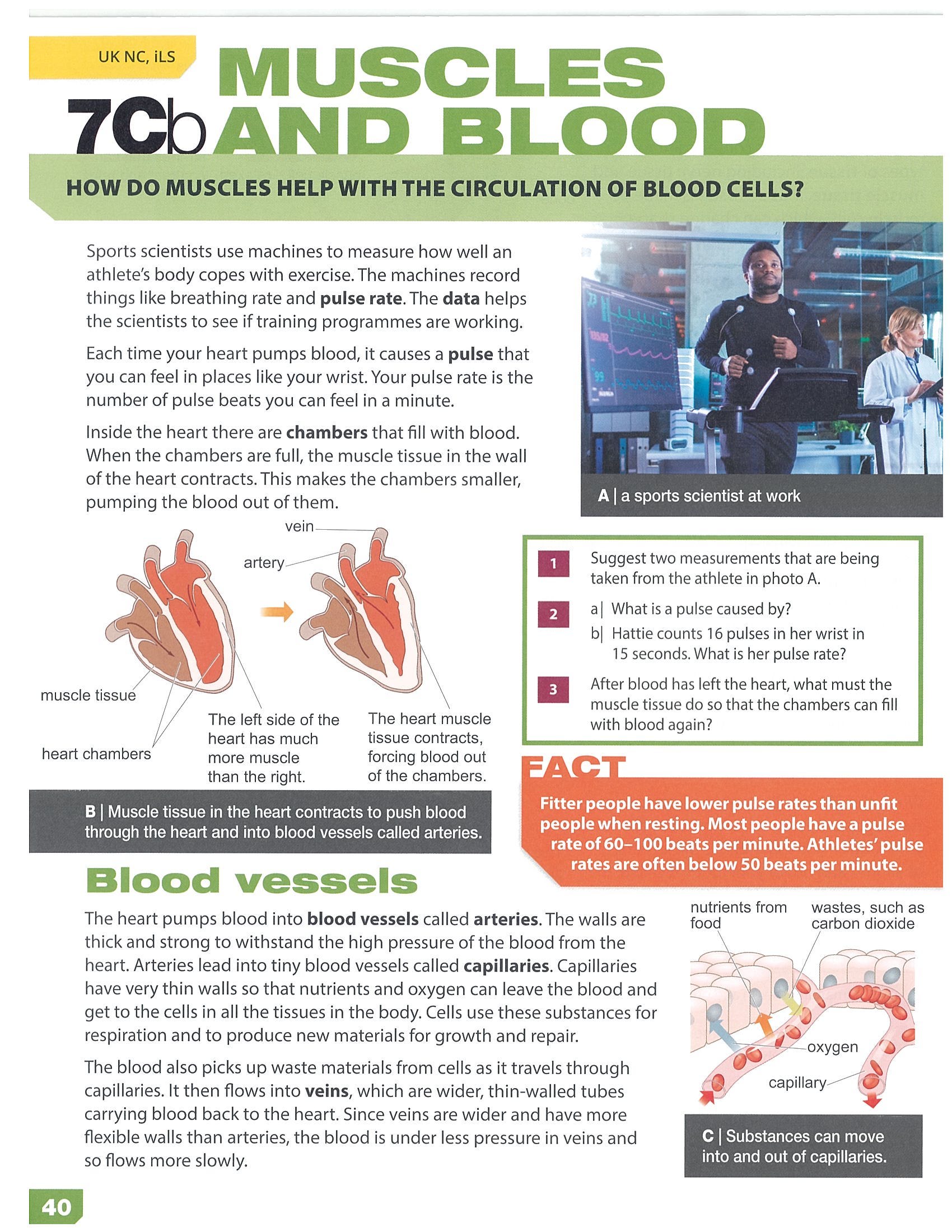
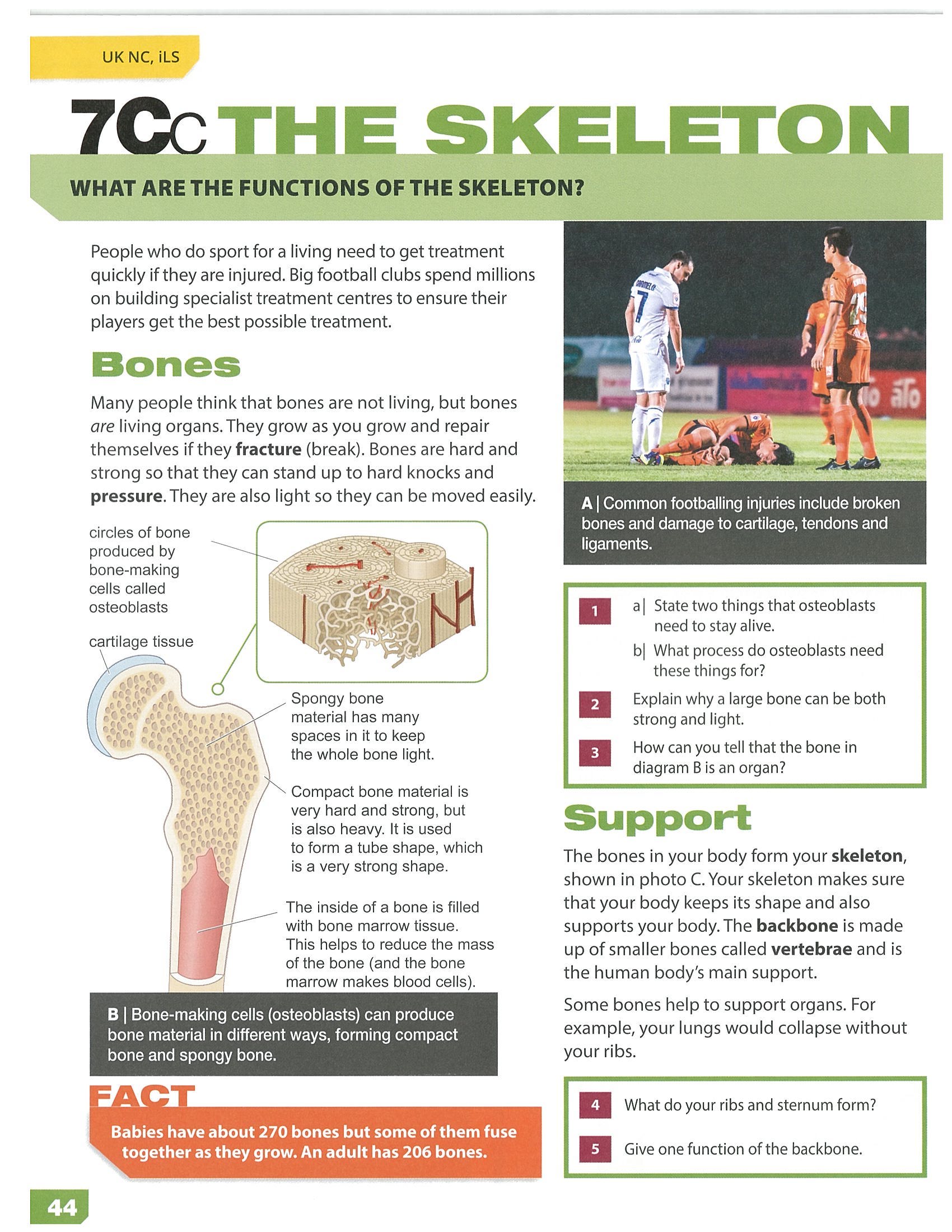
💡 玩法:先点一个英文标签(变金色高亮),再点正确的骨骼位置即可放入。点已放好的部位会取回标签。本图是人体骨骼简化图——SUIS 考试这种 label diagram 是必出题型。
把这些标签点到正确位置:
skull
ribcage
vertebrae
upper arm bone
hip
thigh bone
knee cap
shin bone
cartilage
tendon
ligament
💡 注意:bank 里有 11 个标签,但图上只有 8 个空——多出来的是干扰项(cartilage 是组织、tendon 和 ligament 不是骨头)。考试也是这样。
💡 看清楚题干用的指令词,答题方式完全不同。
| 指令词 | 要求 | 错误示范 | 正确示范 |
|---|---|---|---|
| State | 用一个完整句子说清事实 | "control"(光这一个词不行) | "The control variable is the temperature of the water." |
| Name | 给一个单词或短语即可 | "the heart"(前面冠词常加分) | "heart" 或 "the heart" |
| List | 给几个项目(数字明示) | 只写 1 个但题目问 3 个 | 分行写出确切数目,编号 i, ii, iii |
| Describe | 说出"是什么样",需要细节 | "It's an organ."(太短) | "The heart is a muscular organ that pumps blood around the body." |
| Explain | 必须说"为什么",要有 because | "It's important." 没说为什么 | "This is important because blood carries oxygen to cells." |
| Suggest | 给合理猜测(题目没标准答案) | 留白不写 | 大胆给一个有逻辑的回答,写完整句子 |
| Compare | 同时说相同点和不同点 | 只说不同点 | "Both X and Y have...; however, X has..., whereas Y has..." |
| Tick / Choose | 勾选一个或多个框 | 选了 2 个但题目说 one box | 仔细看 "Tick (✓) one box" / "two boxes" |
📌 实战提示:考试翻到一题,先圈出指令词(state / explain / suggest...),再答题。这一步能让你少丢 5–10 分。
📝 分级练习 · 由易到难闯关
❌ 错题本 · 自动收集你标错的题
还没有错题。做题时点击"做错了"会自动收集到这里。
✅ 考前自检清单 · 全勾上才能进考场
已掌握 0 / 0