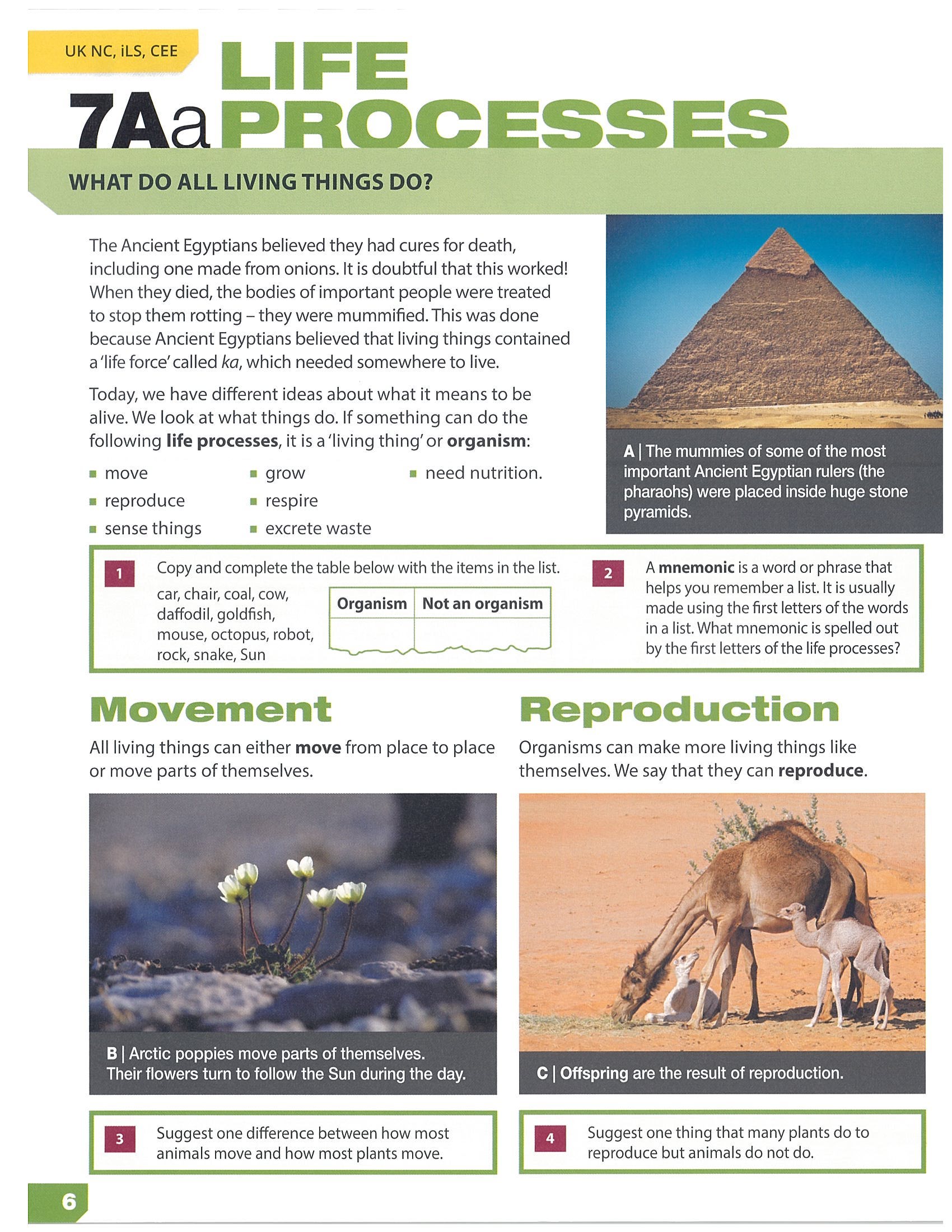
The Ancient Egyptians believed they had cures for death, including one made from onions.
古埃及人相信他们有"治死"的办法,其中一种是用洋葱做的。
It is doubtful that this worked!
这显然不太可能管用!
When they died, the bodies of important people were treated to stop them rotting – they were mummified.
重要的人死后,他们的尸体会被处理以防止腐烂——也就是做成木乃伊。
This was done because Ancient Egyptians believed that living things contained a 'life force' called ka, which needed somewhere to live.
这么做是因为古埃及人相信生物体内含有一种叫"ka"的"生命力",它需要一个寄居的地方。
Today, we have different ideas about what it means to be alive.
今天我们对"活着"有不同的理解。
We look at what things do.
我们看一个东西在做什么。
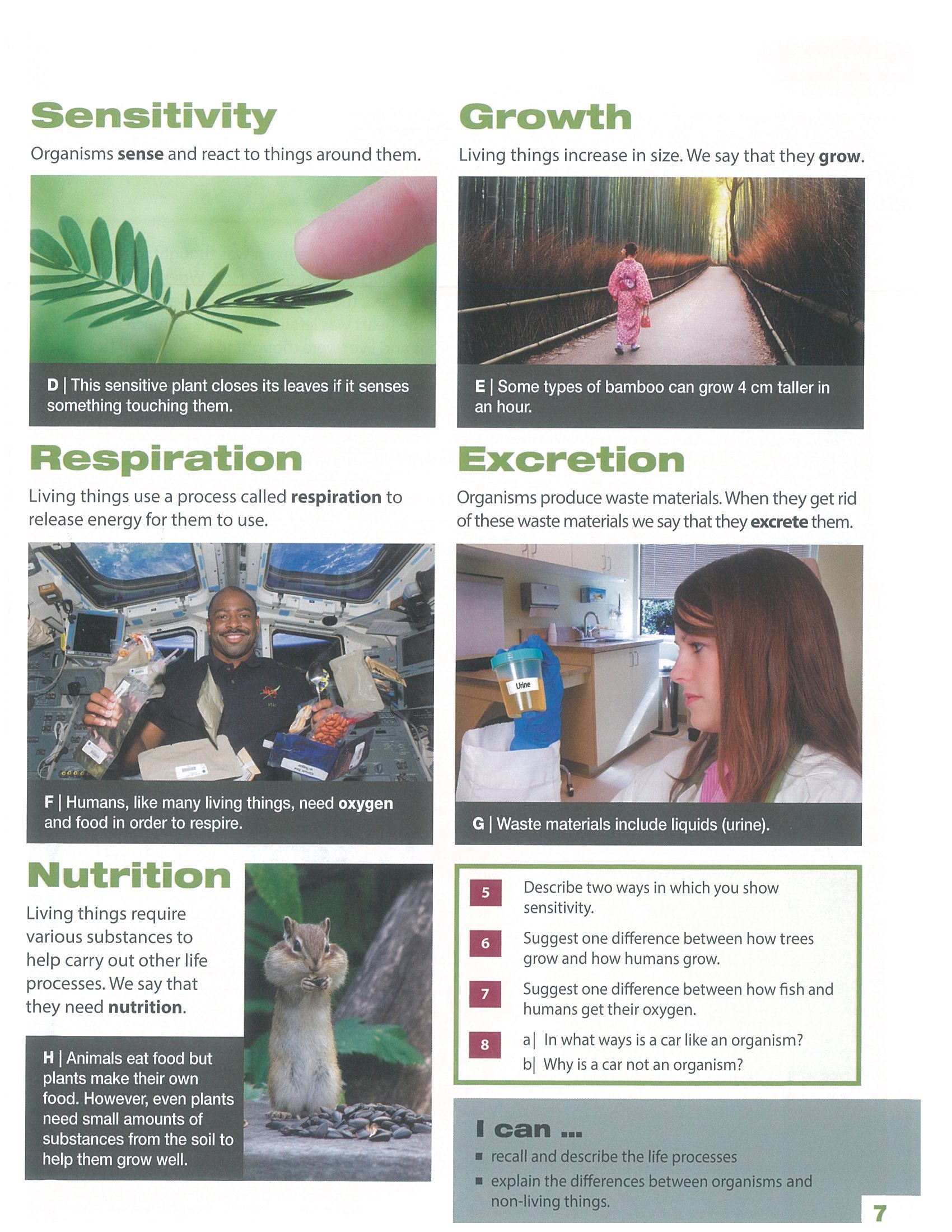
If something can do the following life processes, it is a 'living thing' or organism: move, reproduce, sense things, grow, respire, excrete waste, need nutrition.
Q2 A mnemonic is a word or phrase that helps you remember a list. It is usually made using the first letters of the words in a list. What mnemonic is spelled out by the first letters of the life processes?
Doctors use tests to see if there are changes in a person's body compared to normal. List three tests a doctor may perform.
i.ii.iii.
✅ 答案(任意 3 个即可):
Blood test 验血(血糖、胆固醇等)
Blood pressure 量血压
X-ray / ultrasound / MRI 影像扫描
Temperature 体温
Urine test 验尿
Listening to heart and lungs with a stethoscope 听诊
💡 讲解:
题干强调 "changes... compared to normal" —— 任何能测量身体状态的常规测试都可以。
⚠️ 命题套路:
List 题必须写够数。问 3 个就写 3 个,分行编号 (i)(ii)(iii) 更清楚——少写一个就扣一分。
Q2[Suggest · short answer]WB p.5
A doctor tells a patient that they have acne. Suggest what evidence the doctor has found to make them think this.
✅ 答案:
The doctor has looked at the patient's skin and seen spots / pimples / red bumps / inflammation — usually on the face, neck, chest or back. These visible skin changes are the evidence for acne.
In your group, look at your answers to question 5 on page 3 (= our Q5 above). Discuss your ideas again to find out if they have changed. If you can, write a better answer in the lower box.
💡 思路:
对比学完 MRS GREN 之前 vs 之后的认识——你的第一答案里可能漏了:
Sensitivity(感知)—— 容易漏
Excretion(排泄)—— 不只是"上厕所",是任何排废物的过程
Nutrition vs Respiration —— 是两件事,别搞混
Better answer 应该是:A living organism must do all 7 life processes (MRS GREN): movement, respiration, sensitivity, growth, reproduction, excretion, nutrition.
📄 教材 p.8–11
📝 学习内容
核心理解:器官有特定功能
Organ(器官)= 身体里有特定function(功能)的一个部位。每个 organ 都有"工作"。
古埃及人做木乃伊时,特别保留心脏、胃、肠、肺、肝,却经常把脑丢掉。为什么?
💡 他们认为脑不重要——以为思考是用心脏。今天我们知道脑才是"控制中心"。考点:教材里说"They did not think the brain was important and so it was often thrown away."
人体主要器官(必背)
英文
中文
功能
brain
脑
控制身体
heart
心脏
泵血
lungs
肺
把氧送入血液,排出二氧化碳
liver
肝
制造/储存物质,分解物质
kidneys
肾(一对)
清洁血液,制造尿液
stomach
胃
分解食物
small intestine
小肠
分解食物 + 吸收营养
large intestine
大肠
⚠️ 不是消化!是从废物中吸收水
bladder
膀胱
储存尿液
skin
皮肤
保护和感知(人体最大的 organ)
植物主要器官
leaf 叶:捕捉阳光做食物(photosynthesis 光合作用)
stem 茎:运输物质 + 支撑
root 根:固定 + 吸水
storage organs 储藏器官:储存光合作用的食物(如土豆、胡萝卜)
胡萝卜 carrot 是 organ 还是 tissue?
💡 是 organ(更准确说是 storage organ 储藏器官)。它由多种 tissue 组成(外层 + 中间黄色木质部 xylem + 储食物的部分),所以是 organ。如果选 4 个选项:A organ system / B organ / C tissue / D cell,答案是 B。
In Ancient Egypt, the heart was thought to be the most important part of a person.
古埃及人认为心脏是人最重要的部位。
When people were mummified, the organs in their bodies were removed but the heart was left in place.
人被做成木乃伊时,体内的器官会被取出,但心脏会留在原处。
The stomach, intestines, lungs and liver were thought to be useful on the person's journey in the afterlife and these organs were preserved.
胃、肠、肺、肝被认为对死后旅程有用,所以这些器官也会被保存下来。
They did not think the brain was important and so it was often thrown away.
他们不认为大脑重要,所以经常被扔掉。
Human organs
人体器官
The heart, stomach, intestines, lungs and liver are organs.
心脏、胃、肠、肺、肝都是器官(organs)。
Every organ has an important function (job).
每个器官都有一个重要的功能(function)(也就是工作)。
We now know that the brain is also an organ and has the very important function of controlling the body!
我们今天知道,大脑也是一个器官,它有一个非常重要的功能——控制整个身体!
Your body's biggest organ is on the outside. It's your skin.
你身体最大的器官长在外面——就是皮肤(skin)。
Skin is used for protection and sensing things.
皮肤用来保护身体和感知事物。
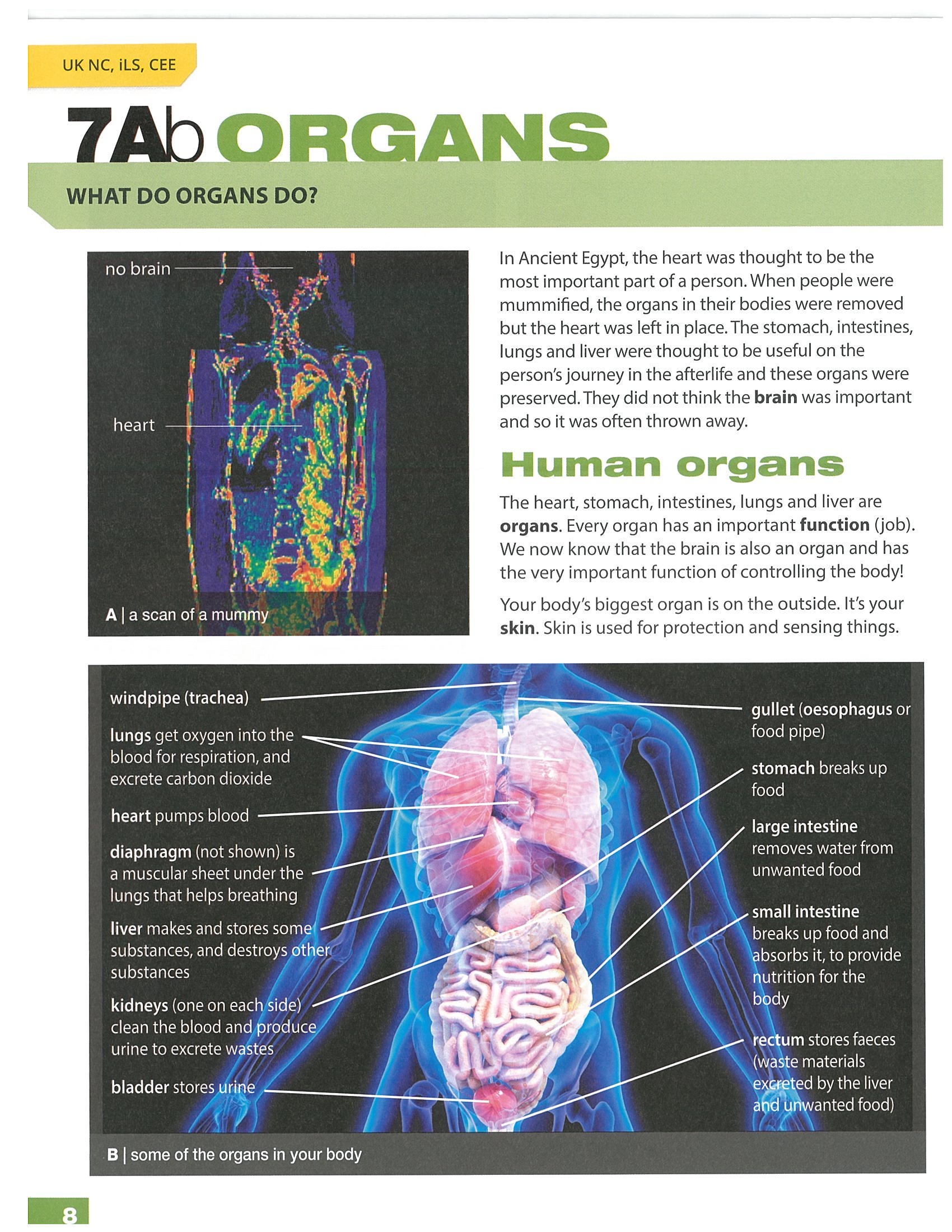
A | a scan of a mummy
图 A | 一具木乃伊的扫描图(标签:no brain 没有大脑、heart 心脏)
B | some of the organs in your body
图 B | 你身体里的部分器官(下面是器官标签和功能)
windpipe (trachea)
气管(trachea / windpipe)
gullet (oesophagus or food pipe)
食道(oesophagus / gullet / food pipe)
lungs get oxygen into the blood for respiration, and excrete carbon dioxide
肺(lungs)把氧气送进血液供呼吸作用使用,并把二氧化碳排出体外
heart pumps blood
心脏(heart)泵血
diaphragm (not shown) is a muscular sheet under the lungs that helps breathing
横膈膜(diaphragm)(图中未画出)是肺下方的一片肌肉,帮助呼吸
stomach breaks up food
胃(stomach)把食物初步分解
liver makes and stores some substances, and destroys other substances
肝脏(liver)制造和储存某些物质,分解其他物质
small intestine breaks up food and absorbs it, to provide nutrition for the body
小肠(small intestine)把食物进一步分解并吸收,为身体提供营养
large intestine removes water from unwanted food
大肠(large intestine)从没用的食物里把水吸出来
kidneys (one on each side) clean the blood and produce urine to excrete wastes
肾脏(kidneys)(左右各一个)清洁血液并产生尿液,以排出废物
rectum stores faeces (waste materials excreted by the liver and unwanted food)
直肠(rectum)储存粪便(肝排出的废物 + 没用的食物)
bladder stores urine
膀胱(bladder)储存尿液
📄 教材 p.9 · 7Ab Questions + Plant Organs
Q1 Draw a table to show the functions of five different organs in your body.
第 1 题 画一个表,列出你身体里 5 个不同器官的功能。
Q2 Which organ gets bigger as it fills with air?
第 2 题 哪个器官在充满空气时会变大?(答:肺 lungs)
Q3 List the organs that help to get nutrition into the body.
第 3 题 列出帮助把营养带进身体的器官。(答:胃、小肠 等消化器官)
Q4 List the organs that excrete waste materials.
第 4 题 列出排泄废物的器官。(答:肾脏 kidneys、肺 lungs、大肠 等)
Q5 List two organs that store solid or liquid wastes.
第 5 题 列出两个储存固体或液体废物的器官。(答:rectum 直肠、bladder 膀胱)
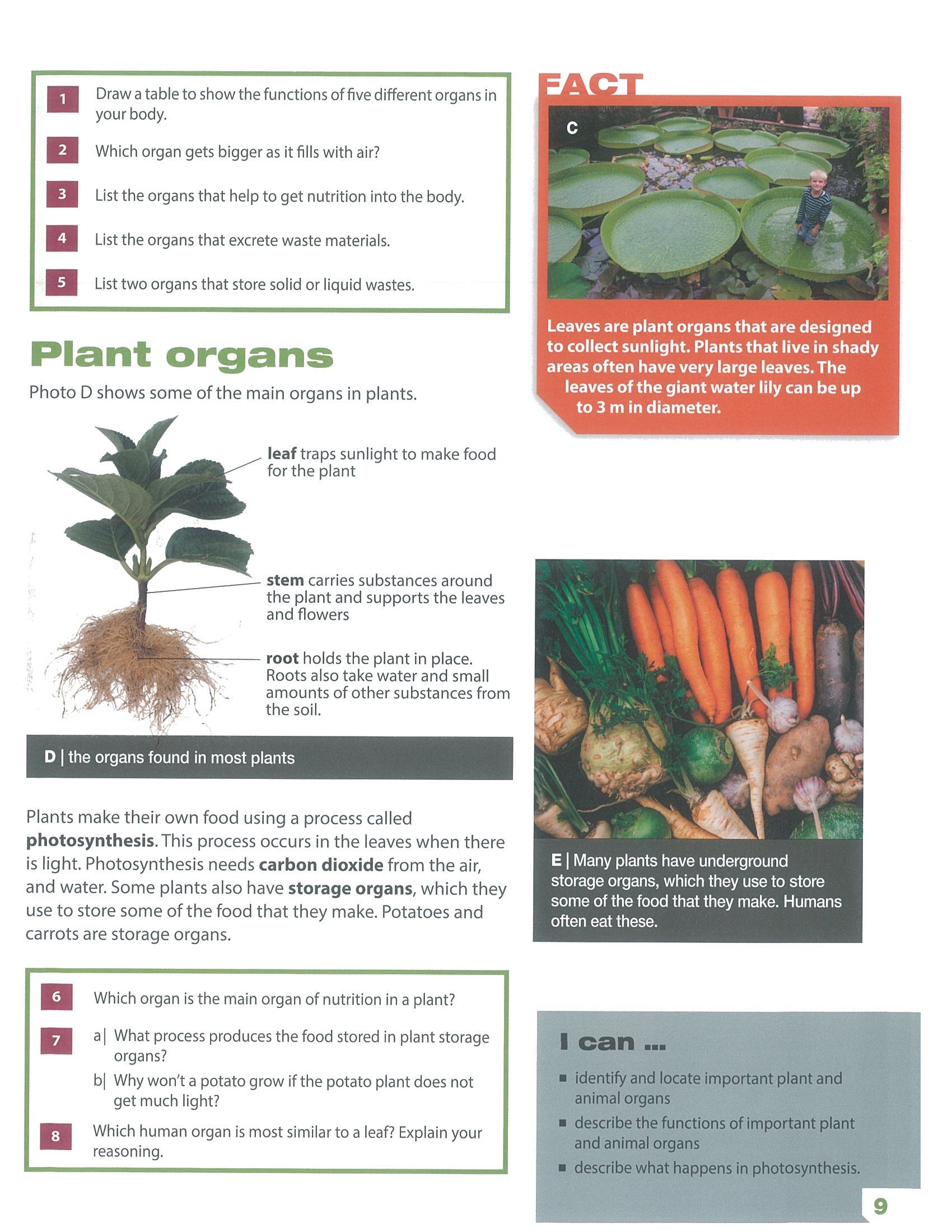
FACT — C | giant water lily leaves
FACT 框 — 图 C | 大王莲的叶子
Leaves are plant organs that are designed to collect sunlight. Plants that live in shady areas often have very large leaves. The leaves of the giant water lily can be up to 3 m in diameter.
There are many interesting jobs open to people with skills in these subjects. These include careers in communications, farming, fashion, films, finance, health, sport and video gaming.
Results from the tests are used as evidence (information used to decide if an idea is correct or incorrect). A decision made using evidence is called a conclusion.
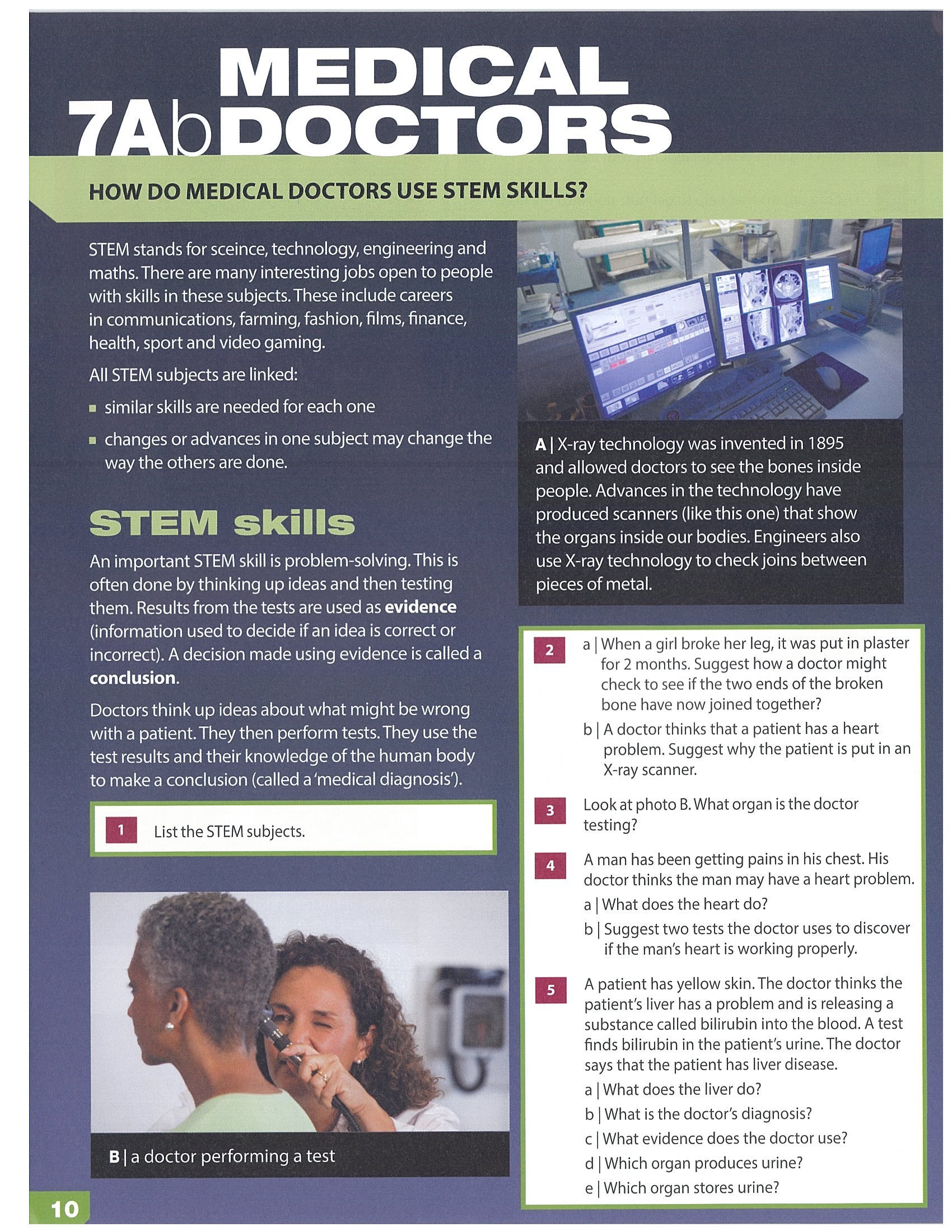
X-ray technology was invented in 1895 and allowed doctors to see the bones inside people.
X 射线技术发明于 1895 年,让医生第一次能看到人体内的骨头。
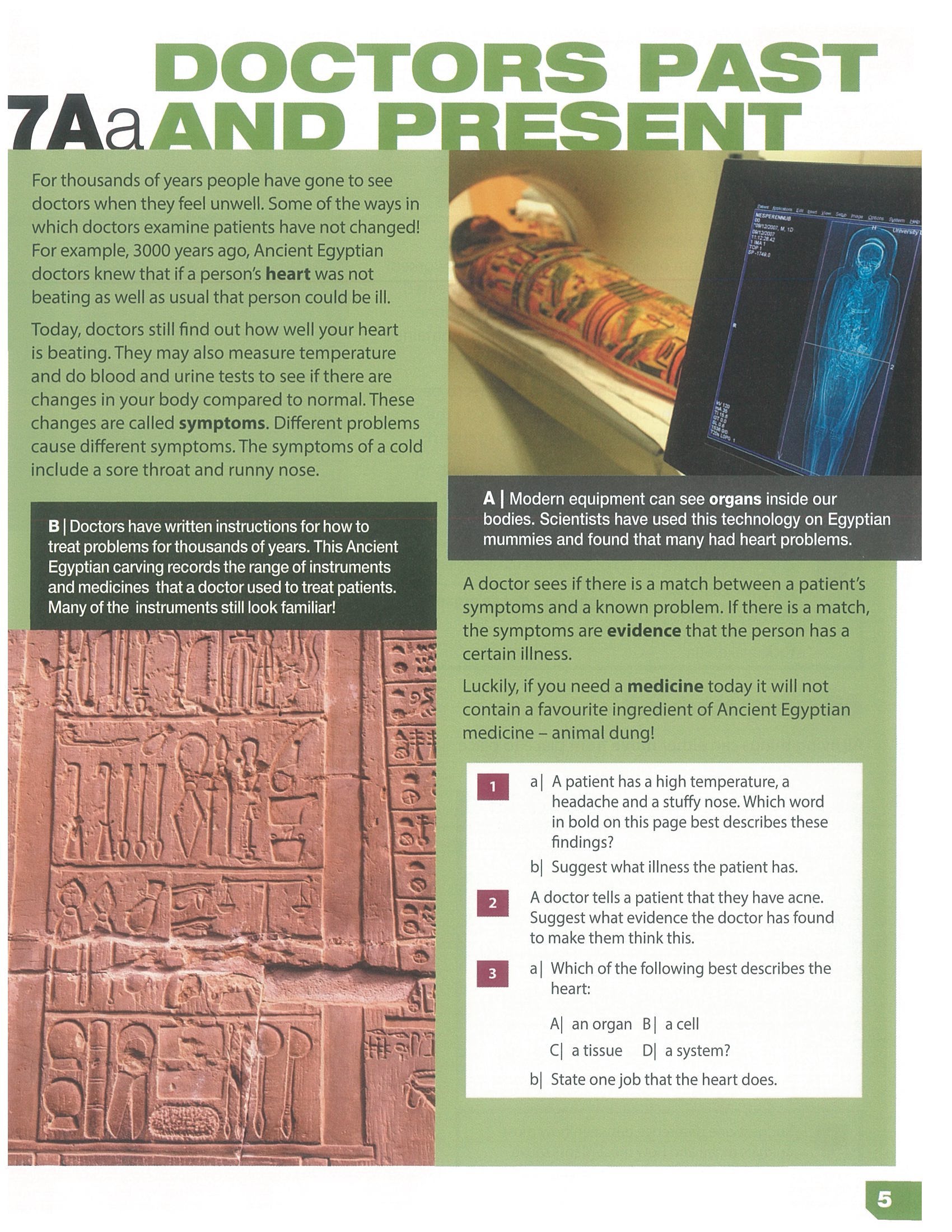
Advances in the technology have produced scanners (like this one) that show the organs inside our bodies. Engineers also use X-ray technology to check joins between pieces of metal.
技术进步后产生了像图中这样的扫描仪,能显示体内的器官。工程师也用 X 射线技术检查金属件之间的连接处。
Q2 a) When a girl broke her leg, it was put in plaster for 2 months. Suggest how a doctor might check to see if the two ends of the broken bone have now joined together. b) A doctor thinks that a patient has a heart problem. Suggest why the patient is put in an X-ray scanner.
第 2 题 a) 女孩腿断了打了 2 个月石膏。医生怎么检查两端骨头有没有长好?(答:拍 X 光看骨头)b) 医生怀疑病人心脏有问题,为什么要让病人做 X 光扫描?(答:用扫描器看心脏 organ 内部)
Q3 Look at photo B. What organ is the doctor testing?
第 3 题 看图 B,医生在检查哪个器官?(答:耳朵——医生在用 otoscope 看耳道)
Q4 A man has been getting pains in his chest. His doctor thinks the man may have a heart problem. a) What does the heart do? b) Suggest two tests the doctor uses to discover if the man's heart is working properly.
第 4 题 一个男人胸口疼。医生认为他可能心脏有问题。a) 心脏的功能是什么?(答:泵血) b) 医生用哪两个检查判断他心脏工作是否正常?(答:听诊器听心跳、心电图 ECG、X 光或扫描)
Q5 A patient has yellow skin. The doctor thinks the patient's liver has a problem and is releasing a substance called bilirubin into the blood. A test finds bilirubin in the patient's urine. The doctor says that the patient has liver disease. a) What does the liver do? b) What is the doctor's diagnosis? c) What evidence does the doctor use? d) Which organ produces urine? e) Which organ stores urine?
To develop their skills and knowledge, people who want to become physiotherapists, nurses or doctors do more training after they leave school.
想成为物理治疗师、护士或医生的人,毕业后还要继续接受培训。
Doctors, for example, usually train at a university for six or seven years. Some doctors then do even more training to specialise in a certain area of the body or to become surgeons or pathologists.
Work with others in your group to think about the different jobs that need a knowledge of the human body and its organs. Write down as many jobs as you can think of. For each job, give a reason why a knowledge of the human body is useful.
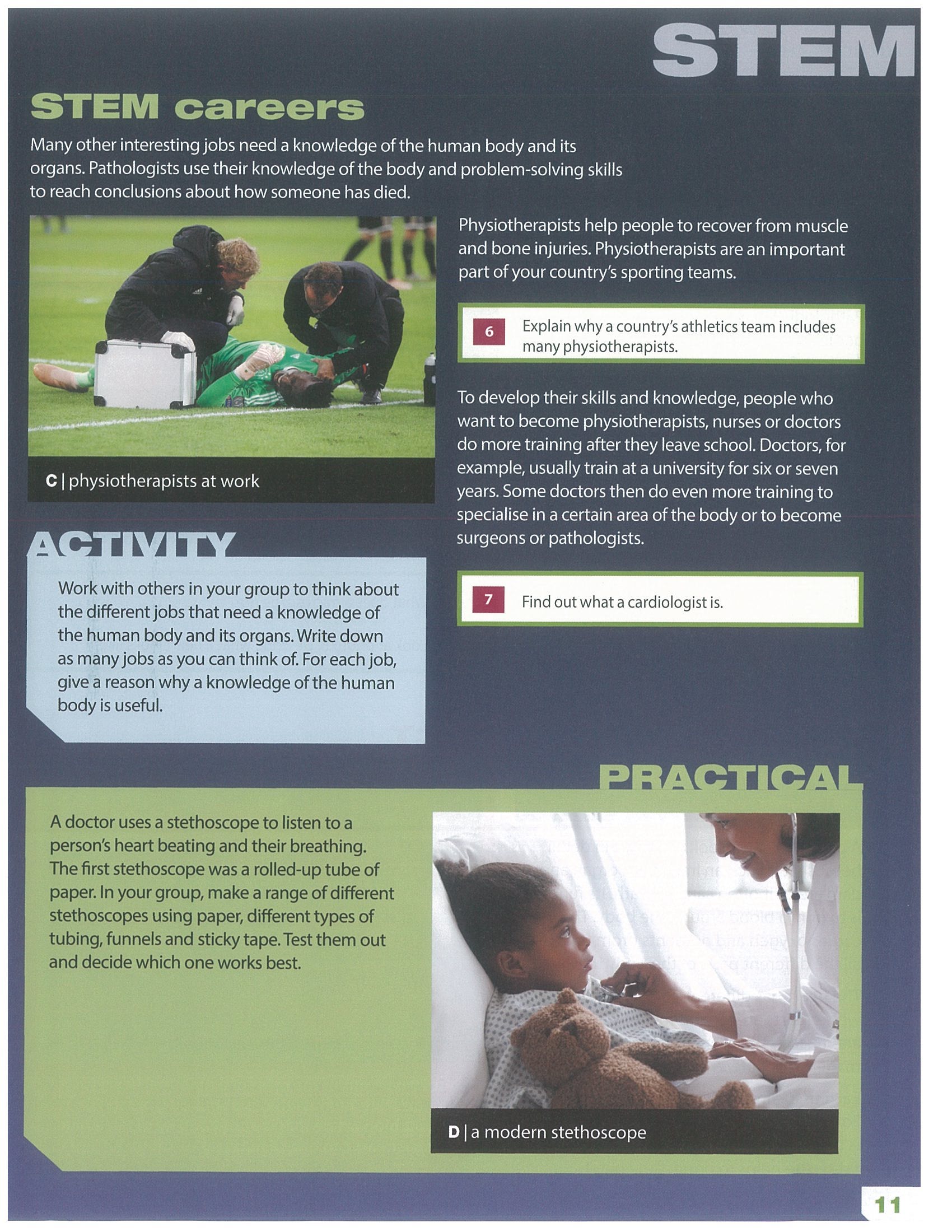
A doctor uses a stethoscope to listen to a person's heart beating and their breathing.
医生用听诊器(stethoscope)听人的心跳和呼吸。
The first stethoscope was a rolled-up tube of paper. In your group, make a range of different stethoscopes using paper, different types of tubing, funnels and sticky tape. Test them out and decide which one works best.
Why won't a potato grow if the potato plant does not get much light?
✅ 答案:
Because photosynthesis needs light. Without enough light, the leaves cannot make enough glucose / food by photosynthesis, so there is no food to be stored in the potato. Without stored food, the potato cannot grow bigger.
Scientists invent ideas to try to things that they see happening. They then do experiments to their ideas. They use the results from their tests as , to decide if an idea is correct or incorrect. This decision is called a . Medical also use this process to try to work out what is wrong with someone. A conclusion about what is wrong with someone is called a .
✅ 答案(按顺序):
① explain(解释观察到的现象)
② test(用实验测试想法)
③ evidence(实验结果就是证据)
④ conclusion(基于证据做出的判断)
⑤ doctors(医生也用这个流程)
⑥ diagnosis(医生对病情的判断 = 诊断)
💡 讲解:
这道题考科学方法 5 步流程对应的术语。注意"conclusion vs diagnosis":科学家做出的判断叫 conclusion;医生做出的具体"病人有什么病"的判断叫 diagnosis(diagnosis 是医学场景下的 conclusion)。
每个 symptom 对应一个特定器官——医生通过看 symptom(evidence)→ 推 organ → 给出 diagnosis。这就是上一题学的科学方法在医学上的应用。
⚠️ 命题套路:
"sore chest after eating food" 这种陷阱要注意——胸口痛**看似**是心脏,但**关键词是 "after eating"**(吃完之后)→ 跟食物消化有关 → 胃。读题时要抓"时机词"(after eating / during exercise / at night 等)来锁定器官。
Q4a[Describe · STEM]WB p.8
You can use these items (paper, tubing, funnels, sticky tape) to make different stethoscopes. Describe how to test a stethoscope.
✅ 答案(任意合理方法):
Put one end of the stethoscope on a partner's chest, and put the other end on your ear. Listen for the partner's heartbeat. Count how many beats you hear in 30 seconds (or 60 seconds). Repeat with each design of stethoscope.
可加:Use the same person, the same chest position, and the same quiet room each time (这些是 fair test 的关键)。
💡 讲解:
"Describe how to test" 要写具体的步骤——把听诊器放哪、听什么、测什么数据。最好同时提到"控制变量"(fair test)让答案完整。
Explain how to judge which design of stethoscope is best.
✅ 答案:
The best stethoscope is the one that makes the heartbeat loudest / clearest / easiest to hear. Rank the designs by how clearly each lets you hear the heartbeat — the one giving the clearest sound is the best.
可加判断标准:(i) 声音音量;(ii) 噪音/干扰最小;(iii) 听到声音的距离最远。
💡 讲解:
题目问"how to judge"——要给一个明确的评估标准(criterion),不是泛泛说"最好的就是最好的"。这里的标准就是"声音清晰度"。
⚠️ 命题套路:
Explain 题在 STEM 题中要点出"评估指标"——评判好坏的具体标准。常见高分句式:"The best design is the one that ... (做到什么)"。
Many good detective stories have a 'pathologist', who inspects a dead body to look for evidence to help to solve a murder.
许多侦探故事里有"病理学家"——检查尸体来寻找证据,帮助破解凶杀案。
Pathologists have a long history; dead bodies were examined in Ancient Egypt, Ancient Greece and in Roman times.
病理学家历史悠久——古埃及、古希腊和罗马时代就已经检查尸体了。
Pathologists are fully trained doctors. Some pathologists examine dead bodies to try to work out causes of death. Others examine small pieces taken from living people to try to identify diseases.
A | Pathologists use microscopes, which magnify things.
图 A | 病理学家使用显微镜(microscopes),它能把物体放大(magnify)。
This allows pieces taken from a body to be examined in great detail.
这样从身体上取下的样本就能被非常仔细地观察。
Q1 What does a microscope do?
第 1 题 显微镜的作用是什么?(答:放大 magnify 物体,让小的东西看起来更大)
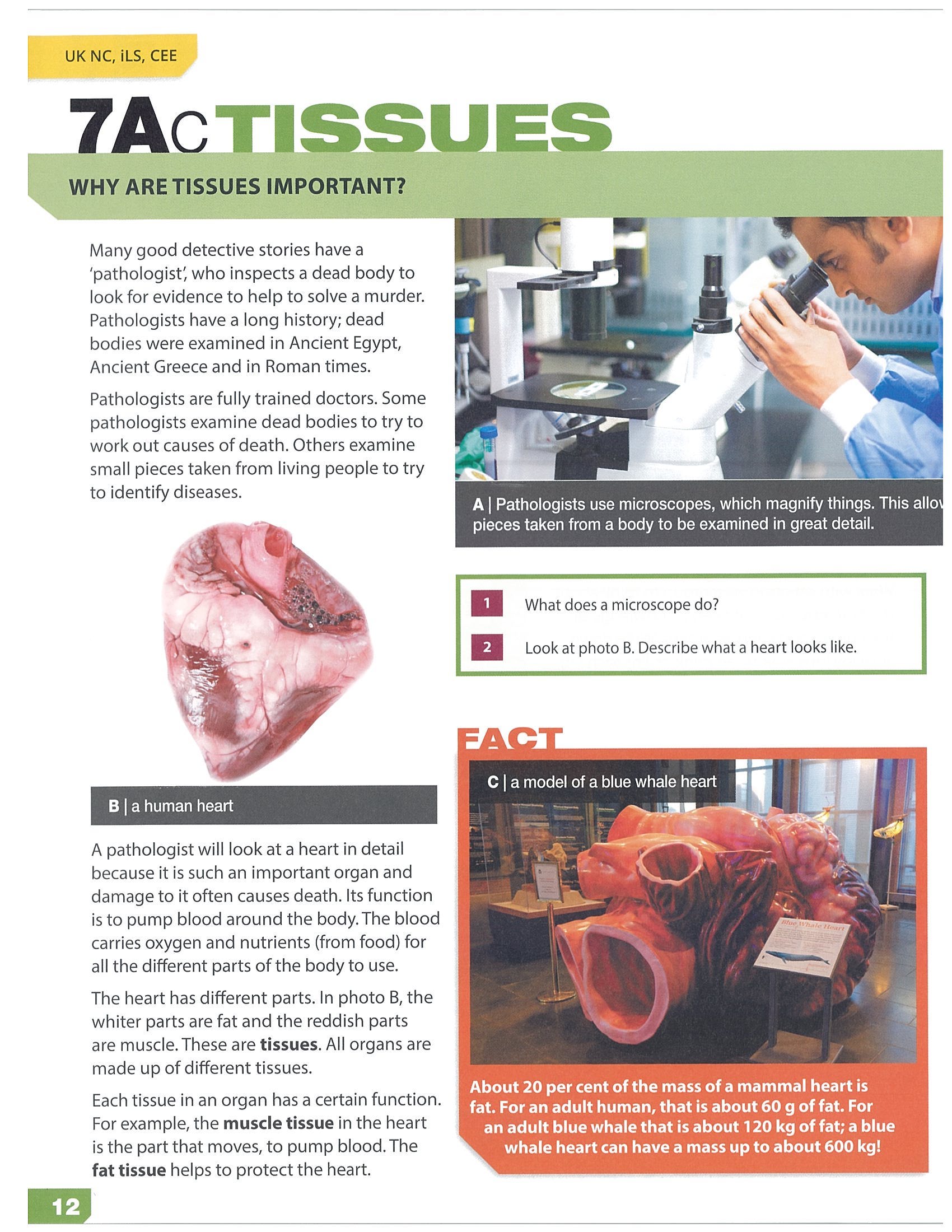
Q2 Look at photo B. Describe what a heart looks like.
第 2 题 看图 B,描述心脏看起来什么样。
B | a human heart
图 B | 一个人的心脏
FACT — C | a model of a blue whale heart
FACT 框 — 图 C | 一个蓝鲸心脏的模型
About 20 per cent of the mass of a mammal heart is fat. For an adult human, that is about 60 g of fat. For an adult blue whale that is about 120 kg of fat; a blue whale heart can have a mass up to about 600 kg!
哺乳动物心脏约 20% 的质量是脂肪。成年人约是 60 g 脂肪,成年蓝鲸约是 120 kg 脂肪;蓝鲸的心脏质量可达 约 600 kg!
A pathologist will look at a heart in detail because it is such an important organ and damage to it often causes death.
病理学家会仔细看心脏——它是一个非常重要的器官,受损常常会导致死亡。
Its function is to pump blood around the body. The blood carries oxygen and nutrients (from food) for all the different parts of the body to use.
心脏的功能是把血泵到全身。血液携带氧气和营养(来自食物)供身体各部位使用。
The heart has different parts. In photo B, the whiter parts are fat and the reddish parts are muscle. These are tissues. All organs are made up of different tissues.
心脏由不同部分组成。在图 B 里,偏白的部分是脂肪,偏红的部分是肌肉——这些都叫组织(tissues)。所有器官都由不同组织构成。
Each tissue in an organ has a certain function. For example, the muscle tissue in the heart is the part that moves, to pump blood. The fat tissue helps to protect the heart.
器官里的每种组织都有一定的功能。比如心脏的肌肉组织是会动的部分,负责泵血;脂肪组织帮助保护心脏。
📄 教材 p.13 · 7Ac Plant Tissues
Q3 a) Name two tissues found in the heart. b) What does each of these tissues do?
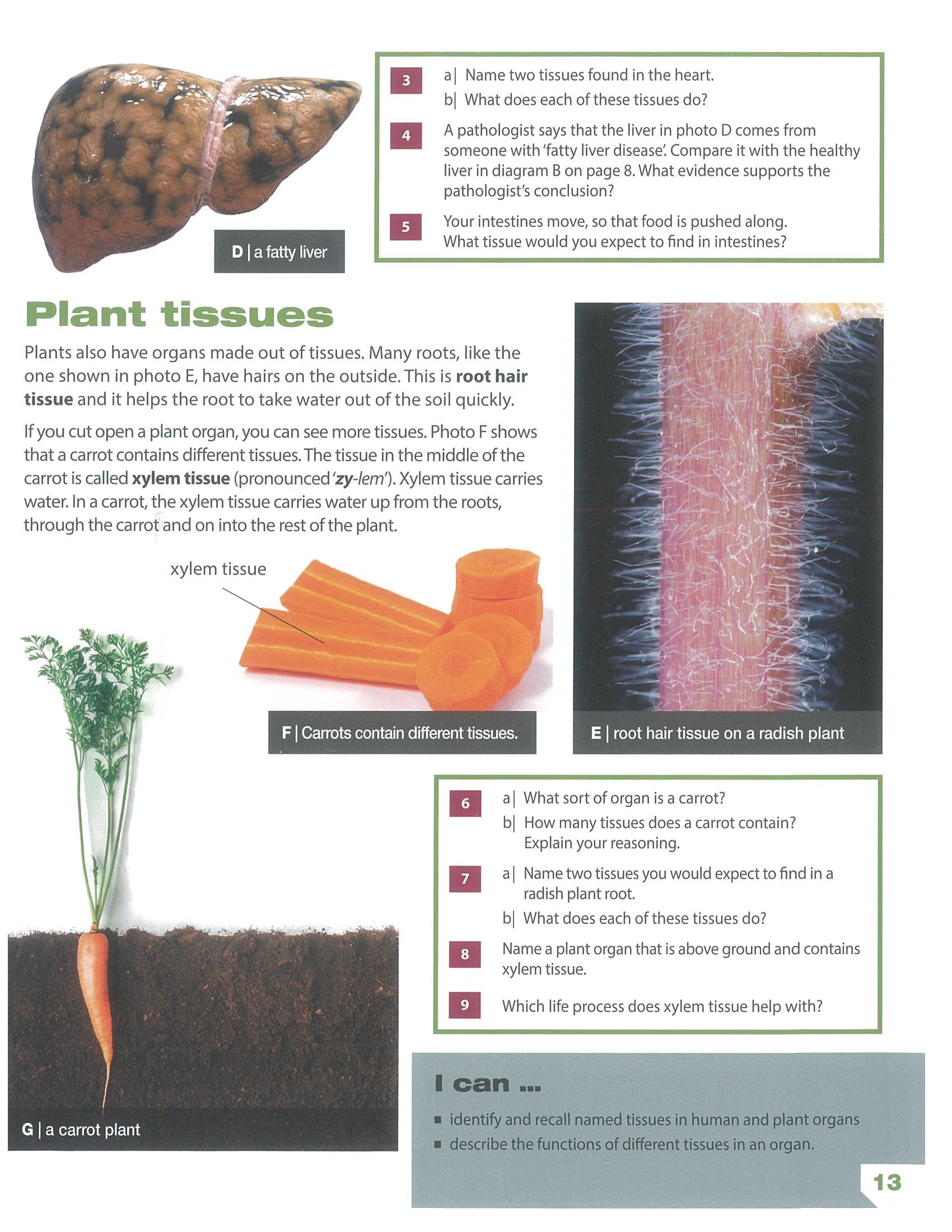
Q4 A pathologist says that the liver in photo D comes from someone with 'fatty liver disease'. Compare it with the healthy liver in diagram B on page 8. What evidence supports the pathologist's conclusion?
第 4 题 病理学家说图 D 的肝来自一位得了"脂肪肝"的人。和 p.8 图 B 的健康肝对比,什么证据支持这个结论?(答:图 D 的肝里有很多白色脂肪组织,比健康肝多)
Q5 Your intestines move, so that food is pushed along. What tissue would you expect to find in intestines?
In a carrot, the xylem tissue carries water up from the roots, through the carrot and on into the rest of the plant.
在胡萝卜里,木质部组织把水从根部向上输送,穿过胡萝卜,再送到植物的其他部分。
F | Carrots contain different tissues.
图 F | 胡萝卜里含有不同的组织(标签:xylem tissue 木质部组织)。
E | root hair tissue on a radish plant
图 E | 小萝卜上的根毛组织
G | a carrot plant
图 G | 一株胡萝卜植物
Q6 a) What sort of organ is a carrot? b) How many tissues does a carrot contain? Explain your reasoning.
第 6 题 a) 胡萝卜是哪种器官?(答:storage organ 储存器官)b) 胡萝卜含多少种组织?解释推理。(答:至少 3 种——根毛组织、木质部组织、储存组织等)
Q7 a) Name two tissues you would expect to find in a radish plant root. b) What does each of these tissues do?
第 7 题 a) 小萝卜根里你预期能找到哪两种组织?(答:根毛组织、木质部组织) b) 各自做什么?(根毛组织吸水;木质部组织向上运输水)
Q8 Name a plant organ that is above ground and contains xylem tissue.
第 8 题 说出一个地上的植物器官,里面含木质部组织。(答:茎 stem,或叶 leaf)
Q9 Which life process does xylem tissue help with?
第 9 题 木质部组织帮助哪个生命过程?(答:nutrition 营养——把水送到叶子做光合作用)
I can…
我能……
identify and recall named tissues in human and plant organs
识别并记住人体和植物器官里有名字的组织
describe the functions of different tissues in an organ
描述同一器官里不同组织的功能
📄 教材 p.14 · 7Ac Microscopes (WS)
HOW IS A LIGHT MICROSCOPE USED TO EXAMINE A SPECIMEN?
怎么用光学显微镜检查样本?
To find out what is wrong with an organ, doctors do tests. Some tests involve taking a small piece of tissue (a biopsy) from an organ and looking at it under a light microscope.
Microscopes make things appear bigger; they magnify things. The Method below shows how to use a light microscope.
显微镜让东西看起来更大——它们放大(magnify)物体。下面的方法说明怎么用光学显微镜。
Method — Step A
方法 — 步骤 A
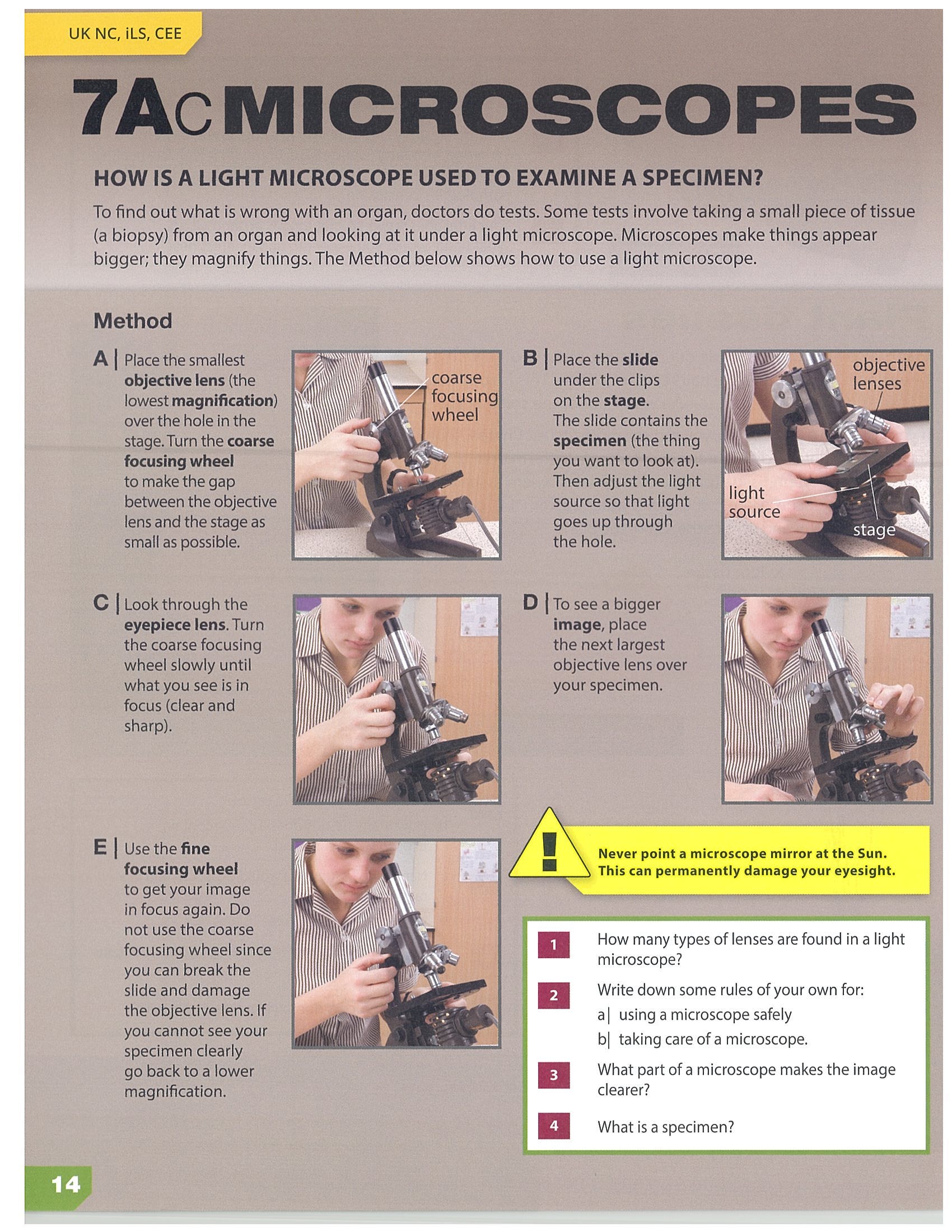
A | Place the smallest objective lens (the lowest magnification) over the hole in the stage. Turn the coarse focusing wheel to make the gap between the objective lens and the stage as small as possible.
A | 把最小的物镜(objective lens)(倍率最低的)转到载物台(stage)孔的上方。转动粗调焦轮(coarse focusing wheel),让物镜和载物台之间的距离尽可能小。
B | Place the slide under the clips on the stage. The slide contains the specimen (the thing you want to look at). Then adjust the light source so that light goes up through the hole.
B | 把载玻片(slide)放在载物台的夹子下。载玻片上是样本(specimen)(你想观察的东西)。然后调整光源,让光从下面的孔向上穿过去。
C | Look through the eyepiece lens. Turn the coarse focusing wheel slowly until what you see is in focus (clear and sharp).
C | 从目镜(eyepiece lens)看进去。慢慢转粗调焦轮,直到看到的画面对焦清晰锐利。
D | To see a bigger image, place the next largest objective lens over your specimen.
D | 想看更大的画面,把下一个更大的物镜转到样本上方。
E | Use the fine focusing wheel to get your image in focus again. Do not use the coarse focusing wheel since you can break the slide and damage the objective lens. If you cannot see your specimen clearly go back to a lower magnification.
E | 用细调焦轮(fine focusing wheel)重新对焦——不要再用粗调焦,否则会压碎载玻片、损坏物镜。如果看不清楚就退回到较低的放大倍率。
⚠️ Warning
⚠️ 警告
Never point a microscope mirror at the Sun. This can permanently damage your eyesight.
永远不要把显微镜的反光镜对准太阳——会永久损伤视力。
Q1 How many types of lenses are found in a light microscope?
The specimen on a microscope slide needs to be thin so that light can pass through it.
载玻片上的样本需要很薄,让光能穿过它。
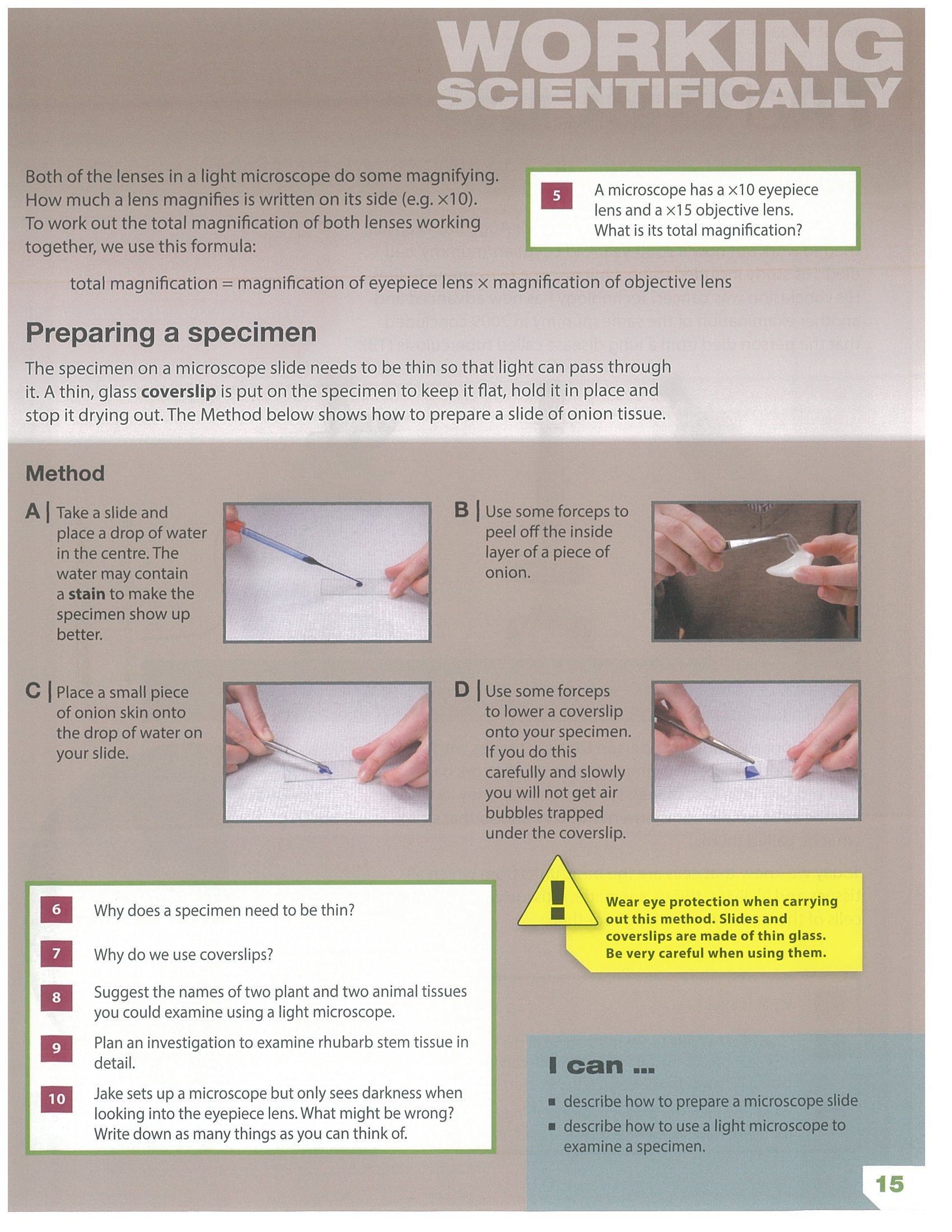
A thin, glass coverslip is put on the specimen to keep it flat, hold it in place and stop it drying out. The Method below shows how to prepare a slide of onion tissue.
A | Take a slide and place a drop of water in the centre. The water may contain a stain to make the specimen show up better.
A | 拿一片载玻片,在中央滴一滴水。水里可能含染色剂(stain),让样本看得更清楚。
B | Use some forceps to peel off the inside layer of a piece of onion.
B | 用镊子(forceps)从洋葱内层撕下一小片。
C | Place a small piece of onion skin onto the drop of water on your slide.
C | 把一小片洋葱皮放到载玻片上那滴水里。
D | Use some forceps to lower a coverslip onto your specimen. If you do this carefully and slowly you will not get air bubbles trapped under the coverslip.
D | 用镊子把盖玻片慢慢盖到样本上。如果做得仔细缓慢,就不会有气泡被困在盖玻片下面。
⚠️ Warning
⚠️ 警告
Wear eye protection when carrying out this method. Slides and coverslips are made of thin glass. Be very careful when using them.
做实验时戴护目镜。载玻片和盖玻片都是薄玻璃,使用时要非常小心。
Q6 Why does a specimen need to be thin?
第 6 题 为什么样本必须薄?(答:让光能穿过去,这样显微镜才能看到)
Q7 Why do we use coverslips?
第 7 题 为什么要用盖玻片?(答:保持样本平整 + 固定位置 + 防干燥)
Q8 Suggest the names of two plant and two animal tissues you could examine using a light microscope.
Q9 Plan an investigation to examine rhubarb stem tissue in detail.
第 9 题 设计一个实验,仔细观察大黄茎的组织。
Q10 Jake sets up a microscope but only sees darkness when looking into the eyepiece lens. What might be wrong? Write down as many things as you can think of.
The leaf of a plant is an organ. Give a function of a leaf.
✅ 答案(任意一个):
To carry out photosynthesis / to make food (glucose) for the plant
To allow gas exchange (take in CO₂, release O₂)
To allow transpiration(蒸腾,让水从叶面蒸发)
💡 讲解:
叶最主要的功能是光合作用——制造植物的食物。这一个就拿满分。
Q4b[Suggest · tissue]WB p.9
Suggest one tissue that the leaf contains.
✅ 答案(任意一个):
Palisade mesophyll(栅栏组织——含大量叶绿体,做光合作用)
Spongy mesophyll(海绵组织——气体交换)
Xylem(运水)
Phloem(运食物)
Epidermis(表皮——保护)
初学阶段答 "photosynthetic tissue" 或 "mesophyll" 也可以。
💡 讲解:
叶里有 5 种主要组织,覆盖光合 / 气体交换 / 运输 / 保护 4 种功能。
Q4c[Explain · 2 marks]WB p.9
Explain why you think the leaf contains this tissue.
✅ 答案(视 Q4b 回答而定):
If palisade mesophyll: Because the leaf needs to carry out photosynthesis, and palisade mesophyll cells contain lots of chloroplasts where photosynthesis happens.
If xylem: Because the leaf needs water for photosynthesis, and xylem brings water up from the roots.
If spongy mesophyll: Because the leaf needs gas exchange (CO₂ in, O₂ out), and spongy mesophyll has large air spaces for gases to move through.
💡 讲解:
把 Q4a(function)+ Q4b(tissue)连起来——这就是 explain 的因果链:叶要做 X 功能 → 所以需要含 Y 组织(因为 Y 组织能做 X)。
⚠️ 命题套路:
"Explain why" + 2 marks = 写 2 个连接点:(1) leaf needs ... ; (2) this tissue does ... 缺一不可。
A microscope is used to look at very small objects (or details) that cannot be seen clearly with the naked eye. It works by magnifying the image of the object using lenses.
💡 讲解:
关键词:magnify(放大) + small objects(小物体) + naked eye(肉眼)。写完整句子带上这 3 个概念就能拿满分。
⚠️ 命题套路:
"Describe" 题要写完整句子。光写 "to see small things" 太简短——加上 "cannot be seen with the naked eye" 让答案更精确。
Q2[Label · diagram]WB p.10
Complete the labels on the microscope (看 workbook 上的图), to show the names of the parts.
His study included using a microscope to examine tissues. His conclusion was 'cancer'.
他的研究包括用显微镜检查组织。他的结论是"癌症"。
Technology has now advanced and another examination of the same mummy in 2009 concluded that the person died from a lung disease called tuberculosis (TB).
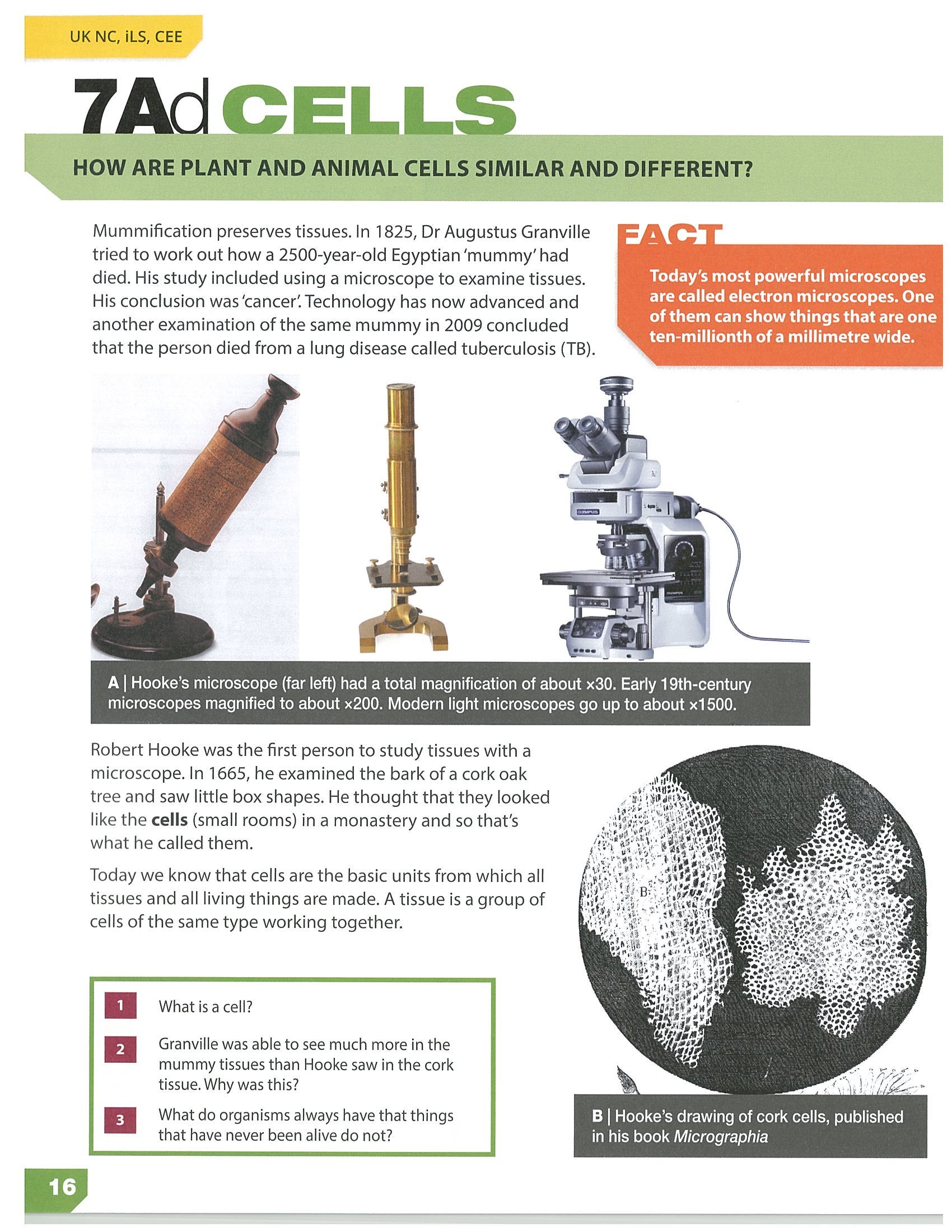
Hooke's microscope (far left) had a total magnification of about ×30. Early 19th-century microscopes magnified to about ×200. Modern light microscopes go up to about ×1500.
Q3 What do organisms always have that things that have never been alive do not?
第 3 题 生物总有,但从未活过的东西没有的,是什么?(答:细胞 cells)
B | Hooke's drawing of cork cells, published in his book Micrographia
图 B | 胡克画的软木细胞,发表在他的书《Micrographia(显微图谱)》里
📄 教材 p.17 · 7Ad Animal Cells + Plant Cells
Animal cells
动物细胞
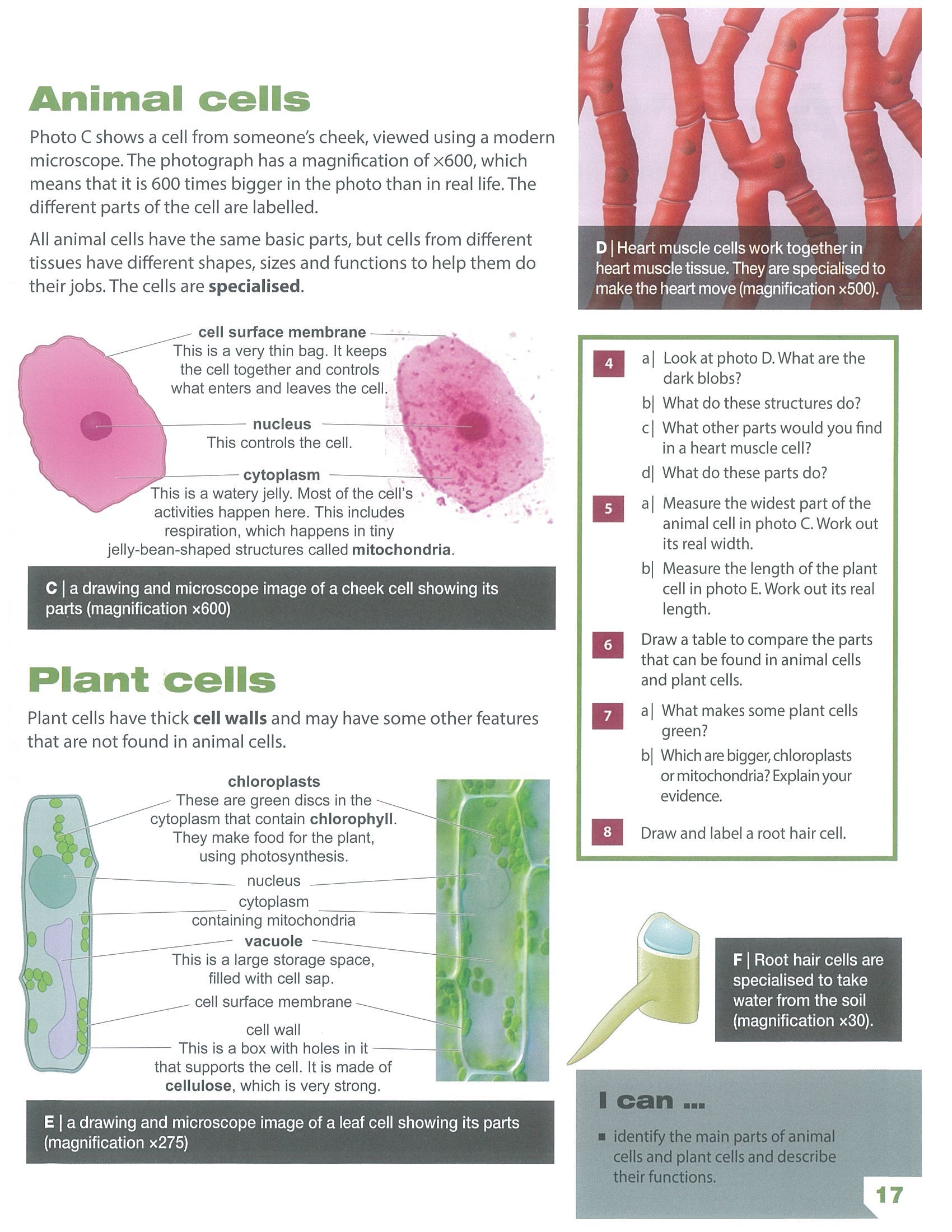
Photo C shows a cell from someone's cheek, viewed using a modern microscope.
图 C 显示用现代显微镜观察的一个人脸颊细胞。
The photograph has a magnification of ×600, which means that it is 600 times bigger in the photo than in real life. The different parts of the cell are labelled.
cytoplasm: This is a watery jelly. Most of the cell's activities happen here. This includes respiration, which happens in tiny jelly-bean-shaped structures called mitochondria.
Heart muscle cells work together in heart muscle tissue. They are specialised to make the heart move.
心脏肌肉细胞在心肌组织里协同工作。它们是特化的,专门让心脏动起来。
Q4 a) Look at photo D. What are the dark blobs? b) What do these structures do? c) What other parts would you find in a heart muscle cell? d) What do these parts do?
第 4 题 a) 看图 D,黑色斑块是什么?(答:细胞核 nuclei) b) 它们的作用?(控制细胞) c) 心肌细胞里还能找到哪些部分?(细胞膜、细胞质、线粒体) d) 它们各做什么?
Q5 a) Measure the widest part of the animal cell in photo C. Work out its real width. b) Measure the length of the plant cell in photo E. Work out its real length.
第 5 题 a) 量图 C 动物细胞最宽处。算出真实宽度(量到的尺寸 ÷ 600)。b) 量图 E 植物细胞的长度,算出真实长度(÷ 275)。
Q6 Draw a table to compare the parts that can be found in animal cells and plant cells.
第 6 题 画一个表,对比动物细胞和植物细胞各有哪些部分。
Plant cells
植物细胞
Plant cells have thick cell walls and may have some other features that are not found in animal cells.
植物细胞有厚厚的细胞壁(cell walls),还有一些动物细胞没有的部件。
E | a leaf cell (×275) — labels
图 E | 叶细胞(×275)— 标签
chloroplasts: These are green discs in the cytoplasm that contain chlorophyll. They make food for the plant, using photosynthesis.
(The last of these is also called the respiratory system.)
(最后一个也叫呼吸系统 respiratory system。)
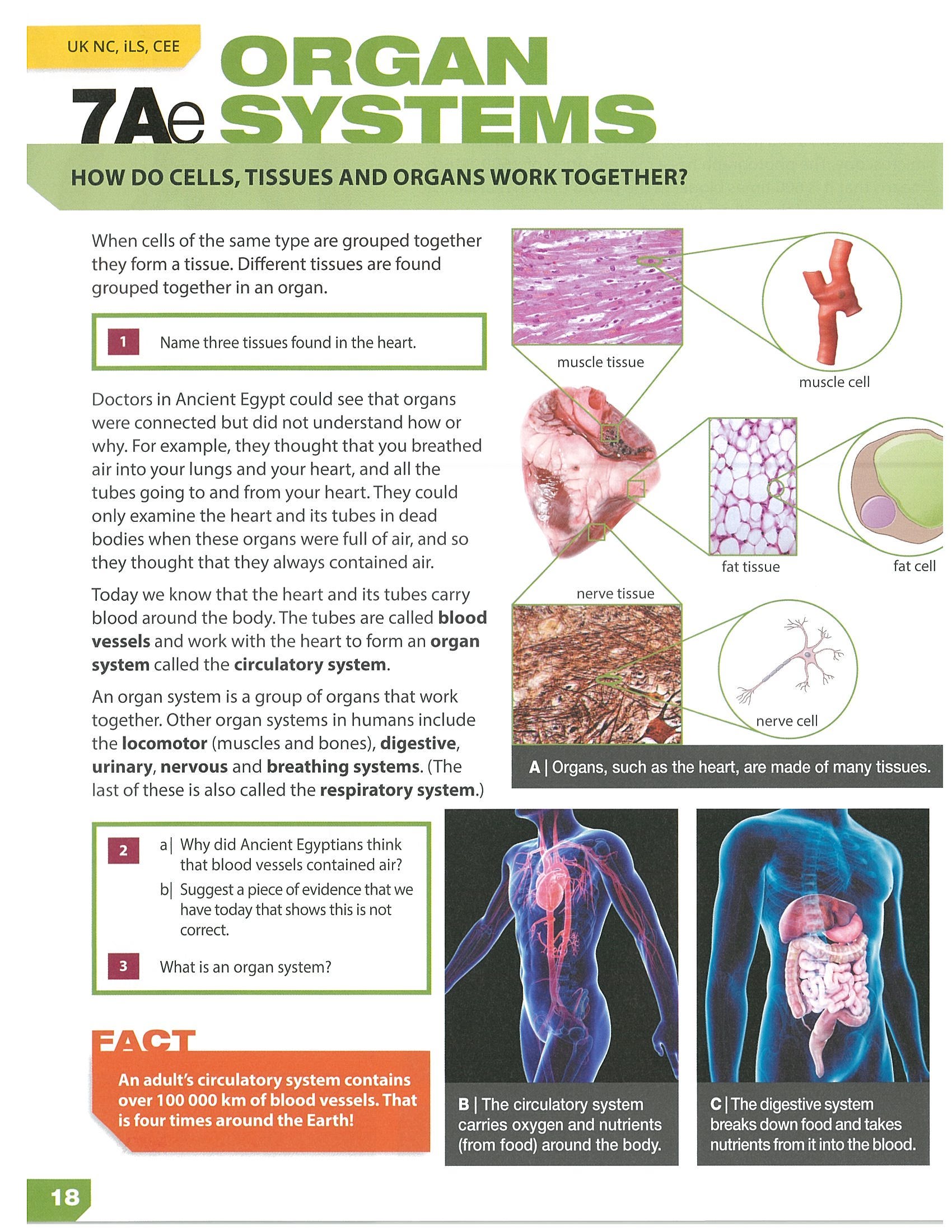
A | Organs, such as the heart, are made of many tissues.
图 A | 心脏等器官由许多组织构成(图示:肌肉组织 → 肌肉细胞;脂肪组织 → 脂肪细胞;神经组织 → 神经细胞)。
Q2 a) Why did Ancient Egyptians think that blood vessels contained air? b) Suggest a piece of evidence that we have today that shows this is not correct.
第 2 题 a) 古埃及人为什么认为血管里装的是空气?(答:他们只在尸体里看到血管,里面已经没血只有空气)b) 推测我们今天有什么证据证明这不对?(答:活人血管里能看到血在流;切开新鲜血管会有血流出)
Q3 What is an organ system?
第 3 题 器官系统是什么?(答:一组协同工作的器官)
FACT
FACT 框
An adult's circulatory system contains over 100 000 km of blood vessels. That is four times around the Earth!
成年人的循环系统含超过 10 万公里的血管——绕地球 4 圈!
B | The circulatory system
图 B | 循环系统
The circulatory system carries oxygen and nutrients (from food) around the body.
循环系统在全身输送氧气和营养(来自食物)。
C | The digestive system
图 C | 消化系统
The digestive system breaks down food and takes nutrients from it into the blood.
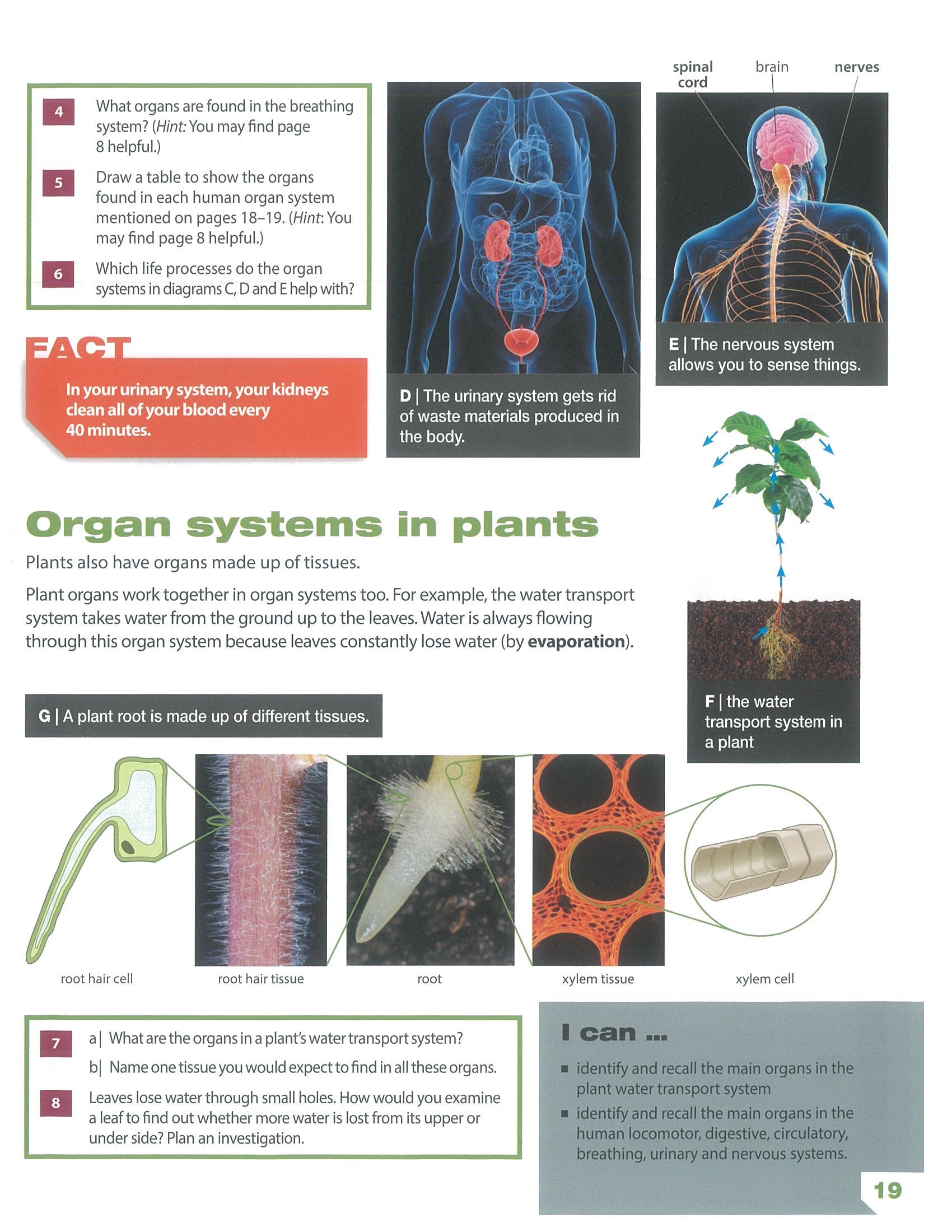
Q8 Leaves lose water through small holes. How would you examine a leaf to find out whether more water is lost from its upper or under side? Plan an investigation.
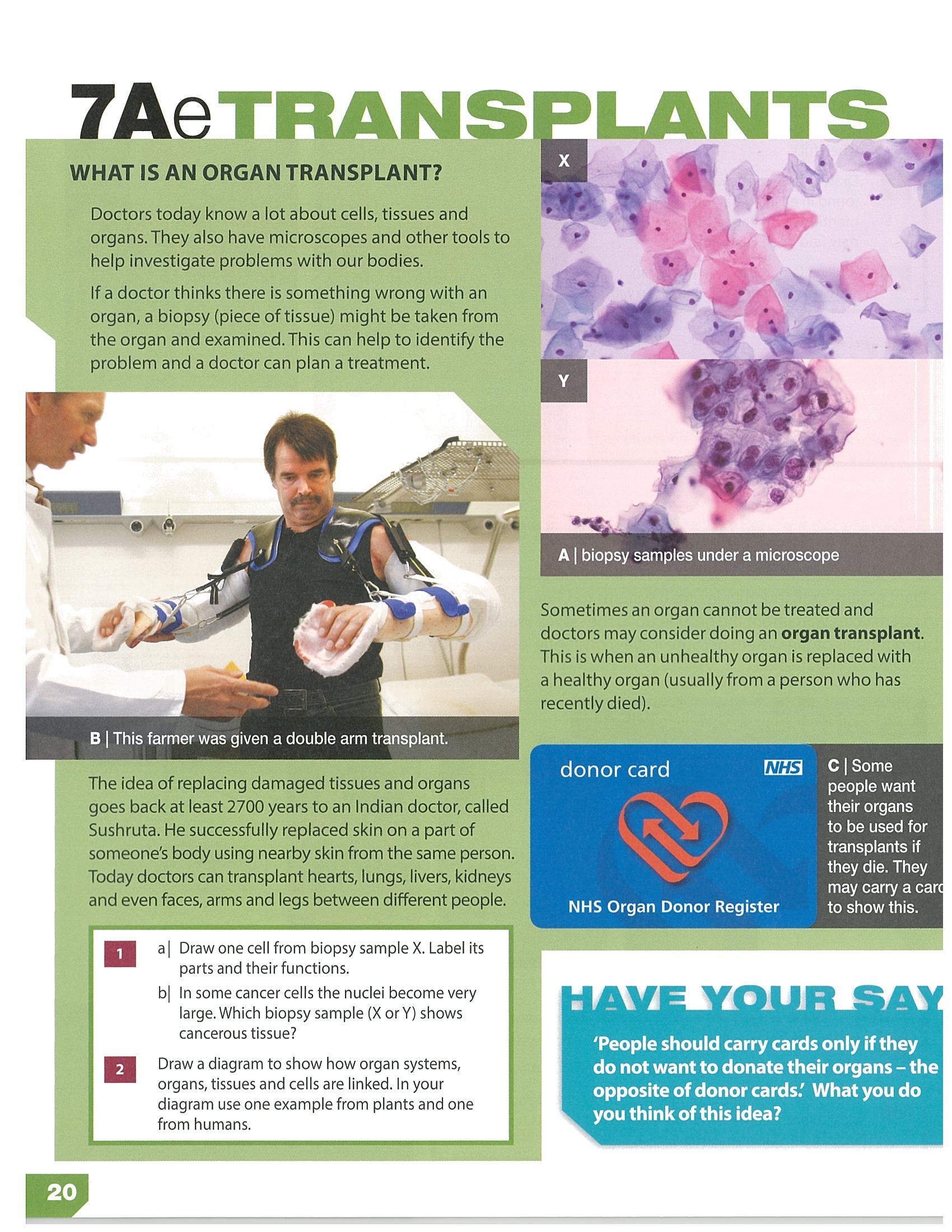
Q1 a) Draw one cell from biopsy sample X. Label its parts and their functions. b) In some cancer cells the nuclei become very large. Which biopsy sample (X or Y) shows cancerous tissue?
第 1 题 a) 从活检样本 X 中画一个细胞,标出各部分和功能。b) 一些癌细胞的细胞核会变得很大。X 还是 Y 显示的是癌组织?(答:看哪个样本里细胞核明显变大)
Q2 Draw a diagram to show how organ systems, organs, tissues and cells are linked. In your diagram use one example from plants and one from humans.
Complete the sentences using words from the box. You may use some words more than once.
cell · cells · tissue · tissues · organ · organs
The basic 'building blocks' of all organisms are . A group of these 'building blocks' of the same type and working together is called a . An is an important part of a plant or animal. Each one is made of different , which are made of smaller parts called . For example, the heart is an that contains muscle (made of muscle ) and fat (made of fat ).
✅ 答案(按顺序):
① cells(所有生物的基本单位)
② tissue(同种细胞协作 = 组织)
③ organ(器官)
④ tissues(每个器官由不同组织构成)
⑤ cells(组织又由细胞构成)
⑥ organ(心脏是器官)
⑦ tissue(心肌组织)
⑧ cells(心肌细胞)
⑨ tissue(脂肪组织)
⑩ cells(脂肪细胞)
💡 讲解:
核心层级(必背):cell → tissue → organ → organ system → organism。注意单复数——一种东西用单数("a tissue"),多种用复数("different tissues")。
这题考因果链一致性:上一题选 B (water),这题就选 D (evaporation/transpiration)——两题逻辑串起来才完整。
📄 Workbook p.16 · 7Ae Transplants
Q1a[Define]WB p.16
Describe what is meant by the term organ transplant.
✅ 答案:
An organ transplant is when an organ is removed from one person (the donor) and placed into another person (the recipient) whose own organ is not working properly.